


Description
About this Product
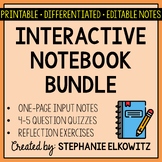
This differentiated unit is composed of interactive notebook lessons organized into chapters. Each chapter includes:
• An overview with photos of the completed INB activity
• One page of input notes (differentiated when necessary)
• At least one INB activity (key included)
• A 4-5 question mini assessment (key included)
• A 2-part reflection exercise
Important Notes:
• Download a FREE Interactive Notebook Unit to learn more about my INB units
• Save $$$ with the Life Science Complete Curriculum
• Save $$$$ with the Integrated Science Complete Curriculum
*********************************************************************************************************
EDITABLE INPUT NOTES
• 100% one-page EDITABLE copies of input notes are included
• Notes are saved as a single .docx file that opens with Microsoft Word & Google Docs
• Editable notes are written in font compatible with Microsoft Word & Google Docs
*********************************************************************************************************
Topics Covered:
Chapter 1: Types of Plants
Chapter 2: Plant Needs
Chapter 3: Plant Structure
Chapter 4: Flower Anatomy
Chapter 5: Leaf Structure
Chapter 6: Deciduous vs. Coniferous
Chapter 7: Types of Angiosperms (Monocots & Dicots)
Chapter 8: Plant Reproduction
Chapter 9: Seed Dispersal
Chapter 10: Seed vs. Spore
Chapter 11: Angiosperm Reproduction
Chapter 12: Gymnosperm Reproduction
Chapter 13: Vegetative Propagation
Chapter 14: Growth Patterns in Angiosperms
Chapter 15: Plant Environmental Adaptations
Chapter 16: Plant Defense Adaptation
Chapter 17: Leaf Adaptations
Chapter 18: Stem Adaptations
Chapter 19: Extreme Environment Adaptations
Chapter 20: Responding to the Environment
Chapter 21: Water Regulation (Stomata)
Chapter 22: Oxygen & Carbon Dioxide Cycling
Chapter 23: Photosynthesis
Chapter 24: Plant vs. Algae
Chapter 25: Symbiotic Relationships (Plants, Algae & Other Organisms)
Chapter 26: Plant Uses
Additional Info:
-Topics are differentiated for upper elementary and intermediate grades.
-Topics are differentiated with a color and shape code.
-Two pages of generic and self-assessment reflection prompts are included.
NGSS Alignment
• This resource supports NGSS 4-LS1-1, 5-LS1-1, MS-LS1-4, MS-LS1-5, MS-LS1-6 and MS-LS2-2.
• Refer to my Free Curriculum Support Materials to help incorporate INB lessons into a NGSS aligned curriculum.
TERMS OF USE
• All rights reserved by Stephanie Elkowitz.
• This product is to be used by the original purchaser only.
• Intended for classroom and personal use only.
• Copying for more than one teacher, classroom, department, school, or school system is prohibited.
• This product may not be distributed or displayed digitally for public view.
• Failure to comply is a copyright infringement and a violation of the Digital Millennium Copyright Act (DMCA).

Highlights


Save even more with bundles


Description
About this Product
This differentiated unit is composed of interactive notebook lessons organized into chapters. Each chapter includes:
• An overview with photos of the completed INB activity
• One page of input notes (differentiated when necessary)
• At least one INB activity (key included)
• A 4-5 question mini assessment (key included)
• A 2-part reflection exercise
Important Notes:
• Download a FREE Interactive Notebook Unit to learn more about my INB units
• Save $$$ with the Life Science Complete Curriculum
• Save $$$$ with the Integrated Science Complete Curriculum
*********************************************************************************************************
EDITABLE INPUT NOTES
• 100% one-page EDITABLE copies of input notes are included
• Notes are saved as a single .docx file that opens with Microsoft Word & Google Docs
• Editable notes are written in font compatible with Microsoft Word & Google Docs
*********************************************************************************************************
Topics Covered:
Chapter 1: Types of Plants
Chapter 2: Plant Needs
Chapter 3: Plant Structure
Chapter 4: Flower Anatomy
Chapter 5: Leaf Structure
Chapter 6: Deciduous vs. Coniferous
Chapter 7: Types of Angiosperms (Monocots & Dicots)
Chapter 8: Plant Reproduction
Chapter 9: Seed Dispersal
Chapter 10: Seed vs. Spore
Chapter 11: Angiosperm Reproduction
Chapter 12: Gymnosperm Reproduction
Chapter 13: Vegetative Propagation
Chapter 14: Growth Patterns in Angiosperms
Chapter 15: Plant Environmental Adaptations
Chapter 16: Plant Defense Adaptation
Chapter 17: Leaf Adaptations
Chapter 18: Stem Adaptations
Chapter 19: Extreme Environment Adaptations
Chapter 20: Responding to the Environment
Chapter 21: Water Regulation (Stomata)
Chapter 22: Oxygen & Carbon Dioxide Cycling
Chapter 23: Photosynthesis
Chapter 24: Plant vs. Algae
Chapter 25: Symbiotic Relationships (Plants, Algae & Other Organisms)
Chapter 26: Plant Uses
Additional Info:
-Topics are differentiated for upper elementary and intermediate grades.
-Topics are differentiated with a color and shape code.
-Two pages of generic and self-assessment reflection prompts are included.
NGSS Alignment
• This resource supports NGSS 4-LS1-1, 5-LS1-1, MS-LS1-4, MS-LS1-5, MS-LS1-6 and MS-LS2-2.
• Refer to my Free Curriculum Support Materials to help incorporate INB lessons into a NGSS aligned curriculum.
TERMS OF USE
• All rights reserved by Stephanie Elkowitz.
• This product is to be used by the original purchaser only.
• Intended for classroom and personal use only.
• Copying for more than one teacher, classroom, department, school, or school system is prohibited.
• This product may not be distributed or displayed digitally for public view.
• Failure to comply is a copyright infringement and a violation of the Digital Millennium Copyright Act (DMCA).
