

Description
Do your students rush through word problems without truly understanding them?
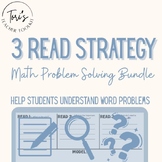
The 3 Read Strategy Problem Solving Mats help students slow down, analyze the problem, and develop strong math reasoning skills. This structured routine teaches students to read a word problem three times with a different focus each time, helping them understand the situation, identify key information, and determine what the problem is asking.
Perfect for Grades 3–5, this resource builds student confidence with word problems while encouraging deeper mathematical thinking and explanation.
What’s Included
- Teacher Instructions
- 3 Read Strategy Anchor Chart
- 10+ Problem Solving Mat Variations
- Problem Examples for Grades 3–5
- Worked Example
- 2 Math Thinking Reflection Sheets
*Printer-friendly black and white format
Perfect For
• Math word problem routines
• Math workshop
• Small group instruction
• Math intervention
• Test prep
• Math journals
• Problem solving practice
Teacher Tips
• Laminate the problem solving mats for daily use with dry erase markers
• Use the anchor chart to model the routine during whole group instruction
• Pair with any word problem for consistent problem solving practice
Skills Addressed
• Word problem solving
• Mathematical reasoning
• Multi-step problem solving
• Identifying key information
• Explaining mathematical thinking
⭐ Follow my store, Tori’s Teacher Toolkit, to be notified when new resources are posted!
3 Read Strategy Math | Problem Solving Mats | Math Thinking Routine

Highlights


Description
Do your students rush through word problems without truly understanding them?
The 3 Read Strategy Problem Solving Mats help students slow down, analyze the problem, and develop strong math reasoning skills. This structured routine teaches students to read a word problem three times with a different focus each time, helping them understand the situation, identify key information, and determine what the problem is asking.
Perfect for Grades 3–5, this resource builds student confidence with word problems while encouraging deeper mathematical thinking and explanation.
What’s Included
- Teacher Instructions
- 3 Read Strategy Anchor Chart
- 10+ Problem Solving Mat Variations
- Problem Examples for Grades 3–5
- Worked Example
- 2 Math Thinking Reflection Sheets
*Printer-friendly black and white format
Perfect For
• Math word problem routines
• Math workshop
• Small group instruction
• Math intervention
• Test prep
• Math journals
• Problem solving practice
Teacher Tips
• Laminate the problem solving mats for daily use with dry erase markers
• Use the anchor chart to model the routine during whole group instruction
• Pair with any word problem for consistent problem solving practice
Skills Addressed
• Word problem solving
• Mathematical reasoning
• Multi-step problem solving
• Identifying key information
• Explaining mathematical thinking
⭐ Follow my store, Tori’s Teacher Toolkit, to be notified when new resources are posted!
