TPT
Total:
$0.00
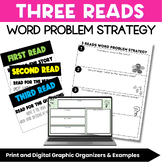
3 Reads Strategy Math Word Problems Graphic Organizer ELL Math Language Routine
Share

What others say

"The 3 Reads Strategy Math Word Problems Graphic Organizer (ESL Math Language Routine) effectively supports students by building comprehension through structured rereading, academic language development, and clear steps for identifying key information in math word problems."
star
Ariana M.

Description

This 3 Read Strategy math language routine will help students comprehend math word problems! The Three Reads Math Word Problem Strategy helps students tackle complex word problems by breaking them down into three parts. This method encourages students to slow down, analyze key details, and develop a deeper understanding of the problem before solving it. It’s especially effective for building problem-solving skills and serves as a great ELL resource to support language comprehension in math.

What’s Included?

✔️ 3 Posters/Slides to introduce the Three Reads Strategy (color & black and white)

✔️ 2 Graphic Organizers (one with space to solve the problem, one without)

✔️ Reference Sheet with guiding questions for each read

✔️ Student Notebook Versions of all three resources (2 graphic organizers + reference sheet)

✔️ 2 Example Problems with Student Sample Answers (one with whole numbers and one with decimals). Perfect for 4th/5th Graders!

This resource provides a structured, student-friendly way to boost problem-solving confidence and comprehension.

Benefits

  • Improves problem-solving skills
  • Supports language comprehension in math for ELL students
  • Boosts students' confidence in tackling math word problems
  • Provides structured resources for whole class, independent, or small group practice

This resource can be implemented in whole-class lessons as an introduction to the Three Reads Strategy. It can also be used for independent practice or small group work. Have students work through the graphic organizers and reference sheet to practice applying the strategy to different word problems. Use the example problems to demonstrate the application of the strategy.

Looking for more problems to go along with this organizer? Grab this set (more to come!)

5th Grade Multiplying Fractions by Whole Number Word Problems

Check out my other math language resource organizer for Stronger and Clearer Each Time

Report this resource to TPT
Reported resources will be reviewed by our team. Report this resource to let us know if this resource violates TPT's content guidelines.

3 Reads Strategy Math Word Problems Graphic Organizer ELL Math Language Routine

Rated 5 out of 5, based on 1 reviews
5.0 (1 rating)
Megs Math Pages
111 Followers
$4.00

Highlights

Digital downloads
Grades icon
Grades
4th - 6th
Standards icon
Standards
Pages
13 + 2 answer keys
Answer Key
Included

What others say

"The 3 Reads Strategy Math Word Problems Graphic Organizer (ESL Math Language Routine) effectively supports students by building comprehension through structured rereading, academic language development, and clear steps for identifying key information in math word problems."
star
Ariana M.

Save even more with bundles

Help your students tackle math word problems and open-ended math questions with confidence! This bundle brings together two powerful math language routines: the 3 Reads Strategy graphic organizer (a bestselling classroom favorite) and Stronger & Clearer Each Time, so students can break down word
Price $6.00Original Price $7.00Save $1.00
2

Description

This 3 Read Strategy math language routine will help students comprehend math word problems! The Three Reads Math Word Problem Strategy helps students tackle complex word problems by breaking them down into three parts. This method encourages students to slow down, analyze key details, and develop a deeper understanding of the problem before solving it. It’s especially effective for building problem-solving skills and serves as a great ELL resource to support language comprehension in math.

What’s Included?

✔️ 3 Posters/Slides to introduce the Three Reads Strategy (color & black and white)

✔️ 2 Graphic Organizers (one with space to solve the problem, one without)

✔️ Reference Sheet with guiding questions for each read

✔️ Student Notebook Versions of all three resources (2 graphic organizers + reference sheet)

✔️ 2 Example Problems with Student Sample Answers (one with whole numbers and one with decimals). Perfect for 4th/5th Graders!

This resource provides a structured, student-friendly way to boost problem-solving confidence and comprehension.

Benefits

  • Improves problem-solving skills
  • Supports language comprehension in math for ELL students
  • Boosts students' confidence in tackling math word problems
  • Provides structured resources for whole class, independent, or small group practice

This resource can be implemented in whole-class lessons as an introduction to the Three Reads Strategy. It can also be used for independent practice or small group work. Have students work through the graphic organizers and reference sheet to practice applying the strategy to different word problems. Use the example problems to demonstrate the application of the strategy.

Looking for more problems to go along with this organizer? Grab this set (more to come!)

5th Grade Multiplying Fractions by Whole Number Word Problems

Check out my other math language resource organizer for Stronger and Clearer Each Time

Report this resource to TPT
Reported resources will be reviewed by our team. Report this resource to let us know if this resource violates TPT's content guidelines.

Reviews

5.0
Rated 5 out of 5, based on 1 reviews
1
rating
All verified TPT purchases
The 3 Reads Strategy
Rated 5 out of 5
March 24, 2026
The 3 Reads Strategy Math Word Problems Graphic Organizer (ESL Math Language Routine) effectively supports students by building comprehension through structured rereading, academic language development, and clear steps for identifying key information in math word problems.
Made By Morck
(TPT Seller)
232 reviews • New York
Grades taught: 3rd, 4th, 5th
Student populations: Autism, Emerging bilinguals, Learning difficulties, Mild to severe disabilities
Megs Math Pages
Response from
Megs Math Pages
(TPT Seller)
Apr 3, 2026

Thank you for the kind review!

Questions & Answers

Loading

Standards

to see state-specific standards (only available in the US).
Make sense of problems and persevere in solving them. Mathematically proficient students start by explaining to themselves the meaning of a problem and looking for entry points to its solution. They analyze givens, constraints, relationships, and goals. They make conjectures about the form and meaning of the solution and plan a solution pathway rather than simply jumping into a solution attempt. They consider analogous problems, and try special cases and simpler forms of the original problem in order to gain insight into its solution. They monitor and evaluate their progress and change course if necessary. Older students might, depending on the context of the problem, transform algebraic expressions or change the viewing window on their graphing calculator to get the information they need. Mathematically proficient students can explain correspondences between equations, verbal descriptions, tables, and graphs or draw diagrams of important features and relationships, graph data, and search for regularity or trends. Younger students might rely on using concrete objects or pictures to help conceptualize and solve a problem. Mathematically proficient students check their answers to problems using a different method, and they continually ask themselves, "Does this make sense?" They can understand the approaches of others to solving complex problems and identify correspondences between different approaches.
Reason abstractly and quantitatively. Mathematically proficient students make sense of quantities and their relationships in problem situations. They bring two complementary abilities to bear on problems involving quantitative relationships: the ability to decontextualize-to abstract a given situation and represent it symbolically and manipulate the representing symbols as if they have a life of their own, without necessarily attending to their referents-and the ability to contextualize, to pause as needed during the manipulation process in order to probe into the referents for the symbols involved. Quantitative reasoning entails habits of creating a coherent representation of the problem at hand; considering the units involved; attending to the meaning of quantities, not just how to compute them; and knowing and flexibly using different properties of operations and objects.
Attend to precision. Mathematically proficient students try to communicate precisely to others. They try to use clear definitions in discussion with others and in their own reasoning. They state the meaning of the symbols they choose, including using the equal sign consistently and appropriately. They are careful about specifying units of measure, and labeling axes to clarify the correspondence with quantities in a problem. They calculate accurately and efficiently, express numerical answers with a degree of precision appropriate for the problem context. In the elementary grades, students give carefully formulated explanations to each other. By the time they reach high school they have learned to examine claims and make explicit use of definitions.
Loading