

Description
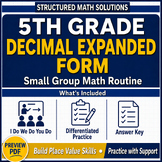
Turn decimal expanded form into a clear, visual small-group routine with this 5th Grade Decimal Expanded Form Small Group Math Routine — a concept-first resource that helps students read, write, and translate decimals to thousandths across standard form, word form, expanded decimal form, expanded fraction form, and expanded notation.
This is not a random decimal forms worksheet packet.
This is not a quick activity that asks students to copy number forms without understanding digit value.
This is not expanded form practice that treats decimals like whole numbers.
This is a structured 5th Grade Decimal Expanded Form Routine designed to help students understand that each decimal form represents the same number by showing the value of each digit. Students learn that the 4 in 2.348 is not 4 — it is 4 hundredths, or 0.04.
What makes this resource different
Most decimal expanded form resources give students format practice.
This resource gives teachers a complete small-group teaching routine.
Students learn to connect:
Decimal place value → Digit value → Standard form → Word form → Expanded decimal form → Expanded fraction form → Expanded notation → Zero placeholders
The routine follows a predictable structure:
I Do → We Do → You Do → Exit Ticket → Regrouping Decision
Teachers model each decimal form with place value charts, guide students through form-to-form translation, release students to differentiated practice, collect exit ticket evidence, and use observation tools to decide who needs re-engagement, on-grade practice, or challenge work.
✔ 24 Print-Ready Pages
✔ 5 Reusable Small-Group Sessions
✔ 20–30 Minute Sessions
✔ Recommended for 4–6 Students
✔ Decimal Forms Anchor Chart
✔ Place Value Chart Support
✔ Standard Form Practice
✔ Word Form Practice
✔ Expanded Decimal Form Practice
✔ Expanded Fraction Form Practice
✔ Expanded Notation Practice
✔ Zero Placeholder Support
✔ I Do Teacher Modeling
✔ We Do Guided Practice
✔ On-Grade You Do Practice
✔ Modified / Scaffolded Practice
✔ Challenge & Extension Practice
✔ Common Misconceptions Guide
✔ Corrective Teacher Language
✔ 4 Cut-Apart Exit Tickets
✔ Observation Checklist
✔ Re-Engagement Guide
✔ Answer Keys Included
✔ Standards Alignment Included
WHAT’S INCLUDED
T-0 Quick Reference & Print Guide
The print guide shows what to print for teacher use, on-grade students, modified students, and challenge students. It also includes a 5-session guide:
Session 1 — Standard Form to Word Form & Expanded Decimal Form
Students use place value charts to connect each digit to its value before writing word form and expanded decimal form.
Session 2 — Zero Placeholders in Expanded Form
Students work with decimals such as 0.506 and learn that zero hundredths means no hundredths addend.
Session 3 — Fraction Form & Notation to Standard Form
Students compose standard form from expanded fraction form and expanded notation.
Session 4 — Matching All Forms + Error Analysis
Students match decimal forms and correct errors involving digit value and zeros.
Session 5 — Mixed Review, Transfer & Re-Engagement
Students use exit ticket data to review, extend, or receive targeted support.
T-1 Teacher Overview
The teacher overview explains the focus of the routine: helping students translate decimals to thousandths across multiple representations while keeping digit value at the center.
The skill progression is:
Decimal place value → Digit value → Standard form → Word form → Expanded decimal form → Expanded fraction form → Expanded notation → Zero placeholders → Multiple representations
This is Resource 4 in the 5th Grade Place Value & Decimals Bundle. It builds after Place Value to Thousandths, Powers of 10, and Decimal Models, then prepares students for decimal number lines, comparing decimals, and rounding decimals.
T-1a Common Misconceptions
The misconceptions guide helps teachers respond to decimal form errors with targeted corrective language.
It addresses students who read 0.305 as “three hundred five,” write 3.482 = 3 + 4 + 8 + 2, confuse tenths and hundredths, skip zero placeholders, misuse word form, write thirty thousandths as 0.30, include zero addends unnecessarily, or place fraction-form digits in the wrong decimal column.
Standards Alignment
This routine is aligned primarily to CCSS 5.NBT.A.3a, with supporting connections to 5.NBT.A.1 and 5.NBT.A.2.
The resource focuses on reading and writing decimals to thousandths using base-ten numerals, number names, and expanded form. Decimal comparison, number line placement, and rounding are intentionally saved for later routines.
Anchor Chart — Decimal Forms to Thousandths
The anchor chart gives students a 4-step process:
1. Read the decimal
2. Find each digit’s value
3. Write the matching form
4. Check that the value stayed the same
It includes examples for standard form, word form, expanded decimal form, fraction form, expanded notation, and zero placeholders.
I Do Teacher Modeling
I Do Part 1 — Standard Form to Word, Expanded & Fraction Form
Teachers model how to translate decimals such as 2.348, 0.506, 7.030, and 14.209 from standard form into word form, expanded decimal form, and expanded fraction form.
Students learn to build the place value chart first, name each digit’s value, omit zero addends, and explain why zeros still matter even when they do not appear as addends.
I Do Part 2 — Expanded Forms to Standard Form
Teachers model the reverse process using expanded decimal form, expanded fraction form, word form, and expanded notation.
Examples include 5 + 0.7 + 0.04 + 0.003 = 5.743, 8 + 3/10 + 9/1000 = 8.309, and (6×1) + (2×0.1) + (5×0.001) = 6.205. Students see how missing addends require zero placeholders in the correct columns.
We Do Guided Practice
We Do Part A — Standard Form to All Expanded Forms
Students practice translating decimals such as 4.716, 0.083, and 12.405 into word form, expanded decimal form, fraction form, and notation.
This section emphasizes filling the place value chart before writing any form, using the correct place value for each digit, and checking that all forms name the same number.
We Do Part B — Error Analysis
Students analyze common mistakes such as writing 6.082 as 6 + 0.8 + 0.2, writing 0.307 as 3/10 + 7/100, including zero addends in 9.450, or naming 5.062 as “five and sixty-two hundredths.”
Students explain the error, correct the form, and name the misconception instead of only fixing the answer.
You Do Student Practice On-Grade Practice
Students independently fill place value charts, write word form, expanded decimal form, fraction form, and expanded notation, then translate given forms back into standard form.
Modified / Scaffolded Practice
Modified pages include labeled place value charts, partially completed forms, matching choices, sentence frames, and structured support for zeros and decimal places.
Challenge & Extension Practice
Challenge pages ask students to translate between all forms, create decimal examples, analyze errors, justify reasoning, and apply digit-value understanding with more independence.
Exit Tickets and Assessment Tools Cut-Apart Exit Tickets
Four exit tickets help teachers check decimal form translation, word form, expanded form, fraction form, notation, zero placeholders, and explanation.
Observation Checklist
The checklist helps teachers track whether students can identify digit value, write each decimal form, use zeros correctly, translate between forms, and explain how all forms represent the same number.
Re-Engagement Guide
The re-engagement guide gives next steps when students need support, including returning to the anchor chart, rebuilding the place value chart, reteaching zero placeholders, matching forms, or targeting specific misconception patterns.
Answer Keys
Answer keys are included for on-grade practice, modified/scaffolded practice, challenge/extension pages, and exit tickets.
The small-group workflow this resource creates
Teachers choose the session focus, prepare place value charts, decimal number cards, student pages, and exit tickets.
The lesson cycle is simple:
Model → Chart → Translate → Explain → Practice → Check → Regroup
Teachers model with the I Do pages, guide students during We Do, assign the right You Do tier, and use exit ticket evidence to decide who is ready to move forward, who needs another session, and who is ready for challenge work.
Why this routine works for 5th grade decimal understanding
Fifth graders need more than memorized decimal forms.
They need to understand that expanded form shows what each digit is worth, that word form depends on the smallest decimal place, that fraction form must match place value, and that zeros hold important positions even when they do not add value.
This reasoning prepares students for decimal number lines, decimal magnitude, comparing decimals, rounding decimals, and later decimal operations.
This resource works for:
5th grade decimal expanded form
Decimals to thousandths
Standard form, word form, and expanded form
Expanded decimal form practice
Expanded fraction form practice
Expanded notation practice
Decimal place value small groups
Guided math teacher table lessons
Zero placeholder reteaching
Beginning-of-year decimal review
Small-group reteaching after diagnostic data
Students who confuse face value and place value
Students who skip zeros in decimal forms
Students who need help translating between decimal forms
5.NBT.A.3a practice
5th Grade Place Value & Decimals Bundle instruction
Supported Grade 5 math skills
Decimal expanded form
Standard form
Word form
Expanded decimal form
Expanded fraction form
Expanded notation
Decimals to thousandths
Tenths
Hundredths
Thousandths
Digit value
Place value charts
Zero placeholders
Reading decimals
Writing decimals
Translating between forms
Omitting zero addends
Error analysis with decimal forms
Conceptual readiness for decimal magnitude, comparison, and rounding
Supported Grade 5 math standards
5.NBT.A.3a — Read and write decimals to thousandths using base-ten numerals, number names, and expanded form.
5.NBT.A.1 — Recognize that in a multi-digit number, a digit in one place represents 10 times as much as it represents in the place to its right and 1/10 of what it represents in the place to its left.
5.NBT.A.2 — Explain patterns when multiplying by powers of 10 and use whole-number exponents to denote powers of 10.
5.NBT.A.3b — Included as contextual preparation only; formal decimal comparison is developed in the later comparing decimals routine.
The primary focus is 5.NBT.A.3a. 5.NBT.A.1 and 5.NBT.A.2 support the place value and expanded notation reasoning behind each decimal form.
The questions this resource answers:
How do I teach decimal expanded form conceptually?
How do I help students translate between standard, word, expanded, fraction, and notation forms?
How do I help students understand that expanded form shows digit value?
How do I correct errors like 3.482 = 3 + 4 + 8 + 2?
How do I teach zeros as placeholders in decimal expanded form?
How do I help students write word form for decimals to thousandths?
How do I support students who confuse tenths, hundredths, and thousandths?
How do I differentiate decimal form practice?
How do I know who is ready for decimal number lines and comparison?
How do I turn exit tickets into regrouping decisions?
This resource is NOT:
A full decimal unit.
A random worksheet packet.
A full-year math curriculum.
A one-day activity.
A generic decimal forms page.
A full decimal number line routine.
A full decimal comparison routine.
A full rounding decimals resource.
A full decimal operations unit.
It is a focused 5th Grade Decimal Expanded Form Small Group Math Routine designed to help students build decimal form fluency and digit-value reasoning before moving into decimal magnitude, comparison, and rounding.
Why Teachers Choose Structured Math Solutions
Structured Math Solutions resources are built for teachers who want small-group math to feel clear, organized, and doable.
Every resource is designed around grade-specific skills, predictable routines, visual models, teacher-friendly planning, and practical classroom systems.
This routine helps 5th grade teachers move students beyond copying decimal forms and into true digit-value understanding — using place value charts, guided modeling, differentiated practice, error analysis, and evidence-based regrouping.
Highlights


Save even more with bundles

Description
Turn decimal expanded form into a clear, visual small-group routine with this 5th Grade Decimal Expanded Form Small Group Math Routine — a concept-first resource that helps students read, write, and translate decimals to thousandths across standard form, word form, expanded decimal form, expanded fraction form, and expanded notation.
This is not a random decimal forms worksheet packet.
This is not a quick activity that asks students to copy number forms without understanding digit value.
This is not expanded form practice that treats decimals like whole numbers.
This is a structured 5th Grade Decimal Expanded Form Routine designed to help students understand that each decimal form represents the same number by showing the value of each digit. Students learn that the 4 in 2.348 is not 4 — it is 4 hundredths, or 0.04.
What makes this resource different
Most decimal expanded form resources give students format practice.
This resource gives teachers a complete small-group teaching routine.
Students learn to connect:
Decimal place value → Digit value → Standard form → Word form → Expanded decimal form → Expanded fraction form → Expanded notation → Zero placeholders
The routine follows a predictable structure:
I Do → We Do → You Do → Exit Ticket → Regrouping Decision
Teachers model each decimal form with place value charts, guide students through form-to-form translation, release students to differentiated practice, collect exit ticket evidence, and use observation tools to decide who needs re-engagement, on-grade practice, or challenge work.
✔ 24 Print-Ready Pages
✔ 5 Reusable Small-Group Sessions
✔ 20–30 Minute Sessions
✔ Recommended for 4–6 Students
✔ Decimal Forms Anchor Chart
✔ Place Value Chart Support
✔ Standard Form Practice
✔ Word Form Practice
✔ Expanded Decimal Form Practice
✔ Expanded Fraction Form Practice
✔ Expanded Notation Practice
✔ Zero Placeholder Support
✔ I Do Teacher Modeling
✔ We Do Guided Practice
✔ On-Grade You Do Practice
✔ Modified / Scaffolded Practice
✔ Challenge & Extension Practice
✔ Common Misconceptions Guide
✔ Corrective Teacher Language
✔ 4 Cut-Apart Exit Tickets
✔ Observation Checklist
✔ Re-Engagement Guide
✔ Answer Keys Included
✔ Standards Alignment Included
WHAT’S INCLUDED
T-0 Quick Reference & Print Guide
The print guide shows what to print for teacher use, on-grade students, modified students, and challenge students. It also includes a 5-session guide:
Session 1 — Standard Form to Word Form & Expanded Decimal Form
Students use place value charts to connect each digit to its value before writing word form and expanded decimal form.
Session 2 — Zero Placeholders in Expanded Form
Students work with decimals such as 0.506 and learn that zero hundredths means no hundredths addend.
Session 3 — Fraction Form & Notation to Standard Form
Students compose standard form from expanded fraction form and expanded notation.
Session 4 — Matching All Forms + Error Analysis
Students match decimal forms and correct errors involving digit value and zeros.
Session 5 — Mixed Review, Transfer & Re-Engagement
Students use exit ticket data to review, extend, or receive targeted support.
T-1 Teacher Overview
The teacher overview explains the focus of the routine: helping students translate decimals to thousandths across multiple representations while keeping digit value at the center.
The skill progression is:
Decimal place value → Digit value → Standard form → Word form → Expanded decimal form → Expanded fraction form → Expanded notation → Zero placeholders → Multiple representations
This is Resource 4 in the 5th Grade Place Value & Decimals Bundle. It builds after Place Value to Thousandths, Powers of 10, and Decimal Models, then prepares students for decimal number lines, comparing decimals, and rounding decimals.
T-1a Common Misconceptions
The misconceptions guide helps teachers respond to decimal form errors with targeted corrective language.
It addresses students who read 0.305 as “three hundred five,” write 3.482 = 3 + 4 + 8 + 2, confuse tenths and hundredths, skip zero placeholders, misuse word form, write thirty thousandths as 0.30, include zero addends unnecessarily, or place fraction-form digits in the wrong decimal column.
Standards Alignment
This routine is aligned primarily to CCSS 5.NBT.A.3a, with supporting connections to 5.NBT.A.1 and 5.NBT.A.2.
The resource focuses on reading and writing decimals to thousandths using base-ten numerals, number names, and expanded form. Decimal comparison, number line placement, and rounding are intentionally saved for later routines.
Anchor Chart — Decimal Forms to Thousandths
The anchor chart gives students a 4-step process:
1. Read the decimal
2. Find each digit’s value
3. Write the matching form
4. Check that the value stayed the same
It includes examples for standard form, word form, expanded decimal form, fraction form, expanded notation, and zero placeholders.
I Do Teacher Modeling
I Do Part 1 — Standard Form to Word, Expanded & Fraction Form
Teachers model how to translate decimals such as 2.348, 0.506, 7.030, and 14.209 from standard form into word form, expanded decimal form, and expanded fraction form.
Students learn to build the place value chart first, name each digit’s value, omit zero addends, and explain why zeros still matter even when they do not appear as addends.
I Do Part 2 — Expanded Forms to Standard Form
Teachers model the reverse process using expanded decimal form, expanded fraction form, word form, and expanded notation.
Examples include 5 + 0.7 + 0.04 + 0.003 = 5.743, 8 + 3/10 + 9/1000 = 8.309, and (6×1) + (2×0.1) + (5×0.001) = 6.205. Students see how missing addends require zero placeholders in the correct columns.
We Do Guided Practice
We Do Part A — Standard Form to All Expanded Forms
Students practice translating decimals such as 4.716, 0.083, and 12.405 into word form, expanded decimal form, fraction form, and notation.
This section emphasizes filling the place value chart before writing any form, using the correct place value for each digit, and checking that all forms name the same number.
We Do Part B — Error Analysis
Students analyze common mistakes such as writing 6.082 as 6 + 0.8 + 0.2, writing 0.307 as 3/10 + 7/100, including zero addends in 9.450, or naming 5.062 as “five and sixty-two hundredths.”
Students explain the error, correct the form, and name the misconception instead of only fixing the answer.
You Do Student Practice On-Grade Practice
Students independently fill place value charts, write word form, expanded decimal form, fraction form, and expanded notation, then translate given forms back into standard form.
Modified / Scaffolded Practice
Modified pages include labeled place value charts, partially completed forms, matching choices, sentence frames, and structured support for zeros and decimal places.
Challenge & Extension Practice
Challenge pages ask students to translate between all forms, create decimal examples, analyze errors, justify reasoning, and apply digit-value understanding with more independence.
Exit Tickets and Assessment Tools Cut-Apart Exit Tickets
Four exit tickets help teachers check decimal form translation, word form, expanded form, fraction form, notation, zero placeholders, and explanation.
Observation Checklist
The checklist helps teachers track whether students can identify digit value, write each decimal form, use zeros correctly, translate between forms, and explain how all forms represent the same number.
Re-Engagement Guide
The re-engagement guide gives next steps when students need support, including returning to the anchor chart, rebuilding the place value chart, reteaching zero placeholders, matching forms, or targeting specific misconception patterns.
Answer Keys
Answer keys are included for on-grade practice, modified/scaffolded practice, challenge/extension pages, and exit tickets.
The small-group workflow this resource creates
Teachers choose the session focus, prepare place value charts, decimal number cards, student pages, and exit tickets.
The lesson cycle is simple:
Model → Chart → Translate → Explain → Practice → Check → Regroup
Teachers model with the I Do pages, guide students during We Do, assign the right You Do tier, and use exit ticket evidence to decide who is ready to move forward, who needs another session, and who is ready for challenge work.
Why this routine works for 5th grade decimal understanding
Fifth graders need more than memorized decimal forms.
They need to understand that expanded form shows what each digit is worth, that word form depends on the smallest decimal place, that fraction form must match place value, and that zeros hold important positions even when they do not add value.
This reasoning prepares students for decimal number lines, decimal magnitude, comparing decimals, rounding decimals, and later decimal operations.
This resource works for:
5th grade decimal expanded form
Decimals to thousandths
Standard form, word form, and expanded form
Expanded decimal form practice
Expanded fraction form practice
Expanded notation practice
Decimal place value small groups
Guided math teacher table lessons
Zero placeholder reteaching
Beginning-of-year decimal review
Small-group reteaching after diagnostic data
Students who confuse face value and place value
Students who skip zeros in decimal forms
Students who need help translating between decimal forms
5.NBT.A.3a practice
5th Grade Place Value & Decimals Bundle instruction
Supported Grade 5 math skills
Decimal expanded form
Standard form
Word form
Expanded decimal form
Expanded fraction form
Expanded notation
Decimals to thousandths
Tenths
Hundredths
Thousandths
Digit value
Place value charts
Zero placeholders
Reading decimals
Writing decimals
Translating between forms
Omitting zero addends
Error analysis with decimal forms
Conceptual readiness for decimal magnitude, comparison, and rounding
Supported Grade 5 math standards
5.NBT.A.3a — Read and write decimals to thousandths using base-ten numerals, number names, and expanded form.
5.NBT.A.1 — Recognize that in a multi-digit number, a digit in one place represents 10 times as much as it represents in the place to its right and 1/10 of what it represents in the place to its left.
5.NBT.A.2 — Explain patterns when multiplying by powers of 10 and use whole-number exponents to denote powers of 10.
5.NBT.A.3b — Included as contextual preparation only; formal decimal comparison is developed in the later comparing decimals routine.
The primary focus is 5.NBT.A.3a. 5.NBT.A.1 and 5.NBT.A.2 support the place value and expanded notation reasoning behind each decimal form.
The questions this resource answers:
How do I teach decimal expanded form conceptually?
How do I help students translate between standard, word, expanded, fraction, and notation forms?
How do I help students understand that expanded form shows digit value?
How do I correct errors like 3.482 = 3 + 4 + 8 + 2?
How do I teach zeros as placeholders in decimal expanded form?
How do I help students write word form for decimals to thousandths?
How do I support students who confuse tenths, hundredths, and thousandths?
How do I differentiate decimal form practice?
How do I know who is ready for decimal number lines and comparison?
How do I turn exit tickets into regrouping decisions?
This resource is NOT:
A full decimal unit.
A random worksheet packet.
A full-year math curriculum.
A one-day activity.
A generic decimal forms page.
A full decimal number line routine.
A full decimal comparison routine.
A full rounding decimals resource.
A full decimal operations unit.
It is a focused 5th Grade Decimal Expanded Form Small Group Math Routine designed to help students build decimal form fluency and digit-value reasoning before moving into decimal magnitude, comparison, and rounding.
Why Teachers Choose Structured Math Solutions
Structured Math Solutions resources are built for teachers who want small-group math to feel clear, organized, and doable.
Every resource is designed around grade-specific skills, predictable routines, visual models, teacher-friendly planning, and practical classroom systems.
This routine helps 5th grade teachers move students beyond copying decimal forms and into true digit-value understanding — using place value charts, guided modeling, differentiated practice, error analysis, and evidence-based regrouping.
