

Description
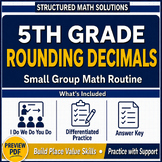
Turn rounding decimals into a clear, visual small-group routine with this 5th Grade Rounding Decimals Small Group Math Routine — a concept-first resource that helps students round decimals to the nearest whole number, tenth, and hundredth using place value understanding, benchmark decimals, midpoint reasoning, and number line models.
This is not a random rounding decimals worksheet packet.
This is not shortcut practice that only teaches “5 or more, raise the score.”
This is not a quick activity that asks students to round without understanding which benchmark a decimal is closest to.
This is a structured 5th Grade Rounding Decimals Routine designed to help students understand that rounding means finding the nearest benchmark value. Students learn why 2.47 rounds to 2.5 because it is between 2.4 and 2.5, past the midpoint 2.45, and closer to 2.5.
What makes this resource different
Most rounding decimals resources give students a procedure.
This resource gives teachers a complete small-group teaching routine.
Students learn to connect:
Decimal place value → Decimal magnitude → Benchmarks → Number lines → Midpoints → Closer-to reasoning → Rounded value → Explanation
The routine follows a predictable structure:
I Do → We Do → You Do → Exit Ticket → Regrouping Decision
Teachers model rounding with number lines and benchmark reasoning, guide students through midpoint comparisons, release students to differentiated practice, collect exit ticket evidence, and use observation tools to decide who needs re-engagement, on-grade practice, or challenge work.
✔ 24 Print-Ready Pages
✔ 5 Reusable Small-Group Sessions
✔ 20–30 Minute Sessions
✔ Recommended for 4–6 Students
✔ Rounding Anchor Chart
✔ Number Line Models
✔ Benchmark Decimal Practice
✔ Midpoint Reasoning
✔ Rounding to Whole Numbers
✔ Rounding to Tenths
✔ Rounding to Hundredths
✔ I Do Teacher Modeling
✔ We Do Guided Practice
✔ You Do Independent Practice
✔ Modified / Scaffolded Practice
✔ Challenge & Extension Practice
✔ 12 Common Misconceptions
✔ Corrective Teacher Language
✔ 4 Cut-Apart Exit Tickets
✔ Observation Checklist
✔ Re-Engagement Guide
✔ Answer Keys Included
✔ Standards Alignment Included
WHAT’S INCLUDED
T-0 Quick Reference & Print Guide
The print guide shows what to print for teacher use, on-grade students, modified students, and challenge students. It also includes a 5-session guide:
Session 1 — Rounding to Tenths
Students identify the two nearest tenth benchmarks, find the midpoint, and round using number line reasoning.
Session 2 — Rounding to Whole Numbers
Students round decimals to the nearest whole number using whole-number benchmarks and midpoint reasoning.
Session 3 — Rounding to Hundredths
Students identify smaller benchmark intervals and round decimals to the nearest hundredth.
Session 4 — Mixed Rounding & Error Analysis
Students round to any place and explain the reasoning behind each decision.
Session 5 — Transfer & Re-Engagement
Students review, extend, or receive targeted support based on exit ticket data.
T-1 Teacher Overview
The teacher overview explains the focus of the routine: using place value understanding, benchmark decimals, and number line models to round decimals through thousandths.
The skill progression is:
Decimal place value → Decimal magnitude → Benchmark identification → Number line reasoning → Midpoint comparison → Rounding to whole numbers → Rounding to tenths → Rounding to hundredths → Justifying rounding decisions
This is Resource 7 in the 5th Grade Place Value & Decimals Bundle. It is the culminating routine that draws on decimal place value, number lines, and comparing decimals from earlier bundle resources.
T-1a Common Misconceptions
The misconceptions guide helps teachers respond to rounding errors with targeted corrective language.
It addresses students who cannot identify benchmarks, rely only on “5 or more,” confuse the rounding place with the indicator digit, round 0.49 to 1 when rounding to the nearest tenth, mix up tenths and hundredths intervals, always round up when extra digits appear, move the decimal when rounding, or round correctly but cannot explain why.
Standards Alignment
This routine is aligned primarily to CCSS 5.NBT.A.4, with supporting connections to 5.NBT.A.3b, 5.NBT.A.3a, and 5.NBT.A.1.
The resource focuses on rounding decimals to any place using place value understanding. Decimal comparison supports midpoint reasoning, decimal forms support benchmark identification, and place value structure explains benchmark interval size.
Anchor Chart — How to Round Decimals
The anchor chart gives students a 4-step process:
1. Find the two benchmarks
2. Build the number line
3. Compare to the midpoint
4. Write the rounded value and explain
It includes examples for rounding to tenths, hundredths, and whole numbers, plus sentence frames and a reminder that rounding means finding the nearest benchmark — not applying a memorized digit rule.
I Do Teacher Modeling
I Do Part A — Rounding to Tenths and Hundredths
Teachers model how to round decimals such as 2.47 to the nearest tenth and 3.286 to the nearest hundredth.
Students learn to identify the target place, name the two nearest benchmarks, find the midpoint, compare the decimal to the midpoint, and choose the closer benchmark.
I Do Part B — Rounding to Whole Numbers and New Decimals
Teachers model how to round decimals such as 5.74 to the nearest whole number and 0.498 to the nearest tenth.
Students see that whole numbers can be benchmarks when rounding to the ones place, and that 0.498 rounds to 0.5, not 1, because the target place is tenths.
We Do Guided Practice
We Do Part A — Full Benchmark Process
Students round decimals such as 7.3, 4.62, 8.75, 6.183, 1.549, and 2.872 using the same four-step process.
This section supports students in identifying benchmarks and midpoints before writing the rounded value.
We Do Part B — Less Scaffolding & Error Analysis
Students take more ownership as they round decimals such as 3.46, 7.83, 5.168, 4.329, and 0.75.
They also analyze an error where a student rounds 6.48 correctly to 6.5 but explains it with shortcut reasoning instead of benchmark reasoning.
You Do
Student Practice On-Grade Practice
Students independently round decimals to the nearest whole number, tenth, and hundredth by identifying benchmarks, finding midpoints, comparing the decimal, and writing the rounded value.
Modified / Scaffolded Practice
Modified pages include labeled number lines, benchmark hints, midpoint support, sentence frames, and structured prompts for students who need more guidance.
Challenge & Extension Practice
Challenge pages ask students to round with more independence, explain reasoning, analyze errors, create decimals that round to a given value, and transfer benchmark reasoning to new numbers.
Exit Tickets and Assessment Tools Cut-Apart Exit Tickets
Four exit tickets help teachers check rounding accuracy, benchmark identification, midpoint reasoning, and explanation.
Observation Checklist
The checklist helps teachers track whether students can identify the rounding place, name benchmarks, locate midpoints, compare to the midpoint, round accurately, and explain the decision.
Re-Engagement Guide
The re-engagement guide gives next steps when students need support, including returning to the anchor chart, rebuilding number lines, identifying benchmarks first, using sentence frames, and targeting specific misconception patterns.
Answer Keys
Answer keys are included for on-grade practice, modified/scaffolded practice, challenge/extension pages, and exit tickets.
The small-group workflow this resource creates
Teachers choose the session focus, prepare number lines, place value charts, student pages, exit tickets, and the observation checklist.
The lesson cycle is simple:
Model → Find benchmarks → Compare midpoint → Round → Explain → Practice → Check → Regroup
Teachers model with the I Do pages, guide students during We Do, assign the right You Do tier, and use exit ticket evidence to decide who is ready to move forward, who needs another session, and who is ready for challenge work.
Why this routine works for 5th grade decimal understanding
Fifth graders need more than a rounding rule.
They need to understand that rounding is a distance decision: Which benchmark is the decimal closest to? That means students must use decimal magnitude, number lines, benchmark values, midpoint reasoning, and comparison skills together.
This routine helps students move from procedural rounding to conceptual rounding they can explain.
This resource works for:
5th grade rounding decimals
Rounding decimals to any place
Rounding to nearest whole number
Rounding to nearest tenth
Rounding to nearest hundredth
Decimal place value small groups
Guided math teacher table lessons
Benchmark decimal reasoning
Number line rounding practice
Midpoint reasoning
Beginning-of-year decimal review
Small-group reteaching after diagnostic data
Students who rely only on rounding shortcuts
Students who confuse tenths and hundredths benchmarks
Students who round correctly but cannot explain why
5.NBT.A.4 practice
5th Grade Place Value & Decimals Bundle instruction
Supported Grade 5 math skills
Rounding decimals
Rounding to whole numbers
Rounding to tenths
Rounding to hundredths
Decimal place value
Decimal magnitude
Number lines
Benchmarks
Midpoints
Closer-to reasoning
Comparing decimals to a midpoint
Writing rounded values
Explaining rounding decisions
Error analysis with rounding mistakes
Conceptual readiness for decimal operations
Supported Grade 5 math standards
5.NBT.A.4 — Use place value understanding to round decimals to any place.
5.NBT.A.3b — Compare two decimals to thousandths based on meanings of the digits in each place, using >, =, and < symbols.
5.NBT.A.3a — Read and write decimals to thousandths using base-ten numerals, number names, and expanded form.
5.NBT.A.1 — Recognize that in a multi-digit number, a digit in one place represents 10 times as much as it represents in the place to its right and 1/10 of what it represents in the place to its left.
The primary focus is 5.NBT.A.4. The routine uses decimal comparison, number forms, and place value structure as supporting skills for benchmark and midpoint reasoning.
The questions this resource answers:
How do I teach rounding decimals conceptually?
How do I help students round without relying only on “5 or more”?
How do I teach students to identify decimal benchmarks?
How do I help students find the midpoint between two decimal benchmarks?
How do I teach rounding to the nearest whole number, tenth, and hundredth?
How do I correct errors like 0.49 rounds to 1?
How do I help students explain why a decimal rounds up or down?
How do I connect rounding to decimal number lines?
How do I differentiate rounding decimals practice?
How do I turn exit tickets into regrouping decisions?
This resource is NOT:
A full decimal unit.
A random worksheet packet.
A full-year math curriculum.
A one-day activity.
A shortcut-only rounding lesson.
A decimal operations resource.
A fraction operations resource.
A generic decimal review packet.
It is a focused 5th Grade Rounding Decimals Small Group Math Routine designed to help students round decimals using place value understanding, benchmark proximity, and number line reasoning.
Why Teachers Choose Structured Math Solutions
Structured Math Solutions resources are built for teachers who want small-group math to feel clear, organized, and doable.
Every resource is designed around grade-specific skills, predictable routines, visual models, teacher-friendly planning, and practical classroom systems.
This routine helps 5th grade teachers move students beyond memorized rounding rules and into true decimal rounding understanding — using benchmark reasoning, number lines, midpoint comparisons, differentiated practice, error analysis, and evidence-based regrouping.
Highlights


Save even more with bundles

Description
Turn rounding decimals into a clear, visual small-group routine with this 5th Grade Rounding Decimals Small Group Math Routine — a concept-first resource that helps students round decimals to the nearest whole number, tenth, and hundredth using place value understanding, benchmark decimals, midpoint reasoning, and number line models.
This is not a random rounding decimals worksheet packet.
This is not shortcut practice that only teaches “5 or more, raise the score.”
This is not a quick activity that asks students to round without understanding which benchmark a decimal is closest to.
This is a structured 5th Grade Rounding Decimals Routine designed to help students understand that rounding means finding the nearest benchmark value. Students learn why 2.47 rounds to 2.5 because it is between 2.4 and 2.5, past the midpoint 2.45, and closer to 2.5.
What makes this resource different
Most rounding decimals resources give students a procedure.
This resource gives teachers a complete small-group teaching routine.
Students learn to connect:
Decimal place value → Decimal magnitude → Benchmarks → Number lines → Midpoints → Closer-to reasoning → Rounded value → Explanation
The routine follows a predictable structure:
I Do → We Do → You Do → Exit Ticket → Regrouping Decision
Teachers model rounding with number lines and benchmark reasoning, guide students through midpoint comparisons, release students to differentiated practice, collect exit ticket evidence, and use observation tools to decide who needs re-engagement, on-grade practice, or challenge work.
✔ 24 Print-Ready Pages
✔ 5 Reusable Small-Group Sessions
✔ 20–30 Minute Sessions
✔ Recommended for 4–6 Students
✔ Rounding Anchor Chart
✔ Number Line Models
✔ Benchmark Decimal Practice
✔ Midpoint Reasoning
✔ Rounding to Whole Numbers
✔ Rounding to Tenths
✔ Rounding to Hundredths
✔ I Do Teacher Modeling
✔ We Do Guided Practice
✔ You Do Independent Practice
✔ Modified / Scaffolded Practice
✔ Challenge & Extension Practice
✔ 12 Common Misconceptions
✔ Corrective Teacher Language
✔ 4 Cut-Apart Exit Tickets
✔ Observation Checklist
✔ Re-Engagement Guide
✔ Answer Keys Included
✔ Standards Alignment Included
WHAT’S INCLUDED
T-0 Quick Reference & Print Guide
The print guide shows what to print for teacher use, on-grade students, modified students, and challenge students. It also includes a 5-session guide:
Session 1 — Rounding to Tenths
Students identify the two nearest tenth benchmarks, find the midpoint, and round using number line reasoning.
Session 2 — Rounding to Whole Numbers
Students round decimals to the nearest whole number using whole-number benchmarks and midpoint reasoning.
Session 3 — Rounding to Hundredths
Students identify smaller benchmark intervals and round decimals to the nearest hundredth.
Session 4 — Mixed Rounding & Error Analysis
Students round to any place and explain the reasoning behind each decision.
Session 5 — Transfer & Re-Engagement
Students review, extend, or receive targeted support based on exit ticket data.
T-1 Teacher Overview
The teacher overview explains the focus of the routine: using place value understanding, benchmark decimals, and number line models to round decimals through thousandths.
The skill progression is:
Decimal place value → Decimal magnitude → Benchmark identification → Number line reasoning → Midpoint comparison → Rounding to whole numbers → Rounding to tenths → Rounding to hundredths → Justifying rounding decisions
This is Resource 7 in the 5th Grade Place Value & Decimals Bundle. It is the culminating routine that draws on decimal place value, number lines, and comparing decimals from earlier bundle resources.
T-1a Common Misconceptions
The misconceptions guide helps teachers respond to rounding errors with targeted corrective language.
It addresses students who cannot identify benchmarks, rely only on “5 or more,” confuse the rounding place with the indicator digit, round 0.49 to 1 when rounding to the nearest tenth, mix up tenths and hundredths intervals, always round up when extra digits appear, move the decimal when rounding, or round correctly but cannot explain why.
Standards Alignment
This routine is aligned primarily to CCSS 5.NBT.A.4, with supporting connections to 5.NBT.A.3b, 5.NBT.A.3a, and 5.NBT.A.1.
The resource focuses on rounding decimals to any place using place value understanding. Decimal comparison supports midpoint reasoning, decimal forms support benchmark identification, and place value structure explains benchmark interval size.
Anchor Chart — How to Round Decimals
The anchor chart gives students a 4-step process:
1. Find the two benchmarks
2. Build the number line
3. Compare to the midpoint
4. Write the rounded value and explain
It includes examples for rounding to tenths, hundredths, and whole numbers, plus sentence frames and a reminder that rounding means finding the nearest benchmark — not applying a memorized digit rule.
I Do Teacher Modeling
I Do Part A — Rounding to Tenths and Hundredths
Teachers model how to round decimals such as 2.47 to the nearest tenth and 3.286 to the nearest hundredth.
Students learn to identify the target place, name the two nearest benchmarks, find the midpoint, compare the decimal to the midpoint, and choose the closer benchmark.
I Do Part B — Rounding to Whole Numbers and New Decimals
Teachers model how to round decimals such as 5.74 to the nearest whole number and 0.498 to the nearest tenth.
Students see that whole numbers can be benchmarks when rounding to the ones place, and that 0.498 rounds to 0.5, not 1, because the target place is tenths.
We Do Guided Practice
We Do Part A — Full Benchmark Process
Students round decimals such as 7.3, 4.62, 8.75, 6.183, 1.549, and 2.872 using the same four-step process.
This section supports students in identifying benchmarks and midpoints before writing the rounded value.
We Do Part B — Less Scaffolding & Error Analysis
Students take more ownership as they round decimals such as 3.46, 7.83, 5.168, 4.329, and 0.75.
They also analyze an error where a student rounds 6.48 correctly to 6.5 but explains it with shortcut reasoning instead of benchmark reasoning.
You Do
Student Practice On-Grade Practice
Students independently round decimals to the nearest whole number, tenth, and hundredth by identifying benchmarks, finding midpoints, comparing the decimal, and writing the rounded value.
Modified / Scaffolded Practice
Modified pages include labeled number lines, benchmark hints, midpoint support, sentence frames, and structured prompts for students who need more guidance.
Challenge & Extension Practice
Challenge pages ask students to round with more independence, explain reasoning, analyze errors, create decimals that round to a given value, and transfer benchmark reasoning to new numbers.
Exit Tickets and Assessment Tools Cut-Apart Exit Tickets
Four exit tickets help teachers check rounding accuracy, benchmark identification, midpoint reasoning, and explanation.
Observation Checklist
The checklist helps teachers track whether students can identify the rounding place, name benchmarks, locate midpoints, compare to the midpoint, round accurately, and explain the decision.
Re-Engagement Guide
The re-engagement guide gives next steps when students need support, including returning to the anchor chart, rebuilding number lines, identifying benchmarks first, using sentence frames, and targeting specific misconception patterns.
Answer Keys
Answer keys are included for on-grade practice, modified/scaffolded practice, challenge/extension pages, and exit tickets.
The small-group workflow this resource creates
Teachers choose the session focus, prepare number lines, place value charts, student pages, exit tickets, and the observation checklist.
The lesson cycle is simple:
Model → Find benchmarks → Compare midpoint → Round → Explain → Practice → Check → Regroup
Teachers model with the I Do pages, guide students during We Do, assign the right You Do tier, and use exit ticket evidence to decide who is ready to move forward, who needs another session, and who is ready for challenge work.
Why this routine works for 5th grade decimal understanding
Fifth graders need more than a rounding rule.
They need to understand that rounding is a distance decision: Which benchmark is the decimal closest to? That means students must use decimal magnitude, number lines, benchmark values, midpoint reasoning, and comparison skills together.
This routine helps students move from procedural rounding to conceptual rounding they can explain.
This resource works for:
5th grade rounding decimals
Rounding decimals to any place
Rounding to nearest whole number
Rounding to nearest tenth
Rounding to nearest hundredth
Decimal place value small groups
Guided math teacher table lessons
Benchmark decimal reasoning
Number line rounding practice
Midpoint reasoning
Beginning-of-year decimal review
Small-group reteaching after diagnostic data
Students who rely only on rounding shortcuts
Students who confuse tenths and hundredths benchmarks
Students who round correctly but cannot explain why
5.NBT.A.4 practice
5th Grade Place Value & Decimals Bundle instruction
Supported Grade 5 math skills
Rounding decimals
Rounding to whole numbers
Rounding to tenths
Rounding to hundredths
Decimal place value
Decimal magnitude
Number lines
Benchmarks
Midpoints
Closer-to reasoning
Comparing decimals to a midpoint
Writing rounded values
Explaining rounding decisions
Error analysis with rounding mistakes
Conceptual readiness for decimal operations
Supported Grade 5 math standards
5.NBT.A.4 — Use place value understanding to round decimals to any place.
5.NBT.A.3b — Compare two decimals to thousandths based on meanings of the digits in each place, using >, =, and < symbols.
5.NBT.A.3a — Read and write decimals to thousandths using base-ten numerals, number names, and expanded form.
5.NBT.A.1 — Recognize that in a multi-digit number, a digit in one place represents 10 times as much as it represents in the place to its right and 1/10 of what it represents in the place to its left.
The primary focus is 5.NBT.A.4. The routine uses decimal comparison, number forms, and place value structure as supporting skills for benchmark and midpoint reasoning.
The questions this resource answers:
How do I teach rounding decimals conceptually?
How do I help students round without relying only on “5 or more”?
How do I teach students to identify decimal benchmarks?
How do I help students find the midpoint between two decimal benchmarks?
How do I teach rounding to the nearest whole number, tenth, and hundredth?
How do I correct errors like 0.49 rounds to 1?
How do I help students explain why a decimal rounds up or down?
How do I connect rounding to decimal number lines?
How do I differentiate rounding decimals practice?
How do I turn exit tickets into regrouping decisions?
This resource is NOT:
A full decimal unit.
A random worksheet packet.
A full-year math curriculum.
A one-day activity.
A shortcut-only rounding lesson.
A decimal operations resource.
A fraction operations resource.
A generic decimal review packet.
It is a focused 5th Grade Rounding Decimals Small Group Math Routine designed to help students round decimals using place value understanding, benchmark proximity, and number line reasoning.
Why Teachers Choose Structured Math Solutions
Structured Math Solutions resources are built for teachers who want small-group math to feel clear, organized, and doable.
Every resource is designed around grade-specific skills, predictable routines, visual models, teacher-friendly planning, and practical classroom systems.
This routine helps 5th grade teachers move students beyond memorized rounding rules and into true decimal rounding understanding — using benchmark reasoning, number lines, midpoint comparisons, differentiated practice, error analysis, and evidence-based regrouping.
