


Description
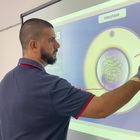
This resource is an EXE file containing interactive simulators that will help teachers explain science content.
Teachers, use our interactive simulators in your lessons, improve performance and increase student engagement.
This file will run until 31/12/2024
Contact: +55 2197226-4519
Report this resource to TPT
Reported resources will be reviewed by our team. Report this resource to let us know if this resource violates TPT's content guidelines.
FREE
Highlights

Grades
6th - 12th

Subjects

Standards
NGSSHS-LS4-2
NGSSHS-LS4-1
NGSSHS-LS4-6
Tags
Pages
5
Answer Key
Included
Description
This resource is an EXE file containing interactive simulators that will help teachers explain science content.
Teachers, use our interactive simulators in your lessons, improve performance and increase student engagement.
This file will run until 31/12/2024
Contact: +55 2197226-4519
Report this resource to TPT
Reported resources will be reviewed by our team. Report this resource to let us know if this resource violates TPT's content guidelines.
Reviews
All verified TPT purchases
a very colorful way to give the best examples of cell cycle. Easy to navigate which is a bonus to not frustrate struggling students and allows them to take in the info
Questions & Answers
Loading
Standards
to see state-specific standards (only available in the US).
NGSSHS-LS4-2
Construct an explanation based on evidence that the process of evolution primarily results from four factors: (1) the potential for a species to increase in number, (2) the heritable genetic variation of individuals in a species due to mutation and sexual reproduction, (3) competition for limited resources, and (4) the proliferation of those organisms that are better able to survive and reproduce in the environment. Emphasis is on using evidence to explain the influence each of the four factors has on number of organisms, behaviors, morphology, or physiology in terms of ability to compete for limited resources and subsequent survival of individuals and adaptation of species. Examples of evidence could include mathematical models such as simple distribution graphs and proportional reasoning. Assessment does not include other mechanisms of evolution, such as genetic drift, gene flow through migration, and co-evolution.
NGSSHS-LS4-1
Communicate scientific information that common ancestry and biological evolution are supported by multiple lines of empirical evidence. Emphasis is on a conceptual understanding of the role each line of evidence has relating to common ancestry and biological evolution. Examples of evidence could include similarities in DNA sequences, anatomical structures, and order of appearance of structures in embryological development.
NGSSHS-LS4-6
Create or revise a simulation to test a solution to mitigate adverse impacts of human activity on biodiversity. Emphasis is on testing solutions for a proposed problem related to threatened or endangered species, or to genetic variation of organisms for multiple species.
Loading
