


What others say

Description
Ready to help your students master complementary and supplementary angles with confidence?
These NO PREP guided notes make teaching and learning about complementary and supplementary angles clear, visual, and engaging. With a classroom-tested, step-by-step format, students build understanding as they learn how angle pairs relate, how to write equations to represent unknown angle measures, and how to solve for missing values. The structured layout supports conceptual understanding while guiding students through real-world and mathematical applications.
Perfect for introducing or reinforcing the concept, this resource includes both full-page printables and interactive notebook versions, giving students a reusable reference tool they can use all year long.
This notes set is designed to help students confidently identify and solve problems involving complementary and supplementary angles, including setting up and solving equations to find unknown measures. The resource includes full-page worksheets as well as interactive notebook versions, offering flexibility for whole-class instruction, small group practice, or independent learning. Each page emphasizes visual reasoning, angle relationships, and algebraic thinking.
Aligned to 7.G.B.5, these notes support students in analyzing angle relationships, interpreting diagrams, and applying equations to determine unknown values in both real-world and mathematical contexts.
What’s Included
- Warm-Up: A brief activity to activate prior knowledge about angles and basic geometric relationships.
- Important Vocabulary: Student-friendly, fill-in-the-blank definitions of essential terms used when discussing angle relationships.
- Guided Notes: Step-by-step, fill-in-the-blank notes that teach how complementary and supplementary angles work and how to represent them with equations.
- Guided Practice: Scaffolded examples modeling how to interpret diagrams, set up equations, and solve for missing angle measures.
- Independent Practice: Problems for students to complete independently to build confidence and fluency.
- Mastery Practice: Multi-step and real-world angle problems requiring deeper reasoning and interpretation.
- Engage & Extend: Critical thinking tasks such as Think It Through, Which One Doesn’t Belong?, error analysis, and challenge puzzles.
- Wrap-Up & Summarize: Quick checks and reflection prompts to reinforce understanding.
- Check Your Understanding: Multiple-choice or short-response items to assess mastery.
- Vocabulary Frayer Models: Graphic organizers for reinforcing important angle concepts.
- Performance Task: A short, real-world project involving diagrams and angle relationships, with a grading checklist for easy assessment.
Why Teachers Love These Notes
- 100% NO PREP — print and teach
- Includes full-page and interactive notebook formats
- Builds strong geometric and algebraic reasoning skills
- Helps students understand how angle relationships form and how to solve for unknowns
- Ideal for special education and English Language Learners
- Creates a reusable reference tool for homework, quizzes, and review
Here’s what other teachers are saying about this resource:
⭐⭐⭐⭐⭐ Alexis K.says “My students loved this assignment. It was so easy to assign and give out and needed no prep. I was able to use it with both in person and online students!”
⭐⭐⭐⭐⭐ Molly P.“love the set up and how easy these notes are to follow”
This resource is part of these popular money-saving bundles:
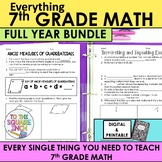
7th Grade Math Guided Notes
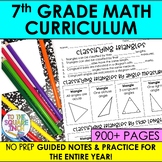
7th Grade Math Curriculum
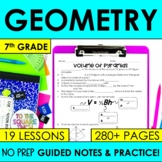
You may also like these other supplemental resources that cover complementary and supplementary angles:
Additionally, these resources can help reinforce your students understanding of key concepts throughout the year:
7th Grade Math Homework
Full Year Worksheets
Full Year FUN Worksheets
Error Analysis
Guided notes are the foundation of my classroom. Here’s why:
- Guided notes keep all students actively engaged in class. Students follow along and fill in missing words and numbers and answer questions. They allow students to focus on problem solving rather than using their working memory to write down everything they hear the teacher say.
- Students create their own reference guide to help them remember and internalize what they learned in class. They can easily refer back to what they learned in previous classes to help them with spiral review, homework, studying for assessments and most importantly building on prior knowledge to learn new concepts.
- It helps students organize information and understand what is important. Middle school students are often new to the expectation of notetaking and guided notes are a perfect way to introduce this practice and perfect a lifelong skill. The blanks can be used as cues to help students decipher what is expected of them- they can tell if a longer definition should be recorded or a smaller blank means they should write an important vocabulary word or number.
- They relieve the stress that many students feel when expected to accurately copy diagrams, figures and equations off the board. Having them right on their notes page allows them to focus on problem solving and less about accurately copying complex notes off the board.
- Guided notes are especially beneficial for students with special education needs and English Language Learners and can easily be adapted to accommodate specific needs.
Copyright © To The Square Inch LLC
All rights reserved by the author.
Permission to copy for single classroom use only.
Complementary and Supplementary Angles Notes & Practice | + Interactive Notebook

Highlights


What others say
Save even more with bundles

Description
Ready to help your students master complementary and supplementary angles with confidence?
These NO PREP guided notes make teaching and learning about complementary and supplementary angles clear, visual, and engaging. With a classroom-tested, step-by-step format, students build understanding as they learn how angle pairs relate, how to write equations to represent unknown angle measures, and how to solve for missing values. The structured layout supports conceptual understanding while guiding students through real-world and mathematical applications.
Perfect for introducing or reinforcing the concept, this resource includes both full-page printables and interactive notebook versions, giving students a reusable reference tool they can use all year long.
This notes set is designed to help students confidently identify and solve problems involving complementary and supplementary angles, including setting up and solving equations to find unknown measures. The resource includes full-page worksheets as well as interactive notebook versions, offering flexibility for whole-class instruction, small group practice, or independent learning. Each page emphasizes visual reasoning, angle relationships, and algebraic thinking.
Aligned to 7.G.B.5, these notes support students in analyzing angle relationships, interpreting diagrams, and applying equations to determine unknown values in both real-world and mathematical contexts.
What’s Included
- Warm-Up: A brief activity to activate prior knowledge about angles and basic geometric relationships.
- Important Vocabulary: Student-friendly, fill-in-the-blank definitions of essential terms used when discussing angle relationships.
- Guided Notes: Step-by-step, fill-in-the-blank notes that teach how complementary and supplementary angles work and how to represent them with equations.
- Guided Practice: Scaffolded examples modeling how to interpret diagrams, set up equations, and solve for missing angle measures.
- Independent Practice: Problems for students to complete independently to build confidence and fluency.
- Mastery Practice: Multi-step and real-world angle problems requiring deeper reasoning and interpretation.
- Engage & Extend: Critical thinking tasks such as Think It Through, Which One Doesn’t Belong?, error analysis, and challenge puzzles.
- Wrap-Up & Summarize: Quick checks and reflection prompts to reinforce understanding.
- Check Your Understanding: Multiple-choice or short-response items to assess mastery.
- Vocabulary Frayer Models: Graphic organizers for reinforcing important angle concepts.
- Performance Task: A short, real-world project involving diagrams and angle relationships, with a grading checklist for easy assessment.
Why Teachers Love These Notes
- 100% NO PREP — print and teach
- Includes full-page and interactive notebook formats
- Builds strong geometric and algebraic reasoning skills
- Helps students understand how angle relationships form and how to solve for unknowns
- Ideal for special education and English Language Learners
- Creates a reusable reference tool for homework, quizzes, and review
Here’s what other teachers are saying about this resource:
⭐⭐⭐⭐⭐ Alexis K.says “My students loved this assignment. It was so easy to assign and give out and needed no prep. I was able to use it with both in person and online students!”
⭐⭐⭐⭐⭐ Molly P.“love the set up and how easy these notes are to follow”
This resource is part of these popular money-saving bundles:
7th Grade Math Guided Notes
7th Grade Math Curriculum
You may also like these other supplemental resources that cover complementary and supplementary angles:
Additionally, these resources can help reinforce your students understanding of key concepts throughout the year:
7th Grade Math Homework
Full Year Worksheets
Full Year FUN Worksheets
Error Analysis
Guided notes are the foundation of my classroom. Here’s why:
- Guided notes keep all students actively engaged in class. Students follow along and fill in missing words and numbers and answer questions. They allow students to focus on problem solving rather than using their working memory to write down everything they hear the teacher say.
- Students create their own reference guide to help them remember and internalize what they learned in class. They can easily refer back to what they learned in previous classes to help them with spiral review, homework, studying for assessments and most importantly building on prior knowledge to learn new concepts.
- It helps students organize information and understand what is important. Middle school students are often new to the expectation of notetaking and guided notes are a perfect way to introduce this practice and perfect a lifelong skill. The blanks can be used as cues to help students decipher what is expected of them- they can tell if a longer definition should be recorded or a smaller blank means they should write an important vocabulary word or number.
- They relieve the stress that many students feel when expected to accurately copy diagrams, figures and equations off the board. Having them right on their notes page allows them to focus on problem solving and less about accurately copying complex notes off the board.
- Guided notes are especially beneficial for students with special education needs and English Language Learners and can easily be adapted to accommodate specific needs.
Copyright © To The Square Inch LLC
All rights reserved by the author.
Permission to copy for single classroom use only.
