


Description
Recognizing and repeating patterns are an important part of a child's development. Patterns are all around, and when you encourage your child to recognize patterns, you are strengthening their math skills. Students who can identify patterns have an easier time solving problems and making mathematical connections.
This AB pattern is very simple and very basic which is great for those just starting out learning about patterns. An AB pattern is simply alternating colors or shapes or really anything. Every other object is the same. Students are encouraged to complete the pattern by drawing the next shape.
------------------------------------------------------------------------------------------
Purchase as a BUNDLE and {SAVE 20%}
The Patterns MEGA Bundle Pack includes this pack plus:
Make A Pattern: AB
Make A Pattern: AAB
Make A Pattern: ABB
Plus BONUS Pages:
Make A Pattern: ABC
This AB pattern is very simple and very basic which is great for those just starting out learning about patterns. An AB pattern is simply alternating colors or shapes or really anything. Every other object is the same. Students are encouraged to complete the pattern by drawing the next shape.
------------------------------------------------------------------------------------------
Purchase as a BUNDLE and {SAVE 20%}
The Patterns MEGA Bundle Pack includes this pack plus:
Make A Pattern: AB
Make A Pattern: AAB
Make A Pattern: ABB
Plus BONUS Pages:
Make A Pattern: ABC
Report this resource to TPT
Reported resources will be reviewed by our team. Report this resource to let us know if this resource violates TPT's content guidelines.
Complete the Pattern: AB Shapes

The Unconventional Classroom
334 Followers
$1.25
Highlights
Digital downloads

Grades
PreK - K

Subjects

Standards
CCSSMP7
CCSSMP8
Pages
7
Save even more with bundles

Recognizing and repeating patterns are an important part of a child's development. Patterns are all around, and when you encourage your child to recognize patterns, you are strengthening their math skills. Students who can identify patterns have an easier time solving problems and making mathematica
Price $4.25Original Price $4.75Save $0.50
5
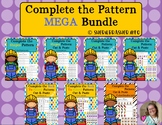
This Complete the Pattern MEGA Bundle includes all of my pattern activities!
There are activities for Back to School, Summer, even Thanksgiving as well as basic Shapes.
With options of full-color or ink-saving black & white you can make this work in your classroom wherever you teach. Many
Price $10.00Original Price $12.25Save $2.25
10

Along with shape recognition, patterns are a very important step for learning difficult concepts such as math and reading.
This bundle includes all of my Shape pattern activities like Complete the Pattern Cut & Paste, and Make a Pattern AB, AAB and ABB.
With drawing and cutting these are g
Price $4.00Original Price $4.75Save $0.75
5
Description
Recognizing and repeating patterns are an important part of a child's development. Patterns are all around, and when you encourage your child to recognize patterns, you are strengthening their math skills. Students who can identify patterns have an easier time solving problems and making mathematical connections.
This AB pattern is very simple and very basic which is great for those just starting out learning about patterns. An AB pattern is simply alternating colors or shapes or really anything. Every other object is the same. Students are encouraged to complete the pattern by drawing the next shape.
------------------------------------------------------------------------------------------
Purchase as a BUNDLE and {SAVE 20%}
The Patterns MEGA Bundle Pack includes this pack plus:
Make A Pattern: AB
Make A Pattern: AAB
Make A Pattern: ABB
Plus BONUS Pages:
Make A Pattern: ABC
This AB pattern is very simple and very basic which is great for those just starting out learning about patterns. An AB pattern is simply alternating colors or shapes or really anything. Every other object is the same. Students are encouraged to complete the pattern by drawing the next shape.
------------------------------------------------------------------------------------------
Purchase as a BUNDLE and {SAVE 20%}
The Patterns MEGA Bundle Pack includes this pack plus:
Make A Pattern: AB
Make A Pattern: AAB
Make A Pattern: ABB
Plus BONUS Pages:
Make A Pattern: ABC
Report this resource to TPT
Reported resources will be reviewed by our team. Report this resource to let us know if this resource violates TPT's content guidelines.
Reviews
This product has not yet been rated.
Questions & Answers
Loading
Standards
to see state-specific standards (only available in the US).
CCSSMP7
Look for and make use of structure. Mathematically proficient students look closely to discern a pattern or structure. Young students, for example, might notice that three and seven more is the same amount as seven and three more, or they may sort a collection of shapes according to how many sides the shapes have. Later, students will see 7 × 8 equals the well remembered 7 × 5 + 7 × 3, in preparation for learning about the distributive property. In the expression 𝑥² + 9𝑥 + 14, older students can see the 14 as 2 × 7 and the 9 as 2 + 7. They recognize the significance of an existing line in a geometric figure and can use the strategy of drawing an auxiliary line for solving problems. They also can step back for an overview and shift perspective. They can see complicated things, such as some algebraic expressions, as single objects or as being composed of several objects. For example, they can see 5 – 3(𝑥 – 𝑦)² as 5 minus a positive number times a square and use that to realize that its value cannot be more than 5 for any real numbers 𝑥 and 𝑦.
CCSSMP8
Look for and express regularity in repeated reasoning. Mathematically proficient students notice if calculations are repeated, and look both for general methods and for shortcuts. Upper elementary students might notice when dividing 25 by 11 that they are repeating the same calculations over and over again, and conclude they have a repeating decimal. By paying attention to the calculation of slope as they repeatedly check whether points are on the line through (1, 2) with slope 3, middle school students might abstract the equation (𝑦 – 2)/(𝑥 – 1) = 3. Noticing the regularity in the way terms cancel when expanding (𝑥 – 1)(𝑥 + 1), (𝑥 – 1)(𝑥² + 𝑥 + 1), and (𝑥 – 1)(𝑥³ + 𝑥² + 𝑥 + 1) might lead them to the general formula for the sum of a geometric series. As they work to solve a problem, mathematically proficient students maintain oversight of the process, while attending to the details. They continually evaluate the reasonableness of their intermediate results.
Loading
