


Description
Looking for a change in your math class? Wanna Have Fun in Math while let your student think and be creative on solving math problems on their own
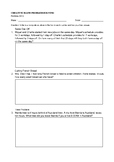
Here's another problem set I created which my class did enjoy.
Have your students work by pair or group and tell them to put their complete solution in the box provided in each number.
Their solution can be a computation type, by diagram, by table, etc. You will be amaze how creative some students answer these questions! If you have time, You can let them explain how they got their answers.
Challenge your students with this 6 non-routine math problems!! The level of these problems are not that hard! I believe grade 7 or grade 8 students can answer these easily! (Only the last problem is a bit of tricky, but this can be easily answered by creating a table)
Summary of the six problems
1. Same Day Off
2. Cutting French Bread
3. Time Problem
4. Arranging tables
5. Sequence in Shape
6. Who is married to Whom?
Mathematics is not all about the canon of numbers but also about literacy and comprehension. These things play a pivotal part in the deeper cognitive processes identified in students’ learning. With this problem sets about non-routine math student will be able to make connections between different aspects of text in mathematics and to draw out the key information, process this into a mathematical expression or operation, and to solve the problem in context. Moreover, this will show how student reason out a method and relate their solutions to the context of the problem.
This will provide opportunities for students to demonstrate high levels of cognitive mathematical thinking because they require students to: make connections within text, infer for deeper meaning, reason deductively, choose and apply relevant information, and accurately write mathematical reasoning.
Viva Math!! :D
Creative Math Problem Set 2: 6 non-routine math problems challenge

Highlights


Description
Looking for a change in your math class? Wanna Have Fun in Math while let your student think and be creative on solving math problems on their own
Here's another problem set I created which my class did enjoy.
Have your students work by pair or group and tell them to put their complete solution in the box provided in each number.
Their solution can be a computation type, by diagram, by table, etc. You will be amaze how creative some students answer these questions! If you have time, You can let them explain how they got their answers.
Challenge your students with this 6 non-routine math problems!! The level of these problems are not that hard! I believe grade 7 or grade 8 students can answer these easily! (Only the last problem is a bit of tricky, but this can be easily answered by creating a table)
Summary of the six problems
1. Same Day Off
2. Cutting French Bread
3. Time Problem
4. Arranging tables
5. Sequence in Shape
6. Who is married to Whom?
Mathematics is not all about the canon of numbers but also about literacy and comprehension. These things play a pivotal part in the deeper cognitive processes identified in students’ learning. With this problem sets about non-routine math student will be able to make connections between different aspects of text in mathematics and to draw out the key information, process this into a mathematical expression or operation, and to solve the problem in context. Moreover, this will show how student reason out a method and relate their solutions to the context of the problem.
This will provide opportunities for students to demonstrate high levels of cognitive mathematical thinking because they require students to: make connections within text, infer for deeper meaning, reason deductively, choose and apply relevant information, and accurately write mathematical reasoning.
Viva Math!! :D
