TPT
Total:
$0.00
Decimal Multiplication Math - Cotton Candy Stand - Project Based Learning
Share

What others say

"My students really enjoyed this activity, with several asking if they could take it home to complete. I loved the real-world aspects and having two levels of difficulty was perfect to span the abilities in my students."
star
Melinda B.

Description

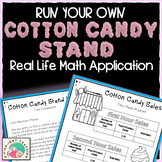
Are you looking for a fun way to practice multiplication, subtraction, and addition with decimals? Then look no further! This is an engaging activity for all students. This is a fun math project to practice multiplication with decimals. Students will get to put their math skills into practice in a real life situation. They will create a mock cotton candy stand where they will have to be in charge of buying their product, figuring out how much each customer owes, and how much they will profit. This activity lets each student set up their own cotton candy stand, so all their answers may differ. At the end of the activity students will determine if their cotton candy stand was successful, whether they made a big enough profit to do it again.

This activity has students practice multiplying, dividing, and subtracting numbers with decimals.

What's included:

  • A letter to the teacher explaining the task.
  • A letter to the students (business owner) explaining their task.
  • A page for students to create their own sign for their shop.
  • The product page, where students will pick what products they will buy.
  • Hourly sales page (There are two options) One will break it down for each step and there is another page that is more challenging for your higher math students to stretch their thinking and not lay out each step explicitly.
  • A total sales sheet with reflection questions.
  • A social media post for students to create.

The best part? Students have autonomy over their own cotton candy stand. Let them have the reins of their learning. It allows for math practice and a little creativity.

Get creative in the classroom and have your students apply real world math. Show them where they might use multiplication, addition, and subtraction of decimals. Get rid of the boring old math worksheets and let your students create their own little business.

What other teachers are saying:

⭐️⭐️⭐️⭐️⭐️Anaida W. says, "Fantastic math project! Engaging and full of great questions for students. Thanks."

⭐️⭐️⭐️⭐️⭐Just Another Smith says, "Oh my! I love this activity! It was perfect for basic arithmetic reinforcement for my students. I loved that the activity has a mix of fixed tasks but also some open ended elements so that the students had some choice and creativity. I really enjoy giving my students real-world tasks and felt like this was right at their level. The instructions were clear and there were also some choices for me with built in differentiation."

These are ready to use, just print them out and get started. This could be a great lesson to leave for a substitute as it is no prep!

If you enjoyed this product, please leave a review and follow my store. If you would like to see more products by me follow the link E•Fish•ient Teaching Thank you for your purchase and I hope you enjoy!

Report this resource to TPT
Reported resources will be reviewed by our team. Report this resource to let us know if this resource violates TPT's content guidelines.

Decimal Multiplication Math - Cotton Candy Stand - Project Based Learning

Rated 5 out of 5, based on 9 reviews
5.0 (9 ratings)
EFishient Teaching
186 Followers
$3.00

Highlights

Digital downloads
Grades icon
Grades
4th - 6th
Standards icon
Standards
Pages
10

What others say

"My students really enjoyed this activity, with several asking if they could take it home to complete. I loved the real-world aspects and having two levels of difficulty was perfect to span the abilities in my students."
star
Melinda B.

Description

Are you looking for a fun way to practice multiplication, subtraction, and addition with decimals? Then look no further! This is an engaging activity for all students. This is a fun math project to practice multiplication with decimals. Students will get to put their math skills into practice in a real life situation. They will create a mock cotton candy stand where they will have to be in charge of buying their product, figuring out how much each customer owes, and how much they will profit. This activity lets each student set up their own cotton candy stand, so all their answers may differ. At the end of the activity students will determine if their cotton candy stand was successful, whether they made a big enough profit to do it again.

This activity has students practice multiplying, dividing, and subtracting numbers with decimals.

What's included:

  • A letter to the teacher explaining the task.
  • A letter to the students (business owner) explaining their task.
  • A page for students to create their own sign for their shop.
  • The product page, where students will pick what products they will buy.
  • Hourly sales page (There are two options) One will break it down for each step and there is another page that is more challenging for your higher math students to stretch their thinking and not lay out each step explicitly.
  • A total sales sheet with reflection questions.
  • A social media post for students to create.

The best part? Students have autonomy over their own cotton candy stand. Let them have the reins of their learning. It allows for math practice and a little creativity.

Get creative in the classroom and have your students apply real world math. Show them where they might use multiplication, addition, and subtraction of decimals. Get rid of the boring old math worksheets and let your students create their own little business.

What other teachers are saying:

⭐️⭐️⭐️⭐️⭐️Anaida W. says, "Fantastic math project! Engaging and full of great questions for students. Thanks."

⭐️⭐️⭐️⭐️⭐Just Another Smith says, "Oh my! I love this activity! It was perfect for basic arithmetic reinforcement for my students. I loved that the activity has a mix of fixed tasks but also some open ended elements so that the students had some choice and creativity. I really enjoy giving my students real-world tasks and felt like this was right at their level. The instructions were clear and there were also some choices for me with built in differentiation."

These are ready to use, just print them out and get started. This could be a great lesson to leave for a substitute as it is no prep!

If you enjoyed this product, please leave a review and follow my store. If you would like to see more products by me follow the link E•Fish•ient Teaching Thank you for your purchase and I hope you enjoy!

Report this resource to TPT
Reported resources will be reviewed by our team. Report this resource to let us know if this resource violates TPT's content guidelines.

Reviews

5.0
Rated 5 out of 5, based on 9 reviews
9
ratings
All verified TPT purchases
Fun math practice
Rated 5 out of 5
May 23, 2026
Met expectations
Great value
Standards-aligned
My students really enjoyed this activity, with several asking if they could take it home to complete. I loved the real-world aspects and having two levels of difficulty was perfect to span the abilities in my students.
Melinda B.
11 reviews • Maryland
Grades taught: 5th
Student populations: Learning difficulties
Rated 5 out of 5
July 23, 2025
Great resource!! Kept my students engaged, will use again this year.
Marybeth B.
29 reviews
Grades taught: 4th
Rated 5 out of 5
November 15, 2024
I have students who need enrichment and they are having a great time working on this project.
Class4-316
(TPT Seller)
1,111 reviews
Grades taught: 5th
Student populations: Learning difficulties
Rated 5 out of 5
March 10, 2024
My students loved using this resource! I used it in a small group; it was great to use independently, with a small group, or with partners.
Cool Catz Teach
(TPT Seller)
1,344 reviews
Grades taught: 5th
Rated 5 out of 5
June 21, 2023
I used some adaptions to accommodate my students. They had so much fun designing their signs. I actually did this activity while reading Lemonade Wars.
ANN B.
138 reviews
Grades taught: 4th
Student populations: Learning difficulties
EFishient Teaching
Response from
EFishient Teaching
(TPT Seller)
Jun 27, 2023
What a great way to use it alongside the Lemonade Wars. So glad you found it useful!
Rated 5 out of 5
January 26, 2023
This resource was amazing! My students were so engaged and loved the idea of a cotton candy stand! I loved the math that was involved - it really got my students thinking. Thank you so much for this great resource!
Ready Set Kinder
(TPT Seller)
460 reviews
EFishient Teaching
Response from
EFishient Teaching
(TPT Seller)
Jan 27, 2023
So glad they liked it! Thanks!
Rated 5 out of 5
January 26, 2023
Fantastic math project! Engaging and full of great questions for students. Thanks.
Anaida W.
535 reviews
EFishient Teaching
Response from
EFishient Teaching
(TPT Seller)
Jan 26, 2023
So happy your students were engaged! Thank you!
Rated 5 out of 5
January 24, 2023
Creative and so fun! Students loved it. I want more resources like this!
41 reviews
Grades taught: 7th
EFishient Teaching
Response from
EFishient Teaching
(TPT Seller)
Jan 24, 2023
So glad you loved it! Thank you!

Questions & Answers

Loading

Standards

to see state-specific standards (only available in the US).
Add, subtract, multiply, and divide decimals to hundredths, using concrete models or drawings and strategies based on place value, properties of operations, and/or the relationship between addition and subtraction; relate the strategy to a written method and explain the reasoning used.
Construct viable arguments and critique the reasoning of others. Mathematically proficient students understand and use stated assumptions, definitions, and previously established results in constructing arguments. They make conjectures and build a logical progression of statements to explore the truth of their conjectures. They are able to analyze situations by breaking them into cases, and can recognize and use counterexamples. They justify their conclusions, communicate them to others, and respond to the arguments of others. They reason inductively about data, making plausible arguments that take into account the context from which the data arose. Mathematically proficient students are also able to compare the effectiveness of two plausible arguments, distinguish correct logic or reasoning from that which is flawed, and-if there is a flaw in an argument-explain what it is. Elementary students can construct arguments using concrete referents such as objects, drawings, diagrams, and actions. Such arguments can make sense and be correct, even though they are not generalized or made formal until later grades. Later, students learn to determine domains to which an argument applies. Students at all grades can listen or read the arguments of others, decide whether they make sense, and ask useful questions to clarify or improve the arguments.
Model with mathematics. Mathematically proficient students can apply the mathematics they know to solve problems arising in everyday life, society, and the workplace. In early grades, this might be as simple as writing an addition equation to describe a situation. In middle grades, a student might apply proportional reasoning to plan a school event or analyze a problem in the community. By high school, a student might use geometry to solve a design problem or use a function to describe how one quantity of interest depends on another. Mathematically proficient students who can apply what they know are comfortable making assumptions and approximations to simplify a complicated situation, realizing that these may need revision later. They are able to identify important quantities in a practical situation and map their relationships using such tools as diagrams, two-way tables, graphs, flowcharts and formulas. They can analyze those relationships mathematically to draw conclusions. They routinely interpret their mathematical results in the context of the situation and reflect on whether the results make sense, possibly improving the model if it has not served its purpose.
Loading