


What others say

Description
Ready to help your students master the Distributive Property with confidence?
These NO PREP guided notes make teaching and learning the Distributive Property simple, structured, and engaging. With a classroom-tested format, students build confidence as they learn how to apply the Distributive Property to expand and simplify expressions step-by-step — all while focusing on understanding, not just memorization.
Perfect for introducing or reinforcing the concept, this resource includes both full-page printables and interactive notebook versions, allowing students to create a reusable reference tool they can rely on throughout the year.
This notes set is designed to help students confidently use and apply the Distributive Property to simplify and rewrite expressions. The resource includes full-page worksheets as well as interactive notebook versions, giving you flexible options for classroom use. Each page breaks down the property through clear examples, visuals, and guided practice, helping students see how multiplication distributes over addition or subtraction.
Aligned to 6.EE.A.3, these notes support students in writing equivalent expressions using the Distributive Property and understanding how algebraic structure can simplify problem solving.
What’s Included
- Warm-Up: A short set of problems to activate prior knowledge about multiplication and addition.
- Important Vocabulary: Student-friendly, fill-in-the-blank definitions of key terms such as term, factor, expression, and Distributive Property.
- Guided Notes: Step-by-step, fill-in-the-blank notes that explain how to apply the Distributive Property to simplify and expand expressions.
- Guided Practice: Scaffolded examples modeling how to distribute coefficients and combine like terms when possible.
- Independent Practice: Targeted problems for students to solve independently to build fluency and confidence.
- Mastery Practice: Real-world and application-based problems that require students to apply the property in context.
- Engage & Extend: Critical thinking prompts such as Think It Through, Which One Doesn’t Belong?, error analysis, and challenge problems.
- Wrap-Up & Summarize: Quick check-in problems and reflection prompts to reinforce understanding.
- Check Your Understanding: Multiple-choice or short-response questions to assess comprehension.
- Vocabulary Frayer Models: Graphic organizers to deepen understanding of essential algebraic terms.
- Performance Task: A short, real-world mini-project with multi-step problems and a grading checklist for easy assessment.
Why Teachers Love These Notes
- 100% NO PREP – just print and go
- Includes interactive notebook format for flexible use
- Builds strong algebra foundations and supports visual learning
- Simplifies a key pre-algebra skill using structured examples
- Perfect for special education and English Language Learners
- Creates a reusable reference tool for homework, review, and assessments
Implementation Tips
- Use the Warm-Up to activate prior knowledge or introduce the concept through discovery.
- Introduce Vocabulary before or after the Guided Notes based on your pacing.
- Model the first Guided Practice example, then gradually release responsibility.
- Assign Independent Practice for reinforcement and fluency.
- Use Engage & Extend for early finishers or enrichment.
- Wrap up with a Quick Check or Exit Ticket to assess mastery.
- Use the Performance Task or Assessment to benchmark student progress.
Here’s what other teachers are saying about this resource:
⭐⭐⭐⭐⭐ Alyssa K. says “These are seriously my favorite notes to use in math. They break the concepts down so well, and the extra practice is great. I tend to quiz my students weekly based on what we are learning and these are perfect for that as well!”
⭐⭐⭐⭐⭐ Belle D. says “Everything is so well organized! I have to teach the distributive property twice in 6th grade, once at the beginning of the year with no variables and then again when we get to algebra with variables. I grabbed both the 5th grade notes (no variables) and the 6th grade notes (with variables) and now my students will be ready to rock both concepts!”
This resource is part of these popular money-saving bundles:
Expressions & Equations Bundle
6th Grade Math Guided Notes Bundle
6th Grade Curriculum
You may also like these other supplemental resources that cover the distributive property:
Additionally, these resources can help reinforce your students understanding of key concepts throughout the year:
6th Grade Math Homework
Full Year Worksheets
Full Year FUN Worksheets
Error Analysis
Guided notes are the foundation of my classroom. Here’s why:
- Guided notes keep all students actively engaged in class. Students follow along and fill in missing words and numbers and answer questions. They allow students to focus on problem solving rather than using their working memory to write down everything they hear the teacher say.
- Students create their own reference guide to help them remember and internalize what they learned in class. They can easily refer back to what they learned in previous classes to help them with spiral review, homework, studying for assessments and most importantly building on prior knowledge to learn new concepts.
- It helps students organize information and understand what is important. Middle school students are often new to the expectation of notetaking and guided notes are a perfect way to introduce this practice and perfect a lifelong skill. The blanks can be used as cues to help students decipher what is expected of them- they can tell if a longer definition should be recorded or a smaller blank means they should write an important vocabulary word or number.
- They relieve the stress that many students feel when expected to accurately copy diagrams, figures and equations off the board. Having them right on their notes page allows them to focus on problem solving and less about accurately copying complex notes off the board.
- Guided notes are especially beneficial for students with special education needs and English Language Learners and can easily be adapted to accommodate specific needs.
Copyright © To The Square Inch LLC
All rights reserved by the author.
Permission to copy for single classroom use only.
Distributive Property of Multiplication Notes | Guided Notes & Practice

Highlights


What others say
Save even more with bundles


Description
Ready to help your students master the Distributive Property with confidence?
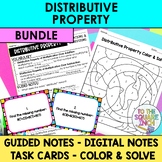
These NO PREP guided notes make teaching and learning the Distributive Property simple, structured, and engaging. With a classroom-tested format, students build confidence as they learn how to apply the Distributive Property to expand and simplify expressions step-by-step — all while focusing on understanding, not just memorization.
Perfect for introducing or reinforcing the concept, this resource includes both full-page printables and interactive notebook versions, allowing students to create a reusable reference tool they can rely on throughout the year.
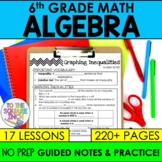
This notes set is designed to help students confidently use and apply the Distributive Property to simplify and rewrite expressions. The resource includes full-page worksheets as well as interactive notebook versions, giving you flexible options for classroom use. Each page breaks down the property through clear examples, visuals, and guided practice, helping students see how multiplication distributes over addition or subtraction.
Aligned to 6.EE.A.3, these notes support students in writing equivalent expressions using the Distributive Property and understanding how algebraic structure can simplify problem solving.
What’s Included
- Warm-Up: A short set of problems to activate prior knowledge about multiplication and addition.
- Important Vocabulary: Student-friendly, fill-in-the-blank definitions of key terms such as term, factor, expression, and Distributive Property.
- Guided Notes: Step-by-step, fill-in-the-blank notes that explain how to apply the Distributive Property to simplify and expand expressions.
- Guided Practice: Scaffolded examples modeling how to distribute coefficients and combine like terms when possible.
- Independent Practice: Targeted problems for students to solve independently to build fluency and confidence.
- Mastery Practice: Real-world and application-based problems that require students to apply the property in context.
- Engage & Extend: Critical thinking prompts such as Think It Through, Which One Doesn’t Belong?, error analysis, and challenge problems.
- Wrap-Up & Summarize: Quick check-in problems and reflection prompts to reinforce understanding.
- Check Your Understanding: Multiple-choice or short-response questions to assess comprehension.
- Vocabulary Frayer Models: Graphic organizers to deepen understanding of essential algebraic terms.
- Performance Task: A short, real-world mini-project with multi-step problems and a grading checklist for easy assessment.
Why Teachers Love These Notes
- 100% NO PREP – just print and go
- Includes interactive notebook format for flexible use
- Builds strong algebra foundations and supports visual learning
- Simplifies a key pre-algebra skill using structured examples
- Perfect for special education and English Language Learners
- Creates a reusable reference tool for homework, review, and assessments
Implementation Tips
- Use the Warm-Up to activate prior knowledge or introduce the concept through discovery.
- Introduce Vocabulary before or after the Guided Notes based on your pacing.
- Model the first Guided Practice example, then gradually release responsibility.
- Assign Independent Practice for reinforcement and fluency.
- Use Engage & Extend for early finishers or enrichment.
- Wrap up with a Quick Check or Exit Ticket to assess mastery.
- Use the Performance Task or Assessment to benchmark student progress.
Here’s what other teachers are saying about this resource:
⭐⭐⭐⭐⭐ Alyssa K. says “These are seriously my favorite notes to use in math. They break the concepts down so well, and the extra practice is great. I tend to quiz my students weekly based on what we are learning and these are perfect for that as well!”
⭐⭐⭐⭐⭐ Belle D. says “Everything is so well organized! I have to teach the distributive property twice in 6th grade, once at the beginning of the year with no variables and then again when we get to algebra with variables. I grabbed both the 5th grade notes (no variables) and the 6th grade notes (with variables) and now my students will be ready to rock both concepts!”
This resource is part of these popular money-saving bundles:
Expressions & Equations Bundle
6th Grade Math Guided Notes Bundle
6th Grade Curriculum
You may also like these other supplemental resources that cover the distributive property:
Additionally, these resources can help reinforce your students understanding of key concepts throughout the year:
6th Grade Math Homework
Full Year Worksheets
Full Year FUN Worksheets
Error Analysis
Guided notes are the foundation of my classroom. Here’s why:
- Guided notes keep all students actively engaged in class. Students follow along and fill in missing words and numbers and answer questions. They allow students to focus on problem solving rather than using their working memory to write down everything they hear the teacher say.
- Students create their own reference guide to help them remember and internalize what they learned in class. They can easily refer back to what they learned in previous classes to help them with spiral review, homework, studying for assessments and most importantly building on prior knowledge to learn new concepts.
- It helps students organize information and understand what is important. Middle school students are often new to the expectation of notetaking and guided notes are a perfect way to introduce this practice and perfect a lifelong skill. The blanks can be used as cues to help students decipher what is expected of them- they can tell if a longer definition should be recorded or a smaller blank means they should write an important vocabulary word or number.
- They relieve the stress that many students feel when expected to accurately copy diagrams, figures and equations off the board. Having them right on their notes page allows them to focus on problem solving and less about accurately copying complex notes off the board.
- Guided notes are especially beneficial for students with special education needs and English Language Learners and can easily be adapted to accommodate specific needs.
Copyright © To The Square Inch LLC
All rights reserved by the author.
Permission to copy for single classroom use only.
