


What others say

Description
A complete 3rd grade math unit covering multiplication and division with conceptual understanding. Discussion, math process skills, deep critical math thinking, and more! Looking to insure that your students UNDERSTAND math concepts? Keep hearing about CGI math but need to know HOW? Needing a way to teach the crucial mathematical process/practice standards? Cognitively-guided, problem-solving based instruction is the key!
This is the UNIT pages only - please check out the bundle that includes bonus content like:
Focus Wall: I Can Statements
Math Writing Prompts
Fact Sheets
Number Sense Warm-ups
For an in-depth video explanation & look into this resource click HERE!
If you're not quite sure, take a look at a lesson FREEBIE -it's lesson 1 from THIS unit! Click here!
Natural math is a lesson plan-resource based upon the research of cognitively-guided math instruction and high-cognitive demand problem solving skills.
*you're downloading a zip file*
The multiplicative reasoning unit has 18 lessons aligned to CCSS and Oklahoma standards. It also aligns to the mathematical process standards found here and the CCSS practice standards found here.
Natural Math is --> lessons that rely upon students' natural curiosity, intuition, and ability to solve. The teacher can help students turn that natural thinking into mathematical content.
Every lesson has 4 KEY COMPONENTS:
1. Review Pages: Once students have obtained a concept, retrieval practice is vital to insure that they are continually accessing that neural pathway. Every lesson has a spiral review "quiz".
2. Number Sense Warm-up: Every math lesson should have an overall number sense component, helping students build their intrinsic number line and think flexibly with numbers. ALL 13 of my math warm-ups are in the multiplicative reasoning unit (and can be bought separately here)
3. High-Cogntive Demand Problem Solving Task: This is one problem that is high-demand and open with multiple entry and exit points. Students will be working with a lot of math content as well as using mathematical practices. Solving these problems is a great way to introduce content, discuss it, and learn it deeply.
4. Content Slides: These are slides that include vocabulary, discussion, problem practice, graphic organizers, and more. Each lesson covers a different skill and is made for the teacher to use openly to meet the needs of their students.
There are 18 lesson in this unit.
WHAT'S COVERED IN THIS UNIT?
Equal Groups & Repeated Addition
Skip Counting & Number Lines
Arrays
Representing Multiplication Problems
Commutative Property
Word Problems
Distributive Property
Division: Size of groups
Division: Number of groups
Fact Families
Multiplication Fact Strategies
-> x0, x1
-> x2, x5
-> x10, x9
-> x3
-> x4
-> x6, x8
-> x7
Associative property
Multiplying 3 factors
Unknown Factor problems
Patterns with Multiplication
Please email aubreeteaches@gmail.com with any questions or comments.
Visit the blog for MORE information on cognitively-guided math or problem solving!
Happy Teaching!
Multiplication Unit: Multiplicative Thinking Lessons-Conceptual Understanding

Highlights


What others say
Save even more with bundles
Description
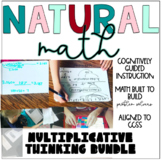
A complete 3rd grade math unit covering multiplication and division with conceptual understanding. Discussion, math process skills, deep critical math thinking, and more! Looking to insure that your students UNDERSTAND math concepts? Keep hearing about CGI math but need to know HOW? Needing a way to teach the crucial mathematical process/practice standards? Cognitively-guided, problem-solving based instruction is the key!
This is the UNIT pages only - please check out the bundle that includes bonus content like:
Focus Wall: I Can Statements
Math Writing Prompts
Fact Sheets
Number Sense Warm-ups
For an in-depth video explanation & look into this resource click HERE!
If you're not quite sure, take a look at a lesson FREEBIE -it's lesson 1 from THIS unit! Click here!
Natural math is a lesson plan-resource based upon the research of cognitively-guided math instruction and high-cognitive demand problem solving skills.
*you're downloading a zip file*
The multiplicative reasoning unit has 18 lessons aligned to CCSS and Oklahoma standards. It also aligns to the mathematical process standards found here and the CCSS practice standards found here.
Natural Math is --> lessons that rely upon students' natural curiosity, intuition, and ability to solve. The teacher can help students turn that natural thinking into mathematical content.
Every lesson has 4 KEY COMPONENTS:
1. Review Pages: Once students have obtained a concept, retrieval practice is vital to insure that they are continually accessing that neural pathway. Every lesson has a spiral review "quiz".
2. Number Sense Warm-up: Every math lesson should have an overall number sense component, helping students build their intrinsic number line and think flexibly with numbers. ALL 13 of my math warm-ups are in the multiplicative reasoning unit (and can be bought separately here)
3. High-Cogntive Demand Problem Solving Task: This is one problem that is high-demand and open with multiple entry and exit points. Students will be working with a lot of math content as well as using mathematical practices. Solving these problems is a great way to introduce content, discuss it, and learn it deeply.
4. Content Slides: These are slides that include vocabulary, discussion, problem practice, graphic organizers, and more. Each lesson covers a different skill and is made for the teacher to use openly to meet the needs of their students.
There are 18 lesson in this unit.
WHAT'S COVERED IN THIS UNIT?
Equal Groups & Repeated Addition
Skip Counting & Number Lines
Arrays
Representing Multiplication Problems
Commutative Property
Word Problems
Distributive Property
Division: Size of groups
Division: Number of groups
Fact Families
Multiplication Fact Strategies
-> x0, x1
-> x2, x5
-> x10, x9
-> x3
-> x4
-> x6, x8
-> x7
Associative property
Multiplying 3 factors
Unknown Factor problems
Patterns with Multiplication
Please email aubreeteaches@gmail.com with any questions or comments.
Visit the blog for MORE information on cognitively-guided math or problem solving!
Happy Teaching!
