TPT
Total:
$0.00
Number Patterns And Shape Patterns Project Based Learning Activity
Share

What others say

"I really liked this resource! I used it for students who were early finishers and they really liked being able to create their own quilt while following a given pattern!"
star
Lilly T.
"My students really enjoyed creating their own patterns! Creating a "quilt" was something new for many of them. "
star
Katherine B.

Description

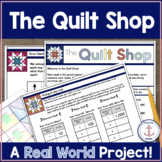
Love project-based learning? Encourage students to apply their learning about number patterns and shape patterns as they open their own quilt shop! This pbl activity takes students beyond a worksheet and creates meaningful learning.

Students use their knowledge of number patterns and shape patterns to open their own pop-up quilt shop!

In this 7 page project students will apply their learning to

  • Identify rules for and complete and extend existing quilt patterns
  • Create quilts using existing pattern examples
  • Use number patterns and function tables to determine profit and cost
  • Design their own quilts and use them to fill out function tables to determine cost and profit
  • Identify and fix errors in both shape and number patterns
  • Create quilts that can be used a beautiful and meaningful math-art project for display!

Skills and topics covered include

  • Increasing / growing patterns
  • Decreasing patterns
  • Number patterns
  • Shape patterns - including rotation
  • Identifying pattern rules
  • Input/Output function tables - one rule
  • Input/output function tables - two rules
  • Error identification

This project also uses

  • Multiplication
  • Addition & Subtraction
  • Critical thinking skills
  • Creativity


Perfect for:

  • Assessment
  • Test Prep
  • Learning Extension
  • Practice
  • Early Finishers

Answer Key and differentiated options included

This project has also been formatted with a TPT EASEL activity to be used digitally.

Products you might also like

Input/Output Function Tables for Google Classroom

Follow me for information about new products, freebies, and information about surprise sales! New products are 20% off for the first 24 hours

Report this resource to TPT
Reported resources will be reviewed by our team. Report this resource to let us know if this resource violates TPT's content guidelines.

Number Patterns And Shape Patterns Project Based Learning Activity

Drop Your Anchor
899 Followers
$3.00

Highlights

Digital downloads
Grades icon
Grades
Standards icon
Standards
Pages
24
Answer Key
Included

What others say

"I really liked this resource! I used it for students who were early finishers and they really liked being able to create their own quilt while following a given pattern!"
star
Lilly T.
"My students really enjoyed creating their own patterns! Creating a "quilt" was something new for many of them. "
star
Katherine B.

Save even more with bundles

This growing bundle is the perfect way to engage your students with real-world applications of math concepts! These products make learning meaningful and no prep is required. The price of this bundle increases as new products are added, so purchase now to guarantee this low price!* This bundle is se
Price $16.40Original Price $20.50Save $4.10
6

Description

Love project-based learning? Encourage students to apply their learning about number patterns and shape patterns as they open their own quilt shop! This pbl activity takes students beyond a worksheet and creates meaningful learning.

Students use their knowledge of number patterns and shape patterns to open their own pop-up quilt shop!

In this 7 page project students will apply their learning to

  • Identify rules for and complete and extend existing quilt patterns
  • Create quilts using existing pattern examples
  • Use number patterns and function tables to determine profit and cost
  • Design their own quilts and use them to fill out function tables to determine cost and profit
  • Identify and fix errors in both shape and number patterns
  • Create quilts that can be used a beautiful and meaningful math-art project for display!

Skills and topics covered include

  • Increasing / growing patterns
  • Decreasing patterns
  • Number patterns
  • Shape patterns - including rotation
  • Identifying pattern rules
  • Input/Output function tables - one rule
  • Input/output function tables - two rules
  • Error identification

This project also uses

  • Multiplication
  • Addition & Subtraction
  • Critical thinking skills
  • Creativity


Perfect for:

  • Assessment
  • Test Prep
  • Learning Extension
  • Practice
  • Early Finishers

Answer Key and differentiated options included

This project has also been formatted with a TPT EASEL activity to be used digitally.

Products you might also like

Input/Output Function Tables for Google Classroom

Follow me for information about new products, freebies, and information about surprise sales! New products are 20% off for the first 24 hours

Report this resource to TPT
Reported resources will be reviewed by our team. Report this resource to let us know if this resource violates TPT's content guidelines.

Reviews

4.5
Rated 4.5 out of 5, based on 18 reviews
18
ratings
5
10
4
7
3
1
2
0
1
0
Mostly used with 4th grade
Reviews
5
12
4
1
3rd
4th
5th
6th
All verified TPT purchases
Great Project
Rated 4 out of 5
April 20, 2026
Met expectations
Great value
Standards-aligned
It was a great activity to assign at the end of the patterns unit, i just wish it was more editable as there were some things that were too advanced for what I needed it for.
Kira F.
194 reviews • Outside the United States
Grades taught: 3rd
A helpful resource
Rated 4 out of 5
January 31, 2026
Thanks for your hard work. My artsy kids really enjoyed this activity.
Danelle F.
244 reviews • Illinois
Grades taught: 4th
Great resource!
Rated 5 out of 5
December 5, 2025
I love using this resource during my centers or small groups!
Meredith T.
99 reviews
Grades taught: 3rd, 4th, 5th
Nice for early finishers
Rated 5 out of 5
November 5, 2025
Met expectations
Great value
Standards-aligned
I really liked this resource! I used it for students who were early finishers and they really liked being able to create their own quilt while following a given pattern!
Lilly T.
4 reviews
Grades taught: 4th
A fun and creative resource
Rated 5 out of 5
October 15, 2025
Met expectations
Great value
Standards-aligned
My students really enjoyed creating their own patterns! Creating a "quilt" was something new for many of them.
Katherine B.
258 reviews • Indiana
Grades taught: 3rd
Student populations: Emerging bilinguals
Rated 4 out of 5
May 23, 2025
My students liked this resource and it did a good job challenging some of my more advanced leaders, while also engaging my students at and below level.
26 reviews
Grades taught: 4th
Rated 5 out of 5
February 21, 2025
Great math and art cross-curricular unit that the students really enjoyed
102 reviews
Grades taught: 3rd, 4th
Rated 5 out of 5
November 26, 2024
This was a great extension to our patterning unit!
Tayler V.
576 reviews
Grades taught: 6th

Questions & Answers

Loading

Standards

to see state-specific standards (only available in the US).
Identify arithmetic patterns (including patterns in the addition table or multiplication table), and explain them using properties of operations. For example, observe that 4 times a number is always even, and explain why 4 times a number can be decomposed into two equal addends.
Generate a number or shape pattern that follows a given rule. Identify apparent features of the pattern that were not explicit in the rule itself. For example, given the rule “Add 3” and the starting number 1, generate terms in the resulting sequence and observe that the terms appear to alternate between odd and even numbers. Explain informally why the numbers will continue to alternate in this way.
Generate two numerical patterns using two given rules. Identify apparent relationships between corresponding terms. Form ordered pairs consisting of corresponding terms from the two patterns, and graph the ordered pairs on a coordinate plane. For example, given the rule “Add 3” and the starting number 0, and given the rule “Add 6” and the starting number 0, generate terms in the resulting sequences, and observe that the terms in one sequence are twice the corresponding terms in the other sequence. Explain informally why this is so.
Loading