


Description
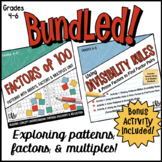
Factors of 100 is a week-long unit that creates a natural bridge from building arrays to establishing patterns with factors and multiples on a 100s table. Students are motivated to find all the factor pairs, as they self-check their work and make corrections, all the while noticing patterns within the table. It's a nice lead-in to division and fractions.
There is built-in homework, computation practice, class discussions, and a final written assessment. It's a good beginning of the year reminder or pre-assessment for 5th & 6th grades, as they articulate the patterns found in the tables.
The unit includes arrays, factor pairs, proper factors, square numbers, prime, composite, abundant, deficient & perfect numbers, as well as multiples.
You will find extensive teaching notes, answer keys, and ideas for uses beyond the initial unit, such as LCM and GCF.
I've used it annually, at the beginning of the year, with my 6th graders as a refresher/reminder of all the pattern connections and vocabulary. I've also used parts of it with high 3rd graders who enjoyed the challenge of figuring out the patterns. The final product makes a year-long reference tool.
CCSS Math 4.OA.B.4, MP1
This unit is also part of the product, Factors of 100 Unit & Using Divisibility Rules Bundle which includes Multiples of 11, a fun extension activity looking for patterns in the multiples of 11.
You might also be interested in my Crack the Code puzzles. These activities offer a fun way to practice a variety of math skills while solving for various quotes.
***************************************************************************
Customer Tips:
How to get TpT credit to use on future purchases:
Please go to your My Purchases page (you may need to log in). Beside each purchase, you’ll see a Provide Feedback button. Simply click it and you will be taken to a page where you can give a quick rating and leave a short comment on the product. Each time you give feedback, TpT gives you feedback credits that you use to lower the cost of your future purchases. I value your feedback greatly, as it helps me determine which products are most valuable for your classroom, so I can create more for you.
Be the first to know about my new discounts, freebies, and product launches:
Look for the green star next to my store logo and click it to become a follower. Voila! You will now receive email updates about this store!
Thanks for stopping by! Pam Kranz
***************************************************************************
© Pamela Kranz Desktop Learning Adventures All Rights Reserved
Patterns with Arrays, Factors, Multiples, Prime & Composites Unit 4.OA.B.4

Highlights


Save even more with bundles
Description
Factors of 100 is a week-long unit that creates a natural bridge from building arrays to establishing patterns with factors and multiples on a 100s table. Students are motivated to find all the factor pairs, as they self-check their work and make corrections, all the while noticing patterns within the table. It's a nice lead-in to division and fractions.
There is built-in homework, computation practice, class discussions, and a final written assessment. It's a good beginning of the year reminder or pre-assessment for 5th & 6th grades, as they articulate the patterns found in the tables.
The unit includes arrays, factor pairs, proper factors, square numbers, prime, composite, abundant, deficient & perfect numbers, as well as multiples.
You will find extensive teaching notes, answer keys, and ideas for uses beyond the initial unit, such as LCM and GCF.
I've used it annually, at the beginning of the year, with my 6th graders as a refresher/reminder of all the pattern connections and vocabulary. I've also used parts of it with high 3rd graders who enjoyed the challenge of figuring out the patterns. The final product makes a year-long reference tool.
CCSS Math 4.OA.B.4, MP1
This unit is also part of the product, Factors of 100 Unit & Using Divisibility Rules Bundle which includes Multiples of 11, a fun extension activity looking for patterns in the multiples of 11.
You might also be interested in my Crack the Code puzzles. These activities offer a fun way to practice a variety of math skills while solving for various quotes.
***************************************************************************
Customer Tips:
How to get TpT credit to use on future purchases:
Please go to your My Purchases page (you may need to log in). Beside each purchase, you’ll see a Provide Feedback button. Simply click it and you will be taken to a page where you can give a quick rating and leave a short comment on the product. Each time you give feedback, TpT gives you feedback credits that you use to lower the cost of your future purchases. I value your feedback greatly, as it helps me determine which products are most valuable for your classroom, so I can create more for you.
Be the first to know about my new discounts, freebies, and product launches:
Look for the green star next to my store logo and click it to become a follower. Voila! You will now receive email updates about this store!
Thanks for stopping by! Pam Kranz
***************************************************************************
© Pamela Kranz Desktop Learning Adventures All Rights Reserved
