TPT
Total:
$0.00
Python Turtle Programming Challenges
Share

Description

Do your students need a little extra help with understanding how to use the turtle to draw patterns using Python programming? Are you looking for some ready to use programming challenges that can be easily incorporated into your lessons?

Download the preview now and see for yourself how useful and flexible this worksheet can be.

HOW CAN THESE PYTHON PROGRAMMING CHALLENGES BE USED?

This worksheet is idea for:

  • A summative assessment task in the classroom
  • A plenary activity
  • A homework task

WHAT IS INCLUDED?

This 2-page PDF printable handout includes:

  • example code,
  • a tasks to read code,
  • a task to correct code and
  • 3 practical challenges for them to practice writing Python code.

You even have a separate PDF with possible answers.

The diversity of these turtle challenges allow pupils to develop a variety of useful programming skills. This resource is perfect for established computer science teachers, non-specialist teachers or newly qualified teachers.

What are you waiting for? Take action straight away and grab your copy of this wonderful worksheet today that will keep your pupils engaged and making real progress. Everything is done for you which will save you hours of preparation time.

Please note: This resource is a non-editable PDF

Don’t miss out on these other essential Python programming challenges to compliment your classroom and give your pupils additional programming practice

Don't forget that leaving feedback earns you points towards FREE TpT purchases.

Also, click here to follow me and be notified when new products are uploaded.

Report this resource to TPT
Reported resources will be reviewed by our team. Report this resource to let us know if this resource violates TPT's content guidelines.

Python Turtle Programming Challenges

Rated 5 out of 5, based on 3 reviews
5.0Β (3 ratings)
Nichola Wilkin
458 Followers
$5.50

Highlights

Grades icon
Grades
8th
Standards icon
Standards
Answer Key
Included

Save even more with bundles

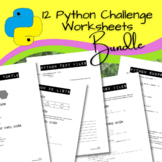
This bundle contains 12 PDF worksheets containing 65 Python coding challenges focusing on specific skills which help pupils to focus on one skill at a time. It also includes 12 PDF worksheets which contain the answers.Download the preview now and see for yourself how useful and flexible this workshe
Price $55.60Original Price $65.00Save $9.40
12

Description

Do your students need a little extra help with understanding how to use the turtle to draw patterns using Python programming? Are you looking for some ready to use programming challenges that can be easily incorporated into your lessons?

Download the preview now and see for yourself how useful and flexible this worksheet can be.

HOW CAN THESE PYTHON PROGRAMMING CHALLENGES BE USED?

This worksheet is idea for:

  • A summative assessment task in the classroom
  • A plenary activity
  • A homework task

WHAT IS INCLUDED?

This 2-page PDF printable handout includes:

  • example code,
  • a tasks to read code,
  • a task to correct code and
  • 3 practical challenges for them to practice writing Python code.

You even have a separate PDF with possible answers.

The diversity of these turtle challenges allow pupils to develop a variety of useful programming skills. This resource is perfect for established computer science teachers, non-specialist teachers or newly qualified teachers.

What are you waiting for? Take action straight away and grab your copy of this wonderful worksheet today that will keep your pupils engaged and making real progress. Everything is done for you which will save you hours of preparation time.

Please note: This resource is a non-editable PDF

Don’t miss out on these other essential Python programming challenges to compliment your classroom and give your pupils additional programming practice

Don't forget that leaving feedback earns you points towards FREE TpT purchases.

Also, click here to follow me and be notified when new products are uploaded.

Report this resource to TPT
Reported resources will be reviewed by our team. Report this resource to let us know if this resource violates TPT's content guidelines.

Reviews

5.0
Rated 5 out of 5, based on 3 reviews
3
ratings
All verified TPT purchases
Rated 5 out of 5
August 11, 2021
A great resource, thank you!
Roxanne H.
1,070 reviews
Grades taught: 9th
Rated 5 out of 5
August 4, 2020
Great resource!
Marti S.
296 reviews
Grades taught: 10th
Rated 5 out of 5
February 25, 2020
many thaks
Karyn L.
197 reviews

Questions & Answers

Loading

Standards

to see state-specific standards (only available in the US).
Follow precisely a multistep procedure when carrying out experiments, taking measurements, or performing technical tasks.
Make sense of problems and persevere in solving them. Mathematically proficient students start by explaining to themselves the meaning of a problem and looking for entry points to its solution. They analyze givens, constraints, relationships, and goals. They make conjectures about the form and meaning of the solution and plan a solution pathway rather than simply jumping into a solution attempt. They consider analogous problems, and try special cases and simpler forms of the original problem in order to gain insight into its solution. They monitor and evaluate their progress and change course if necessary. Older students might, depending on the context of the problem, transform algebraic expressions or change the viewing window on their graphing calculator to get the information they need. Mathematically proficient students can explain correspondences between equations, verbal descriptions, tables, and graphs or draw diagrams of important features and relationships, graph data, and search for regularity or trends. Younger students might rely on using concrete objects or pictures to help conceptualize and solve a problem. Mathematically proficient students check their answers to problems using a different method, and they continually ask themselves, "Does this make sense?" They can understand the approaches of others to solving complex problems and identify correspondences between different approaches.
Use appropriate tools strategically. Mathematically proficient students consider the available tools when solving a mathematical problem. These tools might include pencil and paper, concrete models, a ruler, a protractor, a calculator, a spreadsheet, a computer algebra system, a statistical package, or dynamic geometry software. Proficient students are sufficiently familiar with tools appropriate for their grade or course to make sound decisions about when each of these tools might be helpful, recognizing both the insight to be gained and their limitations. For example, mathematically proficient high school students analyze graphs of functions and solutions generated using a graphing calculator. They detect possible errors by strategically using estimation and other mathematical knowledge. When making mathematical models, they know that technology can enable them to visualize the results of varying assumptions, explore consequences, and compare predictions with data. Mathematically proficient students at various grade levels are able to identify relevant external mathematical resources, such as digital content located on a website, and use them to pose or solve problems. They are able to use technological tools to explore and deepen their understanding of concepts.
Loading