

Description
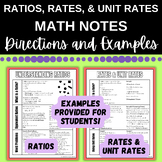
Help middle school students master ratios, rates, and unit rates with these easy-to-follow math notes!
- Step-by-step explanations for ratios, unit rates, and real-world problem solving
- Clear examples with numbers, money, and everyday scenarios
- Perfect for classroom lessons, homework help, or self-study
Make math simple, visual, and fun! Your students will understand how to compare, calculate, and apply ratios and rates in minutes!
FLORIDA BEST STANDARDS in Algebraic Reasoning:
MA.6.AR.3.1 — Given a real-world context, write and interpret ratios to show the relative sizes of two quantities using appropriate notation (a:b, a to b, a/b).
MA.6.AR.3.2 — Given a real-world context, determine a rate for a ratio of quantities with different units. Calculate and interpret the corresponding unit rate.
MA.6.AR.3.3 — Extend previous understanding of fractions and numerical patterns to generate or complete a two- or three-column table to display equivalent part-to-part ratios and part-to-part-to-whole ratios.
MA.6.AR.3.5 — Solve mathematical and real-world problems involving ratios, rates and unit rates, including comparisons, mixtures, ratios of lengths and conversions within the same measurement system.
RATIOS, RATES, UNIT RATE NOTES: Directions & Examples - Quick Reference Page

Highlights


Save even more with bundles

Description
Help middle school students master ratios, rates, and unit rates with these easy-to-follow math notes!
- Step-by-step explanations for ratios, unit rates, and real-world problem solving
- Clear examples with numbers, money, and everyday scenarios
- Perfect for classroom lessons, homework help, or self-study
Make math simple, visual, and fun! Your students will understand how to compare, calculate, and apply ratios and rates in minutes!
FLORIDA BEST STANDARDS in Algebraic Reasoning:
MA.6.AR.3.1 — Given a real-world context, write and interpret ratios to show the relative sizes of two quantities using appropriate notation (a:b, a to b, a/b).
MA.6.AR.3.2 — Given a real-world context, determine a rate for a ratio of quantities with different units. Calculate and interpret the corresponding unit rate.
MA.6.AR.3.3 — Extend previous understanding of fractions and numerical patterns to generate or complete a two- or three-column table to display equivalent part-to-part ratios and part-to-part-to-whole ratios.
MA.6.AR.3.5 — Solve mathematical and real-world problems involving ratios, rates and unit rates, including comparisons, mixtures, ratios of lengths and conversions within the same measurement system.
