


Description
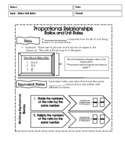
Interactive Notebook pages on ratios, rates, and unit rates. There is a separate practice page for independent practice. Answer key is included. This will be a good introduction for the proportional relationship unit.
Report this resource to TPT
Reported resources will be reviewed by our team. Report this resource to let us know if this resource violates TPT's content guidelines.

Highlights
Digital downloads

Grades
6th - 8th

Subjects

Standards
CCSS6.RP.A.2
CCSS6.RP.A.3b
CCSS7.RP.A.1
Pages
8
Answer Key
Included
Save even more with bundles

Interactive notebook pages covering 7th grade standards on proportional relationships.
Price $6.00Original Price $9.00Save $3.00
4
Description
Interactive Notebook pages on ratios, rates, and unit rates. There is a separate practice page for independent practice. Answer key is included. This will be a good introduction for the proportional relationship unit.
Report this resource to TPT
Reported resources will be reviewed by our team. Report this resource to let us know if this resource violates TPT's content guidelines.
Reviews
This product has not yet been rated.
Questions & Answers
Loading
Standards
to see state-specific standards (only available in the US).
CCSS6.RP.A.2
Understand the concept of a unit rate 𝘢/𝘣 associated with a ratio 𝘢:𝘣 with 𝘣 ≠ 0, and use rate language in the context of a ratio relationship. For example, “This recipe has a ratio of 3 cups of flour to 4 cups of sugar, so there is 3/4 cup of flour for each cup of sugar.” “We paid $75 for 15 hamburgers, which is a rate of $5 per hamburger.”
CCSS6.RP.A.3b
Solve unit rate problems including those involving unit pricing and constant speed. For example, if it took 7 hours to mow 4 lawns, then at that rate, how many lawns could be mowed in 35 hours? At what rate were lawns being mowed?
CCSS7.RP.A.1
Compute unit rates associated with ratios of fractions, including ratios of lengths, areas and other quantities measured in like or different units. For example, if a person walks 1/2 mile in each 1/4 hour, compute the unit rate as the complex fraction ½/¼ miles per hour, equivalently 2 miles per hour.
Loading
