


Description
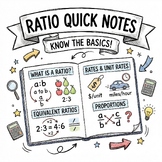
Everything your students need to understand ratios and rates in one cohesive, visual bundle.
This bundle combines two complete reference series — the Ratios collection (Ratios 100–106) and the Rates collection (Rates 100–105) — into a single 13-page visual curriculum that covers every major concept in a 6th grade ratios and rates unit. From defining what a ratio is on day one to comparing unit rates and graphing proportional relationships, this bundle builds understanding progressively and keeps students supported every step of the way.
Each sheet is designed to be visually engaging, clearly organized, and rich enough to stand on its own but together they tell a complete instructional story. Use them to introduce concepts, support independent practice, anchor classroom discussions, or help students review before a test. They work equally well in a math notebook, as a desk reference, or posted as anchor charts.
What's Included:
Ratios Reference Sheets (7 pages)
- Ratios & Rates 100: Key Vocabulary
- Ratios 101: Understanding Ratios
- Ratios 102: Equivalent Ratios
- Ratios 103: Ratio Tables
- Ratios 104: Proportions
- Ratios 105: Comparing Ratios
- Ratios 106: Graphing Ratios
Rates Reference Sheets (6 pages)
- Ratios & Rates 100: Key Vocabulary
- Rates 101: What is a Rate?
- Rates 102: Unit Rate
- Rates 103: Unit Price
- Rates 104: Unit Rate – Speed
- Rates 105: Comparing Unit Rates
Skills Covered:
- Ratio notation, types, and vocabulary
- Equivalent ratios and simplest form
- Ratio tables — scaling up and down
- Proportional relationships and cross multiplication
- Comparing ratios using three methods
- Graphing ratios in the coordinate plane
- Distinguishing ratios from rates
- Calculating unit rates and unit price
- Speed as a unit rate
- Comparing unit rates to find the better buy
- Applying real-world financial literacy contexts
Standards Aligned:
- CCSS 6.RP.A.1 — Understand the concept of a ratio
- CCSS 6.RP.A.2 — Understand the concept of a unit rate
- CCSS 6.RP.A.3 — Use ratio and rate reasoning to solve real-world problems
- CCSS 6.RP.A.3a — Make tables of equivalent ratios
- CCSS 6.RP.A.3b — Solve unit rate problems including unit pricing and constant speed
Perfect for: full unit support, guided notes, independent reference, test prep, interactive notebooks, sub plans, or intervention and enrichment.
Ratios & Rates Visual Reference Bundle | Study Guides | 6th Grade Math

Highlights


Description
Everything your students need to understand ratios and rates in one cohesive, visual bundle.
This bundle combines two complete reference series — the Ratios collection (Ratios 100–106) and the Rates collection (Rates 100–105) — into a single 13-page visual curriculum that covers every major concept in a 6th grade ratios and rates unit. From defining what a ratio is on day one to comparing unit rates and graphing proportional relationships, this bundle builds understanding progressively and keeps students supported every step of the way.
Each sheet is designed to be visually engaging, clearly organized, and rich enough to stand on its own but together they tell a complete instructional story. Use them to introduce concepts, support independent practice, anchor classroom discussions, or help students review before a test. They work equally well in a math notebook, as a desk reference, or posted as anchor charts.
What's Included:
Ratios Reference Sheets (7 pages)
- Ratios & Rates 100: Key Vocabulary
- Ratios 101: Understanding Ratios
- Ratios 102: Equivalent Ratios
- Ratios 103: Ratio Tables
- Ratios 104: Proportions
- Ratios 105: Comparing Ratios
- Ratios 106: Graphing Ratios
Rates Reference Sheets (6 pages)
- Ratios & Rates 100: Key Vocabulary
- Rates 101: What is a Rate?
- Rates 102: Unit Rate
- Rates 103: Unit Price
- Rates 104: Unit Rate – Speed
- Rates 105: Comparing Unit Rates
Skills Covered:
- Ratio notation, types, and vocabulary
- Equivalent ratios and simplest form
- Ratio tables — scaling up and down
- Proportional relationships and cross multiplication
- Comparing ratios using three methods
- Graphing ratios in the coordinate plane
- Distinguishing ratios from rates
- Calculating unit rates and unit price
- Speed as a unit rate
- Comparing unit rates to find the better buy
- Applying real-world financial literacy contexts
Standards Aligned:
- CCSS 6.RP.A.1 — Understand the concept of a ratio
- CCSS 6.RP.A.2 — Understand the concept of a unit rate
- CCSS 6.RP.A.3 — Use ratio and rate reasoning to solve real-world problems
- CCSS 6.RP.A.3a — Make tables of equivalent ratios
- CCSS 6.RP.A.3b — Solve unit rate problems including unit pricing and constant speed
Perfect for: full unit support, guided notes, independent reference, test prep, interactive notebooks, sub plans, or intervention and enrichment.
