TPT
Total:
$0.00
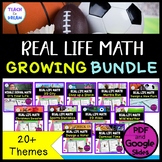
Real World Math Mini Projects | Year Long Math Bundle PBL Grades 4th 5th 6th 7th
Share

What others say

"My students enjoyed this resource. We used this resource to help them to better understand our curriculum."
star
Nicol F.

Description

Make math skills more exciting with these extensive range of Math PBL activities. The growing bundle of real life mini math projects has been developed to be completed by teachers that have limited time. Each Math project covers a range of math skills and provides students with the opportunity to transfer their knowledge. It has been designed for students in grades 3 to 7. (Mostly for 4-7).

Each math project is designed to run between 3-5 lessons (excluding 'It's Your Life' - 10 lessons) depending on how much time you wish to allocate to the tasks.

The projects are easy to follow and can either be teacher run or student driven.

By purchasing this BUNDLE YOU ARE SAVING 30% OFF the individual price of each resource. You will also receive one math choice board FREE in this bundle pack.

Each Project in this resource includes:

✔ Student Project page with task and requirements.

✔ Teacher assessment

✔ Self/ peer assessment

✔ Working out/ design pages

** Suitable for both USA and UK/ AUS classroom.

Titles of resources currently included in this bundle (18+ resources):

  • Real world math project - It's Your Life
  • 2D alien toys (2D shapes)
  • 3D city (3D shapes)
  • Dine at mine (Money, budgeting)
  • Marble run (angles, measurement)
  • Shop up a storm (money, percentages, budgeting)
  • Sports Statistics (mean, median and mode)
  • Design a hotel (money, multiplication, area)
  • Wild Weather (data collection, graphing)
  • Famous Landmarks (measurement, angles, 2D & 3D shapes)
  • Dream Bedroom (perimeter, area)
  • Design a new park (data collection, measurement, multiplication)
  • Fancy Feast (money, budgeting)
  • Plan a Party (money, budgeting)
  • Zoo Days (timetable, 24 hour time, time duration)
  • Carnival Time (money, time, budgeting)
  • Marble Maze/ obstacle course (angles, measurement)
  • Crazy Christmas Sweater (2D shapes, geometry)
  • New World (co-ordinates)
  • Coordinate City (co-ordinates)

This project can be used in many ways, including:

1. At the end of a unit of work to test knowledge.

2. Fun Friday Math lessons.

3. Group work

4. For fast finishers

5. Fun projects for students to complete for homework.

BUY the BUNDLE and SAVE 30%!!

~~~~~~~~~~~~~~~~~~~~~~~~~~~~~~~~~~~~~~~~~~~~~~~~~~~~~~~~~~~~~~~~

You may also be interested in the following resources:

Do your students love to hear about what you get up to outside of school? Have fun with these projects that have students completing MATH to help you solve daily issues; help plan a pizza party, create some pixel art, design a guest house and more!

START OF THE YEAR RESOURCES

LITERACY

MIDDLE SCHOOL PROJECTS

TEACHERS LIKE YOU SAID…

⭐️⭐️⭐️⭐️⭐️ Grey's. G says, "This gave me a starting point for enrichment math projects for my students both online and in person, and everything in between. What a year! But having resources like this help with our transitions back and forth."

⭐️⭐️⭐️⭐️⭐️ Hema. T says, "I am planning for next year and I find this resource really helpful to achieve my goal to create fun and engaging lessons. Thanks."

⭐️⭐️⭐️⭐️⭐️ Shawna. W says, "Authentic and engaging activities."

*I really value your feedback*

I try to go over the work carefully to ensure no errors, however, occasionally I might miss something. If you find an error please email me and I will fix it straight away. Thanks!

Report this resource to TPT
Reported resources will be reviewed by our team. Report this resource to let us know if this resource violates TPT's content guidelines.

Real World Math Mini Projects | Year Long Math Bundle PBL Grades 4th 5th 6th 7th

Teach to Dream
2.1k Followers
$54.25
$77.50
SAVE
$23.25

Highlights

Grades icon
Grades
4th - 7th
Standards icon
Standards

What others say

"My students enjoyed this resource. We used this resource to help them to better understand our curriculum."
star
Nicol F.

Description

Make math skills more exciting with these extensive range of Math PBL activities. The growing bundle of real life mini math projects has been developed to be completed by teachers that have limited time. Each Math project covers a range of math skills and provides students with the opportunity to transfer their knowledge. It has been designed for students in grades 3 to 7. (Mostly for 4-7).

Each math project is designed to run between 3-5 lessons (excluding 'It's Your Life' - 10 lessons) depending on how much time you wish to allocate to the tasks.

The projects are easy to follow and can either be teacher run or student driven.

By purchasing this BUNDLE YOU ARE SAVING 30% OFF the individual price of each resource. You will also receive one math choice board FREE in this bundle pack.

Each Project in this resource includes:

✔ Student Project page with task and requirements.

✔ Teacher assessment

✔ Self/ peer assessment

✔ Working out/ design pages

** Suitable for both USA and UK/ AUS classroom.

Titles of resources currently included in this bundle (18+ resources):

  • Real world math project - It's Your Life
  • 2D alien toys (2D shapes)
  • 3D city (3D shapes)
  • Dine at mine (Money, budgeting)
  • Marble run (angles, measurement)
  • Shop up a storm (money, percentages, budgeting)
  • Sports Statistics (mean, median and mode)
  • Design a hotel (money, multiplication, area)
  • Wild Weather (data collection, graphing)
  • Famous Landmarks (measurement, angles, 2D & 3D shapes)
  • Dream Bedroom (perimeter, area)
  • Design a new park (data collection, measurement, multiplication)
  • Fancy Feast (money, budgeting)
  • Plan a Party (money, budgeting)
  • Zoo Days (timetable, 24 hour time, time duration)
  • Carnival Time (money, time, budgeting)
  • Marble Maze/ obstacle course (angles, measurement)
  • Crazy Christmas Sweater (2D shapes, geometry)
  • New World (co-ordinates)
  • Coordinate City (co-ordinates)

This project can be used in many ways, including:

1. At the end of a unit of work to test knowledge.

2. Fun Friday Math lessons.

3. Group work

4. For fast finishers

5. Fun projects for students to complete for homework.

BUY the BUNDLE and SAVE 30%!!

~~~~~~~~~~~~~~~~~~~~~~~~~~~~~~~~~~~~~~~~~~~~~~~~~~~~~~~~~~~~~~~~

You may also be interested in the following resources:

Do your students love to hear about what you get up to outside of school? Have fun with these projects that have students completing MATH to help you solve daily issues; help plan a pizza party, create some pixel art, design a guest house and more!

START OF THE YEAR RESOURCES

LITERACY

MIDDLE SCHOOL PROJECTS

TEACHERS LIKE YOU SAID…

⭐️⭐️⭐️⭐️⭐️ Grey's. G says, "This gave me a starting point for enrichment math projects for my students both online and in person, and everything in between. What a year! But having resources like this help with our transitions back and forth."

⭐️⭐️⭐️⭐️⭐️ Hema. T says, "I am planning for next year and I find this resource really helpful to achieve my goal to create fun and engaging lessons. Thanks."

⭐️⭐️⭐️⭐️⭐️ Shawna. W says, "Authentic and engaging activities."

*I really value your feedback*

I try to go over the work carefully to ensure no errors, however, occasionally I might miss something. If you find an error please email me and I will fix it straight away. Thanks!

Report this resource to TPT
Reported resources will be reviewed by our team. Report this resource to let us know if this resource violates TPT's content guidelines.

Reviews

4.6
Rated 4.62 out of 5, based on 17 reviews
17
ratings
5
13
4
3
3
0
2
0
1
1
Grades used with
Reviews
2
1
3
5
6
4
3rd
4th
5th
6th
7th
8th
All verified TPT purchases
Rated 5 out of 5
June 30, 2025
My students enjoyed this resource. We used this resource to help them to better understand our curriculum.
Nicol F.
133 reviews
Grades taught: 5th
Rated 5 out of 5
May 14, 2025
Great thing to use and it was something fun to do with my kids
Erin P.
635 reviews
Grades taught: 6th, 8th
Rated 1 out of 5
March 12, 2023
I really misunderstood this package. I saw that this was most frequently used with 7th grade students (I should note it clearly states grades 3-6). I really can't imagine that. I've spent the morning combing through each lesson (about 1/3 seem to be corrupted-they close after about 2 seconds, not allowing me to view them). There isn't a single lesson I can use with my 7th graders. For me, this was extremely disappointing, and I would not recommend this bundle. This purchase has turned into a donation, as I won't get any use from it at all.
Matt R.
1 review
Teach to Dream
Response from
Teach to Dream
(TPT Seller)
Apr 18, 2023
Hi Matt, As much as no-one else has had issues with opening the resources, and I just double checked by downloading them again, I have feel that if you are not able to use any of the products it is no benefit for you to have the bundle. Could you please reach out to TPT and show them this response to allow you to get a refund for your purchase. Hopefully you will be able to find resources for your Grade 7s, and it has also inspired me to create a range for grades 6-8 down the track. Thanks, Teach to Dream
Rated 5 out of 5
January 27, 2023
I liked how it gave real life problems for students to apply what they have learnt.
H K.
329 reviews
Grades taught: 3rd
Rated 5 out of 5
October 29, 2022
My students completed one of these activities, thus far. They work in teams and are successful with the activities. They also stay very engaged during class!
Leginia O.
169 reviews
Grades taught: 7th, 8th
Rated 5 out of 5
September 8, 2022
Great product!
Stanley S.
8 reviews
Grades taught: 7th
Student populations: Learning difficulties
Rated 4 out of 5
March 10, 2022
Finally a resource that interests my non-college bound students. Many of my students are either at risk or dislike school. These activities made sense to them. They weren't asking, "Why do we need to know this?"
Lisa T.
441 reviews
Grades taught: 6th, 7th, 8th
Rated 5 out of 5
November 14, 2021
Great resource! We love projects!
Joanne O.
196 reviews
Grades taught: 3rd, 4th

Questions & Answers

Loading

Standards

to see state-specific standards (only available in the US).
Make sense of problems and persevere in solving them. Mathematically proficient students start by explaining to themselves the meaning of a problem and looking for entry points to its solution. They analyze givens, constraints, relationships, and goals. They make conjectures about the form and meaning of the solution and plan a solution pathway rather than simply jumping into a solution attempt. They consider analogous problems, and try special cases and simpler forms of the original problem in order to gain insight into its solution. They monitor and evaluate their progress and change course if necessary. Older students might, depending on the context of the problem, transform algebraic expressions or change the viewing window on their graphing calculator to get the information they need. Mathematically proficient students can explain correspondences between equations, verbal descriptions, tables, and graphs or draw diagrams of important features and relationships, graph data, and search for regularity or trends. Younger students might rely on using concrete objects or pictures to help conceptualize and solve a problem. Mathematically proficient students check their answers to problems using a different method, and they continually ask themselves, "Does this make sense?" They can understand the approaches of others to solving complex problems and identify correspondences between different approaches.
Construct viable arguments and critique the reasoning of others. Mathematically proficient students understand and use stated assumptions, definitions, and previously established results in constructing arguments. They make conjectures and build a logical progression of statements to explore the truth of their conjectures. They are able to analyze situations by breaking them into cases, and can recognize and use counterexamples. They justify their conclusions, communicate them to others, and respond to the arguments of others. They reason inductively about data, making plausible arguments that take into account the context from which the data arose. Mathematically proficient students are also able to compare the effectiveness of two plausible arguments, distinguish correct logic or reasoning from that which is flawed, and-if there is a flaw in an argument-explain what it is. Elementary students can construct arguments using concrete referents such as objects, drawings, diagrams, and actions. Such arguments can make sense and be correct, even though they are not generalized or made formal until later grades. Later, students learn to determine domains to which an argument applies. Students at all grades can listen or read the arguments of others, decide whether they make sense, and ask useful questions to clarify or improve the arguments.
Model with mathematics. Mathematically proficient students can apply the mathematics they know to solve problems arising in everyday life, society, and the workplace. In early grades, this might be as simple as writing an addition equation to describe a situation. In middle grades, a student might apply proportional reasoning to plan a school event or analyze a problem in the community. By high school, a student might use geometry to solve a design problem or use a function to describe how one quantity of interest depends on another. Mathematically proficient students who can apply what they know are comfortable making assumptions and approximations to simplify a complicated situation, realizing that these may need revision later. They are able to identify important quantities in a practical situation and map their relationships using such tools as diagrams, two-way tables, graphs, flowcharts and formulas. They can analyze those relationships mathematically to draw conclusions. They routinely interpret their mathematical results in the context of the situation and reflect on whether the results make sense, possibly improving the model if it has not served its purpose.
Loading