TPT
Total:
$0.00
Roller Coaster Force and Motion PBL | Project Based Learning Science Enrichment
Share

Description

Looking for a fun and engaging way to teach about different force and motion or Newton's Laws of Motion?

This project allows students to learn about friction, interia, gravity, speed, momentum, and much more by designing their own roller coaster!

What is project based learning?

Project Based Learning (PBL) is a hands-on way for students to learn as they design, build, and/or research a solution to reach the project's goal or a solution.

The project is broken into parts so students can easily stay on track. An instruction and note taking page are included. The product also includes a rubric, peer review forms, and pictures of student's examples.

Here's how it works:

In this project they will imagine, design, and create a marble roller coaster by examining the different factors that will make the marble roll over two hills.

Topics in this product include:

  • force
  • motion
  • friction
  • interia
  • gravity
  • speed
  • momentum

Options for uses:

Since the instructions are so easy for students to understand, it can be given to students who need may not need direct instruction, homework, used as sub plans, maternity leave plans, or test prep.

Please Note:

  • If you need suggestions or advice, reach out to me on Instragram @blossom.curiosity
Report this resource to TPT
Reported resources will be reviewed by our team. Report this resource to let us know if this resource violates TPT's content guidelines.

Roller Coaster Force and Motion PBL | Project Based Learning Science Enrichment

$5.00

Highlights

Digital downloads
Standards icon
Standards
Pages
6
Answer Key
Rubric only

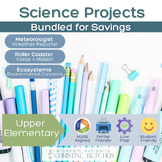
Save even more with bundles

Project/problem based learning is a great way to teach science and have your students learn through discovery. This bundle includes PBLs that teach force and motion, ecosystems, and meteorology. In the force and motion PBL, students design a roller coaster to illustrate different key content vocabul
Price $12.50Original Price $15.50Save $3.00
3

Description

Looking for a fun and engaging way to teach about different force and motion or Newton's Laws of Motion?

This project allows students to learn about friction, interia, gravity, speed, momentum, and much more by designing their own roller coaster!

What is project based learning?

Project Based Learning (PBL) is a hands-on way for students to learn as they design, build, and/or research a solution to reach the project's goal or a solution.

The project is broken into parts so students can easily stay on track. An instruction and note taking page are included. The product also includes a rubric, peer review forms, and pictures of student's examples.

Here's how it works:

In this project they will imagine, design, and create a marble roller coaster by examining the different factors that will make the marble roll over two hills.

Topics in this product include:

  • force
  • motion
  • friction
  • interia
  • gravity
  • speed
  • momentum

Options for uses:

Since the instructions are so easy for students to understand, it can be given to students who need may not need direct instruction, homework, used as sub plans, maternity leave plans, or test prep.

Please Note:

  • If you need suggestions or advice, reach out to me on Instragram @blossom.curiosity
Report this resource to TPT
Reported resources will be reviewed by our team. Report this resource to let us know if this resource violates TPT's content guidelines.

Reviews

4.8
Rated 4.81 out of 5, based on 21 reviews
21
ratings
5
18
4
2
3
0
2
1
1
0
Mostly used with 4th and 5th grades
Reviews
3
4
2
2
2
4th
5th
6th
7th
8th
All verified TPT purchases
Project Based Learning
Rated 5 out of 5
October 1, 2025
Met expectations
Great value
Standards-aligned
This was a great and engaging project to do with my students. We loved this!
Nicole G.
537 reviews • Kansas
Grades taught: 7th, 8th
Student populations: Autism, Learning difficulties, Mild to severe disabilities
Rated 5 out of 5
December 26, 2024
My students loved working on and completing this PBL.
Amanda H.
657 reviews
Grades taught: 8th
Student populations: Learning difficulties
Rated 5 out of 5
February 26, 2024
My students loved this resource. This provided great variety for all students.
Madison T.
16 reviews
Grades taught: 4th
Student populations: Learning difficulties
Rated 5 out of 5
January 18, 2024
My students love this opportunity for hands on learning!
Saudia M.
229 reviews
Grades taught: 4th
Rated 5 out of 5
October 30, 2023
This activity is perfect for our science unit on force and motion. I love that it's a realistic view of this abstract science concept!
Elizabeth C.
313 reviews
Grades taught: 4th
Rated 5 out of 5
February 12, 2023
Great resource for students whose first language is not English. It allowed my students to stay engaged.
187 reviews
Grades taught: 6th
Student populations: Emerging bilinguals
Rated 5 out of 5
February 9, 2022
My students had a blast building and creating their rollercoasters to finish off the year in science.
Elise Erickson
(TPT Seller)
247 reviews
Grades taught: 5th
Rated 5 out of 5
November 22, 2020
My students had so much fun creating their roller coasters! It was a perfect way to wrap up our force and motion unit!
Emily M.
384 reviews
Grades taught: 5th

Questions & Answers

Loading

Standards

to see state-specific standards (only available in the US).
NGSS3-PS2-1
Plan and conduct an investigation to provide evidence of the effects of balanced and unbalanced forces on the motion of an object. Examples could include an unbalanced force on one side of a ball can make it start moving; and, balanced forces pushing on a box from both sides will not produce any motion at all. Assessment is limited to one variable at a time: number, size, or direction of forces. Assessment does not include quantitative force size, only qualitative and relative. Assessment is limited to gravity being addressed as a force that pulls objects down.
NGSS3-5-ETS1-3
Plan and carry out fair tests in which variables are controlled and failure points are considered to identify aspects of a model or prototype that can be improved.
NGSSMS-PS2-4
Construct and present arguments using evidence to support the claim that gravitational interactions are attractive and depend on the masses of interacting objects. Examples of evidence for arguments could include data generated from simulations or digital tools; and charts displaying mass, strength of interaction, distance from the Sun, and orbital periods of objects within the solar system. Assessment does not include Newton’s Law of Gravitation or Kepler’s Laws.
Loading