


What others say

Description
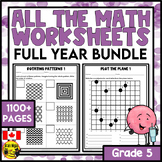
Practice or assess Grade 5 outcomes with the Saskatchewan Math Curriculum. Use these math worksheets for practice, review, or assessment. They only take moments to prep and make differentiation a snap. Your whole year is here!
This time-saving resource includes:
- 550+ different pages about Grade 5 math concepts from the Saskatchewan Math Curriculum.
- pages that can easily be used as assessments.
- colouring pages to reinforce most activities.
- word problems for some of the concepts.
- answer keys or suggested answers for all the pages.
- Canadian/British spellings and metric measurements.
- SI Notation, so numbers are written with spaces between place values instead of commas. (Example: 2 000 instead of 2,000).
- number concepts: Place Value to 100 000, Place Value to 100 000, Comparing and Ordering Numbers to 100 000, Comparing and Ordering Numbers to 1 000 000, Rounding Numbers within 100 000, Rounding Numbers within 1 000 000,
- number operations: Estimation Strategies for All Operations, Multiples, Multiplication (2 by 2 Digit), Division of 3 by 1 Digit Without Remainders, Division of 3 by 1 Digit With Remainders
- financial literacy: Recording Canadian Money to $1 000 which includes English and French notation, Adding and Subtracting Money
- decimals and fractions: Representing Decimals to Thousandths, Adding and Subtracting Decimals to Thousandths, Representing Proper Fractions, Relating Fractions and Decimals to Thousandths, Equivalent Fractions, Simplifying Fractions, Comparing and Ordering Fractions With Uncommon Denominators, Comparing Decimals to Thousandths
- pattern and algebra: Describing and Extending number patterns in Sequences, Describing and Extending number patterns in Tables, Solving One-Step Equations for the Value of an Unknown Variable.
- statistics and probability: reading and creating double bar graphs, describing and predicting probability outcomes with words like certain, impossible, possible, more likely, less likely and equally likely.
- measurement: perimeter, area, comparing area and perimeter, measuring length, calculating the volume of rectangular prisms, and capacity. All the measurements use the metric system.
- geometry: types of lines (parallel, perpendicular, intersecting, diagonal, horizontal, vertical), names of polygons (triangles, quadrilaterals, pentagons, hexagons, octagons) and attributes including congruent sides, lines of symmetry, number of sides, vertices and types of lines (parallel sides, perpendicular sides), names and attributes of quadrilaterals (parallelograms, rectangles, squares, rhombuses, kites, trapezoids), attributes of prisms and pyramids including faces, edges, vertices, planes of symmetry and types of lines, identifying transformations including translations (slides), rotations (turns) and reflections (flips)
Ninja Note: This resource was not designed with Easel by TpT in mind. It works best when printed.
This set aligns with:
- Saskatchewan Mathematics Curriculum Grade 5
We use these worksheets to support our lessons:
- Grade 4/5 Full Year Interactive Math Notebook
- Grade 5 Full Year Interactive Math Notebook
- Grade 5/6 Full Year Interactive Math Notebook
Teaching in a different province?
Not sure if this is the set you need? Download our free math alignment guide.
FOLLOW US TO GET THE LATEST!
Please let us know how this resource works for you by rating it or providing comments. You'll get TpT credits to use toward future purchases.
Find us on social media: Instagram, Facebook or our website.
Thank you for your consideration! Happy teaching Grade 5 Math in Saskatchewan from the Brain Ninjas!
Highlights


What others say
Save even more with bundles

Description
Practice or assess Grade 5 outcomes with the Saskatchewan Math Curriculum. Use these math worksheets for practice, review, or assessment. They only take moments to prep and make differentiation a snap. Your whole year is here!
This time-saving resource includes:
- 550+ different pages about Grade 5 math concepts from the Saskatchewan Math Curriculum.
- pages that can easily be used as assessments.
- colouring pages to reinforce most activities.
- word problems for some of the concepts.
- answer keys or suggested answers for all the pages.
- Canadian/British spellings and metric measurements.
- SI Notation, so numbers are written with spaces between place values instead of commas. (Example: 2 000 instead of 2,000).
- number concepts: Place Value to 100 000, Place Value to 100 000, Comparing and Ordering Numbers to 100 000, Comparing and Ordering Numbers to 1 000 000, Rounding Numbers within 100 000, Rounding Numbers within 1 000 000,
- number operations: Estimation Strategies for All Operations, Multiples, Multiplication (2 by 2 Digit), Division of 3 by 1 Digit Without Remainders, Division of 3 by 1 Digit With Remainders
- financial literacy: Recording Canadian Money to $1 000 which includes English and French notation, Adding and Subtracting Money
- decimals and fractions: Representing Decimals to Thousandths, Adding and Subtracting Decimals to Thousandths, Representing Proper Fractions, Relating Fractions and Decimals to Thousandths, Equivalent Fractions, Simplifying Fractions, Comparing and Ordering Fractions With Uncommon Denominators, Comparing Decimals to Thousandths
- pattern and algebra: Describing and Extending number patterns in Sequences, Describing and Extending number patterns in Tables, Solving One-Step Equations for the Value of an Unknown Variable.
- statistics and probability: reading and creating double bar graphs, describing and predicting probability outcomes with words like certain, impossible, possible, more likely, less likely and equally likely.
- measurement: perimeter, area, comparing area and perimeter, measuring length, calculating the volume of rectangular prisms, and capacity. All the measurements use the metric system.
- geometry: types of lines (parallel, perpendicular, intersecting, diagonal, horizontal, vertical), names of polygons (triangles, quadrilaterals, pentagons, hexagons, octagons) and attributes including congruent sides, lines of symmetry, number of sides, vertices and types of lines (parallel sides, perpendicular sides), names and attributes of quadrilaterals (parallelograms, rectangles, squares, rhombuses, kites, trapezoids), attributes of prisms and pyramids including faces, edges, vertices, planes of symmetry and types of lines, identifying transformations including translations (slides), rotations (turns) and reflections (flips)
Ninja Note: This resource was not designed with Easel by TpT in mind. It works best when printed.
This set aligns with:
- Saskatchewan Mathematics Curriculum Grade 5
We use these worksheets to support our lessons:
- Grade 4/5 Full Year Interactive Math Notebook
- Grade 5 Full Year Interactive Math Notebook
- Grade 5/6 Full Year Interactive Math Notebook
Teaching in a different province?
Not sure if this is the set you need? Download our free math alignment guide.
FOLLOW US TO GET THE LATEST!
Please let us know how this resource works for you by rating it or providing comments. You'll get TpT credits to use toward future purchases.
Find us on social media: Instagram, Facebook or our website.
Thank you for your consideration! Happy teaching Grade 5 Math in Saskatchewan from the Brain Ninjas!
Reviews

Thank you for your feedback. We truly appreciate hearing about how this resource helped you and kept your students engaged. Thanks!
