


Description
This resource includes six half pages of notes that are perfect for interactive notebooks. The first three pages introduce students to positive, negative or no correlation scatter plots. Students are asked to describe real world situations that might exist for each type of correlation. Students will graph three different sets of data in order to visualize the different types of scatterplots. Definitions for the line of best fit and correlation coefficient are provided. Each one of the half pages asks students to describe the relationship that exists between the two variables. Additional pages of notes focus on the strength of the correlation coefficient, writing an equation for the line of best fit and linear vs. non linear scatterplots.
The following related resources are also available for purchase.
Scatter Plot Mini - Bundle
Scatter Plot Worksheet
Scatter Plot Matching Activity
Leaving feedback will earn you credits for future TPT resources. Follow me to receive discounts for the first 24 hours on new resources.
Please contact me if you have any questions. The Clever Clover
Connect with me on social media!
The Clever Clover - Pinterest
The Clever Clover - Instagram
The Clever Clover - Facebook
The following related resources are also available for purchase.
Scatter Plot Mini - Bundle
Scatter Plot Worksheet
Scatter Plot Matching Activity
Leaving feedback will earn you credits for future TPT resources. Follow me to receive discounts for the first 24 hours on new resources.
Please contact me if you have any questions. The Clever Clover
Connect with me on social media!
The Clever Clover - Pinterest
The Clever Clover - Instagram
The Clever Clover - Facebook
Report this resource to TPT
Reported resources will be reviewed by our team. Report this resource to let us know if this resource violates TPT's content guidelines.
$2.00
Highlights
Digital downloads

Grades
6th - 9th, Adult Education

Subjects

Standards
CCSS8.SP.A.1
CCSS8.SP.A.2
CCSS8.SP.A.3
Pages
3 + answer keys
Answer Key
Included
Teaching Duration
3 days
Save even more with bundles
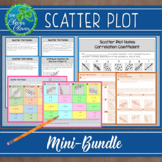
This resource includes six half pages of notes that are perfect for interactive notebooks. The first three pages introduce students to positive, negative and no correlation scatter plots. Students are asked to describe real world situations that might exist for each type of correlation. Students wi
Price $4.50Original Price $5.00Save $0.50
3

Are your kids studying the measures of central tendency, box and whisker plots, stem and leaf plots, two-way tables, histograms and scatter plots? This valuable resource includes guided notes, worksheets, scavenger hunts, assessments and more that you can use for your statistics unit. Below you will
Price $20.80Original Price $26.00Save $5.20
9
Description
This resource includes six half pages of notes that are perfect for interactive notebooks. The first three pages introduce students to positive, negative or no correlation scatter plots. Students are asked to describe real world situations that might exist for each type of correlation. Students will graph three different sets of data in order to visualize the different types of scatterplots. Definitions for the line of best fit and correlation coefficient are provided. Each one of the half pages asks students to describe the relationship that exists between the two variables. Additional pages of notes focus on the strength of the correlation coefficient, writing an equation for the line of best fit and linear vs. non linear scatterplots.
The following related resources are also available for purchase.
Scatter Plot Mini - Bundle
Scatter Plot Worksheet
Scatter Plot Matching Activity
Leaving feedback will earn you credits for future TPT resources. Follow me to receive discounts for the first 24 hours on new resources.
Please contact me if you have any questions. The Clever Clover
Connect with me on social media!
The Clever Clover - Pinterest
The Clever Clover - Instagram
The Clever Clover - Facebook
The following related resources are also available for purchase.
Scatter Plot Mini - Bundle
Scatter Plot Worksheet
Scatter Plot Matching Activity
Leaving feedback will earn you credits for future TPT resources. Follow me to receive discounts for the first 24 hours on new resources.
Please contact me if you have any questions. The Clever Clover
Connect with me on social media!
The Clever Clover - Pinterest
The Clever Clover - Instagram
The Clever Clover - Facebook
Report this resource to TPT
Reported resources will be reviewed by our team. Report this resource to let us know if this resource violates TPT's content guidelines.
Reviews
All verified TPT purchases
Scatter Plot Notes are a concise guide to understanding and effectively using scatter plots in data analysis.
These notes offer clear explanations of how to create, interpret, and analyze scatter plots.
The inclusion of practical examples enhances comprehension, allowing students or learners to connect theory with real-world data visualization.
In summary, Scatter Plot Notes are a valuable resource for anyone looking to understand and utilize scatter plots as a powerful tool for visualizing and analyzing data.
These notes provided a nice visual for learning about scatterplots. I like that my students learned to create the scatterplot as well as investigate the relationship between the variables.
A PERFECT resource for practice... this is fun and not traditional worksheet.
Clear and easy to use!
Great resource for their notebooks!
I used these notes to cover linear and non - linear graphs.
There were some important concepts missing

Sheri,
Thank you for your review. Which important concepts are missing? Did you read the description before purchasing the resource? Did you look at the thumbnails? Please send me an email at clever.clover17@gmail.com. I would like to know what you think is missing from this $2 resource. Thank you!
Good resource!
Questions & Answers
Loading
Standards
to see state-specific standards (only available in the US).
CCSS8.SP.A.1
Construct and interpret scatter plots for bivariate measurement data to investigate patterns of association between two quantities. Describe patterns such as clustering, outliers, positive or negative association, linear association, and nonlinear association.
CCSS8.SP.A.2
Know that straight lines are widely used to model relationships between two quantitative variables. For scatter plots that suggest a linear association, informally fit a straight line, and informally assess the model fit by judging the closeness of the data points to the line.
CCSS8.SP.A.3
Use the equation of a linear model to solve problems in the context of bivariate measurement data, interpreting the slope and intercept. For example, in a linear model for a biology experiment, interpret a slope of 1.5 cm/hr as meaning that an additional hour of sunlight each day is associated with an additional 1.5 cm in mature plant height.
Loading
