


Description
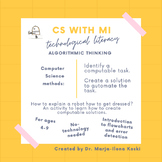
This activity teaches the learner to think daily tasks in a way that it would be possible for a robot to execute them. The activity turns getting dressed into a computing problem by asking the learner to identify a computable task and to come up with an answer to automate the task.
With this activity, the learner starts to think in terms of programmable units. Using a flowchart as a means, the learner presents his/her thinking and algorithmic solution. Furthermore, the activity can be used as an introduction to error detection.
This digital copy includes six printable pages with detailed instructions for the activity and materials for completing the activity as well as additional exercises for the older children.
Notes to the Teacher:
Please pay attention to what the learner can do. The activity gradually increases in the level of abstraction. For younger learners (pre-K and K), two first sheets give an idea of algorithmic thinking. The first flowchart can be done in the form of a discussion with them. An optional activity is for grade 4 (and above).
A flowchart is merely an example way to demonstrate thinking. If the learner doesn't use diamond and oval shapes correctly, it doesn't devalue the answer. If the activity is broken into meaningful, executable tasks, it is evidence of algorithmic thinking.
I’m trying to keep the downloadable file as small and printer-friendly as possible, hence the minimal look.
Also, the point in all my activities is in the thinking process. You can call this Technological Literacy or Computational Thinking or Systems Thinking. The point is that I want to move children from being passive technology users to active (technology) problem-solvers. I value thinking skills above using the right terminology, especially with children from the age range I’m developing this material for.
In the materials, you’ll find questions to start a discussion. It is important to ignite thinking rather than getting the correct answer. The activity is a success when after completing it, a child looks at the world he/she is living in from a new perspective.
CSTA K-12 Computer Science Standards:
Grades K-2 (Ages 5-7)
- 1A-AP-08 Model daily processes by creating and following algorithms (sets of step-by-step instructions) to complete tasks
- 1A-AP-10 Develop programs with sequences and simple loops, to express ideas or address a problem
- 1A-AP-11 Decompose (break down) the steps needed to solve a problem into a precise sequence of instructions
- 1A-AP-14 Debug (identify and fix) errors in an algorithm or program that includes sequences and simple loops
- 1A-AP-15 Using correct terminology, describe steps taken and choices made during the iterative process of program development
Grades 3-5 (Ages 8-11)
- 1B-AP-08 Compare and refine multiple algorithms for the same task and determine which is the most appropriate
- 1B-AP-11 Decompose (break down) problems into smaller, manageable subproblems to facilitate the program development process
- 1B-AP-13 Use an iterative process to plan the development of a program by including others' perspectives and considering user preferences
- 1B-AP-15 Test and debug (identify and fix errors) a program or algorithm to ensure it runs as intended.
Follow me on:
facebook for more behind the scene discussions.
Or send me an email cswithmi(a)gmail.com for feedback
Terms of Use:
Copyright © 2020 Marja-Ilona Koski
All rights reserved by the author.
Permission to copy for classroom use only.
Electronic distribution limited to classroom use only.
Thank you for stopping by!
- MI -
Unplugged Computer Science - Instruct Robot to Get Dressed - Distance Learning

Highlights


Description
This activity teaches the learner to think daily tasks in a way that it would be possible for a robot to execute them. The activity turns getting dressed into a computing problem by asking the learner to identify a computable task and to come up with an answer to automate the task.
With this activity, the learner starts to think in terms of programmable units. Using a flowchart as a means, the learner presents his/her thinking and algorithmic solution. Furthermore, the activity can be used as an introduction to error detection.
This digital copy includes six printable pages with detailed instructions for the activity and materials for completing the activity as well as additional exercises for the older children.
Notes to the Teacher:
Please pay attention to what the learner can do. The activity gradually increases in the level of abstraction. For younger learners (pre-K and K), two first sheets give an idea of algorithmic thinking. The first flowchart can be done in the form of a discussion with them. An optional activity is for grade 4 (and above).
A flowchart is merely an example way to demonstrate thinking. If the learner doesn't use diamond and oval shapes correctly, it doesn't devalue the answer. If the activity is broken into meaningful, executable tasks, it is evidence of algorithmic thinking.
I’m trying to keep the downloadable file as small and printer-friendly as possible, hence the minimal look.
Also, the point in all my activities is in the thinking process. You can call this Technological Literacy or Computational Thinking or Systems Thinking. The point is that I want to move children from being passive technology users to active (technology) problem-solvers. I value thinking skills above using the right terminology, especially with children from the age range I’m developing this material for.
In the materials, you’ll find questions to start a discussion. It is important to ignite thinking rather than getting the correct answer. The activity is a success when after completing it, a child looks at the world he/she is living in from a new perspective.
CSTA K-12 Computer Science Standards:
Grades K-2 (Ages 5-7)
- 1A-AP-08 Model daily processes by creating and following algorithms (sets of step-by-step instructions) to complete tasks
- 1A-AP-10 Develop programs with sequences and simple loops, to express ideas or address a problem
- 1A-AP-11 Decompose (break down) the steps needed to solve a problem into a precise sequence of instructions
- 1A-AP-14 Debug (identify and fix) errors in an algorithm or program that includes sequences and simple loops
- 1A-AP-15 Using correct terminology, describe steps taken and choices made during the iterative process of program development
Grades 3-5 (Ages 8-11)
- 1B-AP-08 Compare and refine multiple algorithms for the same task and determine which is the most appropriate
- 1B-AP-11 Decompose (break down) problems into smaller, manageable subproblems to facilitate the program development process
- 1B-AP-13 Use an iterative process to plan the development of a program by including others' perspectives and considering user preferences
- 1B-AP-15 Test and debug (identify and fix errors) a program or algorithm to ensure it runs as intended.
Follow me on:
facebook for more behind the scene discussions.
Or send me an email cswithmi(a)gmail.com for feedback
Terms of Use:
Copyright © 2020 Marja-Ilona Koski
All rights reserved by the author.
Permission to copy for classroom use only.
Electronic distribution limited to classroom use only.
Thank you for stopping by!
- MI -
