

Description
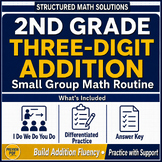
Turn three-digit addition into a clear, place-value-based small-group routine with this 2nd Grade Three-Digit Addition Small Group Math Routine — a structured resource that helps students add within 1,000 using base-ten models, expanded form, place value charts, open number lines, regrouping, and the standard algorithm.
This is not a random three-digit addition worksheet packet.
This is not shortcut practice that asks students to “carry” without understanding place value.
This is not a quick algorithm page that skips why 10 ones = 1 ten and 10 tens = 1 hundred.
This is a structured 2nd Grade Three-Digit Addition Routine designed to help students extend two-digit addition strategies into hundreds, tens, and ones. Students learn to add each place value, regroup when a column total reaches 10 or more, and explain why regrouping preserves the total value.
What makes this resource different
Most three-digit addition resources give students procedural practice.
This resource gives teachers a complete small-group teaching routine.
Students learn to connect:
Hundreds, tens, ones → Expanded form → Base-ten models → Place value charts → Open number lines → Regroup ones → Regroup tens → Standard algorithm → Explanation
The routine follows a predictable structure:
I Do → We Do → You Do → Exit Ticket → Regrouping Decision
Teachers model three-digit addition with visual models, guide students through regrouping ones into tens and tens into hundreds, release students to differentiated practice, and use exit tickets plus observation tools to decide who needs re-engagement, on-grade practice, or challenge work.
✔ 24 Print-Ready Pages
✔ 5 Reusable Small-Group Sessions
✔ 20–30 Minute Sessions
✔ Recommended for 4–6 Students
✔ Three-Digit Addition Anchor Chart
✔ Base-Ten Model Support
✔ Expanded Form Connections
✔ Place Value Charts
✔ Open Number Line Practice
✔ Standard Algorithm Practice
✔ Regrouping Ones Into a Ten
✔ Regrouping Tens Into a Hundred
✔ Modified / Scaffolded Practice
✔ On-Grade Practice
✔ Challenge & Extension Practice
✔ Common Misconceptions Guide
✔ Corrective Teacher Language
✔ 4 Cut-Apart Exit Tickets
✔ Observation Checklist
✔ Re-Engagement Guide
✔ Answer Keys Included
✔ Standards Alignment Included
WHAT’S INCLUDED
T-0 Quick Reference & Print Guide
The print guide shows what to print for teacher use, on-grade students, modified students, and challenge students. It also includes a 5-session guide:
Session 1 — No Regrouping
Students add hundreds, tens, and ones separately using base-ten models, expanded form, and place value charts.
Session 2 — Regrouping Ones Into a Ten
Students add the ones first, recognize when the total is 10 or more, and regroup 10 ones as 1 new ten.
Session 3 — Regrouping Tens Into a Hundred
Students add three-digit numbers that require regrouping ones and tens, including open number line reasoning.
Session 4 — Zero in the Tens Place & Standard Algorithm
Students use the standard algorithm with three-digit numbers, including problems where a regrouped ten enters an empty tens column.
Session 5 — Mixed Review, Transfer & Re-Engagement
Students review, extend, or receive targeted support based on exit ticket data.
T-1 Teacher Overview
The teacher overview explains the focus of the routine: adding three-digit numbers within 1,000, including problems that require regrouping ones into a ten and/or tens into a hundred.
The skill progression is:
Hundreds, tens & ones review → Expanded form → No-regrouping addition → Regroup ones into a ten → Regroup tens into a hundred → Open number lines → Standard algorithm → Strategy explanation
This is Resource 5 in the 2nd Grade Addition & Subtraction Small Group Bundle. It builds directly from Addition Within 100 and Addition With Regrouping, then prepares students for three-digit subtraction, word problems, and later error analysis.
T-1a Common Misconceptions
The misconceptions guide helps teachers respond to three-digit addition errors with targeted corrective language.
It addresses students who add columns independently without regrouping, forget to include the regrouped ten or hundred, treat the small 1 as decoration, regroup ones but not tens, misalign place value columns, struggle with zeros in the tens place, over-regroup, confuse regrouping and rounding, or solve correctly without explaining why regrouping was needed.
Standards Alignment
This routine is aligned primarily to CCSS 2.NBT.B.7, with supporting connections to 2.NBT.B.8, 2.NBT.B.9, and 2.NBT.A.1.
The resource focuses on adding within 1,000 using concrete models, drawings, place-value strategies, open number lines, and written methods. Subtraction, multi-step word problems, and a full error-analysis routine are intentionally saved for later bundle resources.
Anchor Chart — Regrouping to Add Three-Digit Numbers
The anchor chart gives students a 4-step process:
1. Add the ones
2. Regroup the ones
3. Add the tens
4. Add the hundreds and check
It reinforces the key question students should ask in every column:
Is the column sum 10 or more?
I Do Teacher Modeling
I Do Part 1 — Base-Ten Models & Expanded Form
Teachers model three-digit addition using expanded form, base-ten models, and place value charts.
Examples include 234 + 125 with no regrouping and 156 + 127 with regrouping ones into a ten. Students see how hundreds, tens, and ones are added separately before combining into the final sum.
I Do
Part 2 — Place Value Charts & the Standard Algorithm
Teachers model how regrouping connects to the standard algorithm using examples such as 385 + 276 and 609 + 184.
Students learn that regrouped numbers above the columns are not tricks — they represent a new ten or a new hundred that must be added into the next place value column.
We Do Guided Practice
We Do Part A — Guided Practice With Regrouping
Students add three-digit numbers while checking each column for regrouping.
Practice includes problems such as 312 + 456, 248 + 135, 426 + 283, 174 + 256, 503 + 298, and 367 + 145. Students decide whether to regroup in the ones and tens columns before writing the final sum.
We Do
Part B — Place Value Charts & Regrouping
Students fill in place value charts, explain whether regrouping was needed, and solve problems with and without zeros in the tens place.
This section helps students connect the written method to place value reasoning instead of just following steps.
You Do
Student Practice On-Grade Practice
Students independently solve three-digit addition problems using place value charts, base-ten drawings, expanded form, open number lines, the standard algorithm, and explanation prompts.
Modified / Scaffolded Practice
Modified pages include started place value charts, partially completed models, regrouping prompts, sentence frames, and structured support for students who need more guidance.
Challenge & Extension Practice
Challenge pages ask students to solve with more independence, choose efficient strategies, explain regrouping, check reasonableness, and analyze addition errors.
Exit Tickets and Assessment Tools
Cut-Apart Exit Tickets
Four exit tickets help teachers check whether students can add three-digit numbers, identify when regrouping is needed, regroup ones and tens accurately, and explain their reasoning.
Observation Checklist
The checklist helps teachers track whether students can represent three-digit numbers, add by place value, regroup ones into tens, regroup tens into hundreds, use the standard algorithm, and explain why strategies work.
Re-Engagement Guide
The re-engagement guide gives next steps when students need support, including returning to base-ten models, rebuilding with place value charts, practicing 10 ones = 1 ten and 10 tens = 1 hundred, and targeting specific regrouping errors.
Answer Keys
Answer keys are included for on-grade practice, modified/scaffolded practice, challenge/extension pages, and exit tickets.
The small-group workflow this resource creates
Teachers choose the session focus, prepare the anchor chart, base-ten tools, place value charts, open number lines, student pages, and exit tickets.
The lesson cycle is simple:
Model → Add each place → Check for 10 or more → Regroup → Record → Explain → Check → Regroup
Teachers model with the I Do pages, guide students during We Do, assign the right You Do tier, and use exit ticket evidence to decide who is ready to move forward, who needs another session, and who is ready for challenge work.
Why this routine works for 2nd grade addition
Second graders need more than a three-digit algorithm.
They need to understand that three-digit addition is an extension of the same place value reasoning they already used in two-digit addition: hundreds add to hundreds, tens to tens, and ones to ones. When a place value total reaches 10 or more, students regroup into the next place.
This routine helps students connect models, drawings, number lines, and written methods so three-digit addition becomes meaningful instead of mechanical.
This resource works for:
2nd grade three-digit addition
Adding within 1,000
Three-digit addition small groups
Addition with regrouping
Regrouping ones into tens
Regrouping tens into hundreds
Base-ten model practice
Expanded form addition
Open number line addition
Place value chart practice
Standard algorithm introduction
Guided math teacher table lessons
Small-group reteaching after diagnostic data
Students who forget regrouped tens or hundreds
Students who misalign place value columns
2.NBT.B.7 practice
2nd Grade Addition & Subtraction Bundle instruction
Supported Grade 2 math skills
Three-digit addition
Adding within 1,000
Hundreds, tens, and ones
Expanded form
Base-ten models
Place value charts
Open number lines
Standard algorithm notation
Regrouping ones into a ten
Regrouping tens into a hundred
Adding with zero tens
Checking each column for regrouping
Explaining addition strategies
Error analysis with three-digit addition
Conceptual readiness for three-digit subtraction
Supported Grade 2 math standards
2.NBT.B.7 — Add and subtract within 1,000 using concrete models or drawings and strategies based on place value; relate the strategy to a written method; understand that hundreds are added to hundreds, tens to tens, ones to ones, and that it is sometimes necessary to compose tens or hundreds.
2.NBT.B.8 — Mentally add or subtract 10 or 100 from a given number 100–900.
2.NBT.B.9 — Explain why addition and subtraction strategies work, using place value and the properties of operations.
2.NBT.A.1 — Understand that the three digits of a three-digit number represent amounts of hundreds, tens, and ones.
The primary focus is 2.NBT.B.7. The routine uses 2.NBT.B.8, 2.NBT.B.9, and 2.NBT.A.1 as supporting standards for place value structure, mental 10/100 reasoning, and strategy explanation.
The questions this resource answers:
How do I teach three-digit addition conceptually?
How do I help students add hundreds, tens, and ones correctly?
How do I teach regrouping ones into a ten?
How do I teach regrouping tens into a hundred?
How do I connect base-ten models to the standard algorithm?
How do I support students who forget the regrouped ten or hundred?
How do I help students add when there is a zero in the tens place?
How do I differentiate three-digit addition practice?
How do I know who is ready for three-digit subtraction?
How do I turn exit tickets into regrouping decisions?
This resource is NOT:
A full addition unit.
A random worksheet packet.
A full-year math curriculum.
A one-day activity.
A shortcut-only addition algorithm lesson.
A subtraction routine.
A full word-problem resource.
A full error-analysis routine.
It is a focused 2nd Grade Three-Digit Addition Small Group Math Routine designed to help students add within 1,000 using place value understanding before moving into three-digit subtraction, word problems, and larger computation.
Why Teachers Choose Structured Math Solutions
Structured Math Solutions resources are built for teachers who want small-group math to feel clear, organized, and doable.
Every resource is designed around grade-specific skills, predictable routines, visual models, teacher-friendly planning, and practical classroom systems.
This routine helps 2nd grade teachers move students beyond three-digit addition shortcuts and into true place value understanding — using base-ten models, expanded form, place value charts, open number lines, standard algorithm connections, differentiated practice, and evidence-based regrouping.
Highlights


Save even more with bundles

Description
Turn three-digit addition into a clear, place-value-based small-group routine with this 2nd Grade Three-Digit Addition Small Group Math Routine — a structured resource that helps students add within 1,000 using base-ten models, expanded form, place value charts, open number lines, regrouping, and the standard algorithm.
This is not a random three-digit addition worksheet packet.
This is not shortcut practice that asks students to “carry” without understanding place value.
This is not a quick algorithm page that skips why 10 ones = 1 ten and 10 tens = 1 hundred.
This is a structured 2nd Grade Three-Digit Addition Routine designed to help students extend two-digit addition strategies into hundreds, tens, and ones. Students learn to add each place value, regroup when a column total reaches 10 or more, and explain why regrouping preserves the total value.
What makes this resource different
Most three-digit addition resources give students procedural practice.
This resource gives teachers a complete small-group teaching routine.
Students learn to connect:
Hundreds, tens, ones → Expanded form → Base-ten models → Place value charts → Open number lines → Regroup ones → Regroup tens → Standard algorithm → Explanation
The routine follows a predictable structure:
I Do → We Do → You Do → Exit Ticket → Regrouping Decision
Teachers model three-digit addition with visual models, guide students through regrouping ones into tens and tens into hundreds, release students to differentiated practice, and use exit tickets plus observation tools to decide who needs re-engagement, on-grade practice, or challenge work.
✔ 24 Print-Ready Pages
✔ 5 Reusable Small-Group Sessions
✔ 20–30 Minute Sessions
✔ Recommended for 4–6 Students
✔ Three-Digit Addition Anchor Chart
✔ Base-Ten Model Support
✔ Expanded Form Connections
✔ Place Value Charts
✔ Open Number Line Practice
✔ Standard Algorithm Practice
✔ Regrouping Ones Into a Ten
✔ Regrouping Tens Into a Hundred
✔ Modified / Scaffolded Practice
✔ On-Grade Practice
✔ Challenge & Extension Practice
✔ Common Misconceptions Guide
✔ Corrective Teacher Language
✔ 4 Cut-Apart Exit Tickets
✔ Observation Checklist
✔ Re-Engagement Guide
✔ Answer Keys Included
✔ Standards Alignment Included
WHAT’S INCLUDED
T-0 Quick Reference & Print Guide
The print guide shows what to print for teacher use, on-grade students, modified students, and challenge students. It also includes a 5-session guide:
Session 1 — No Regrouping
Students add hundreds, tens, and ones separately using base-ten models, expanded form, and place value charts.
Session 2 — Regrouping Ones Into a Ten
Students add the ones first, recognize when the total is 10 or more, and regroup 10 ones as 1 new ten.
Session 3 — Regrouping Tens Into a Hundred
Students add three-digit numbers that require regrouping ones and tens, including open number line reasoning.
Session 4 — Zero in the Tens Place & Standard Algorithm
Students use the standard algorithm with three-digit numbers, including problems where a regrouped ten enters an empty tens column.
Session 5 — Mixed Review, Transfer & Re-Engagement
Students review, extend, or receive targeted support based on exit ticket data.
T-1 Teacher Overview
The teacher overview explains the focus of the routine: adding three-digit numbers within 1,000, including problems that require regrouping ones into a ten and/or tens into a hundred.
The skill progression is:
Hundreds, tens & ones review → Expanded form → No-regrouping addition → Regroup ones into a ten → Regroup tens into a hundred → Open number lines → Standard algorithm → Strategy explanation
This is Resource 5 in the 2nd Grade Addition & Subtraction Small Group Bundle. It builds directly from Addition Within 100 and Addition With Regrouping, then prepares students for three-digit subtraction, word problems, and later error analysis.
T-1a Common Misconceptions
The misconceptions guide helps teachers respond to three-digit addition errors with targeted corrective language.
It addresses students who add columns independently without regrouping, forget to include the regrouped ten or hundred, treat the small 1 as decoration, regroup ones but not tens, misalign place value columns, struggle with zeros in the tens place, over-regroup, confuse regrouping and rounding, or solve correctly without explaining why regrouping was needed.
Standards Alignment
This routine is aligned primarily to CCSS 2.NBT.B.7, with supporting connections to 2.NBT.B.8, 2.NBT.B.9, and 2.NBT.A.1.
The resource focuses on adding within 1,000 using concrete models, drawings, place-value strategies, open number lines, and written methods. Subtraction, multi-step word problems, and a full error-analysis routine are intentionally saved for later bundle resources.
Anchor Chart — Regrouping to Add Three-Digit Numbers
The anchor chart gives students a 4-step process:
1. Add the ones
2. Regroup the ones
3. Add the tens
4. Add the hundreds and check
It reinforces the key question students should ask in every column:
Is the column sum 10 or more?
I Do Teacher Modeling
I Do Part 1 — Base-Ten Models & Expanded Form
Teachers model three-digit addition using expanded form, base-ten models, and place value charts.
Examples include 234 + 125 with no regrouping and 156 + 127 with regrouping ones into a ten. Students see how hundreds, tens, and ones are added separately before combining into the final sum.
I Do
Part 2 — Place Value Charts & the Standard Algorithm
Teachers model how regrouping connects to the standard algorithm using examples such as 385 + 276 and 609 + 184.
Students learn that regrouped numbers above the columns are not tricks — they represent a new ten or a new hundred that must be added into the next place value column.
We Do Guided Practice
We Do Part A — Guided Practice With Regrouping
Students add three-digit numbers while checking each column for regrouping.
Practice includes problems such as 312 + 456, 248 + 135, 426 + 283, 174 + 256, 503 + 298, and 367 + 145. Students decide whether to regroup in the ones and tens columns before writing the final sum.
We Do
Part B — Place Value Charts & Regrouping
Students fill in place value charts, explain whether regrouping was needed, and solve problems with and without zeros in the tens place.
This section helps students connect the written method to place value reasoning instead of just following steps.
You Do
Student Practice On-Grade Practice
Students independently solve three-digit addition problems using place value charts, base-ten drawings, expanded form, open number lines, the standard algorithm, and explanation prompts.
Modified / Scaffolded Practice
Modified pages include started place value charts, partially completed models, regrouping prompts, sentence frames, and structured support for students who need more guidance.
Challenge & Extension Practice
Challenge pages ask students to solve with more independence, choose efficient strategies, explain regrouping, check reasonableness, and analyze addition errors.
Exit Tickets and Assessment Tools
Cut-Apart Exit Tickets
Four exit tickets help teachers check whether students can add three-digit numbers, identify when regrouping is needed, regroup ones and tens accurately, and explain their reasoning.
Observation Checklist
The checklist helps teachers track whether students can represent three-digit numbers, add by place value, regroup ones into tens, regroup tens into hundreds, use the standard algorithm, and explain why strategies work.
Re-Engagement Guide
The re-engagement guide gives next steps when students need support, including returning to base-ten models, rebuilding with place value charts, practicing 10 ones = 1 ten and 10 tens = 1 hundred, and targeting specific regrouping errors.
Answer Keys
Answer keys are included for on-grade practice, modified/scaffolded practice, challenge/extension pages, and exit tickets.
The small-group workflow this resource creates
Teachers choose the session focus, prepare the anchor chart, base-ten tools, place value charts, open number lines, student pages, and exit tickets.
The lesson cycle is simple:
Model → Add each place → Check for 10 or more → Regroup → Record → Explain → Check → Regroup
Teachers model with the I Do pages, guide students during We Do, assign the right You Do tier, and use exit ticket evidence to decide who is ready to move forward, who needs another session, and who is ready for challenge work.
Why this routine works for 2nd grade addition
Second graders need more than a three-digit algorithm.
They need to understand that three-digit addition is an extension of the same place value reasoning they already used in two-digit addition: hundreds add to hundreds, tens to tens, and ones to ones. When a place value total reaches 10 or more, students regroup into the next place.
This routine helps students connect models, drawings, number lines, and written methods so three-digit addition becomes meaningful instead of mechanical.
This resource works for:
2nd grade three-digit addition
Adding within 1,000
Three-digit addition small groups
Addition with regrouping
Regrouping ones into tens
Regrouping tens into hundreds
Base-ten model practice
Expanded form addition
Open number line addition
Place value chart practice
Standard algorithm introduction
Guided math teacher table lessons
Small-group reteaching after diagnostic data
Students who forget regrouped tens or hundreds
Students who misalign place value columns
2.NBT.B.7 practice
2nd Grade Addition & Subtraction Bundle instruction
Supported Grade 2 math skills
Three-digit addition
Adding within 1,000
Hundreds, tens, and ones
Expanded form
Base-ten models
Place value charts
Open number lines
Standard algorithm notation
Regrouping ones into a ten
Regrouping tens into a hundred
Adding with zero tens
Checking each column for regrouping
Explaining addition strategies
Error analysis with three-digit addition
Conceptual readiness for three-digit subtraction
Supported Grade 2 math standards
2.NBT.B.7 — Add and subtract within 1,000 using concrete models or drawings and strategies based on place value; relate the strategy to a written method; understand that hundreds are added to hundreds, tens to tens, ones to ones, and that it is sometimes necessary to compose tens or hundreds.
2.NBT.B.8 — Mentally add or subtract 10 or 100 from a given number 100–900.
2.NBT.B.9 — Explain why addition and subtraction strategies work, using place value and the properties of operations.
2.NBT.A.1 — Understand that the three digits of a three-digit number represent amounts of hundreds, tens, and ones.
The primary focus is 2.NBT.B.7. The routine uses 2.NBT.B.8, 2.NBT.B.9, and 2.NBT.A.1 as supporting standards for place value structure, mental 10/100 reasoning, and strategy explanation.
The questions this resource answers:
How do I teach three-digit addition conceptually?
How do I help students add hundreds, tens, and ones correctly?
How do I teach regrouping ones into a ten?
How do I teach regrouping tens into a hundred?
How do I connect base-ten models to the standard algorithm?
How do I support students who forget the regrouped ten or hundred?
How do I help students add when there is a zero in the tens place?
How do I differentiate three-digit addition practice?
How do I know who is ready for three-digit subtraction?
How do I turn exit tickets into regrouping decisions?
This resource is NOT:
A full addition unit.
A random worksheet packet.
A full-year math curriculum.
A one-day activity.
A shortcut-only addition algorithm lesson.
A subtraction routine.
A full word-problem resource.
A full error-analysis routine.
It is a focused 2nd Grade Three-Digit Addition Small Group Math Routine designed to help students add within 1,000 using place value understanding before moving into three-digit subtraction, word problems, and larger computation.
Why Teachers Choose Structured Math Solutions
Structured Math Solutions resources are built for teachers who want small-group math to feel clear, organized, and doable.
Every resource is designed around grade-specific skills, predictable routines, visual models, teacher-friendly planning, and practical classroom systems.
This routine helps 2nd grade teachers move students beyond three-digit addition shortcuts and into true place value understanding — using base-ten models, expanded form, place value charts, open number lines, standard algorithm connections, differentiated practice, and evidence-based regrouping.
