


Description
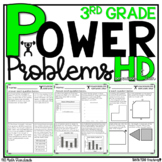
36 CONCEPTUAL BASED QUESTIONS TO TRANSFORM YOUR HOMEWORK ASSIGNMENTS. EACH SHEET HAS FOUR QUESTIONS THAT ARE MEANINGFUL AND RIGOROUS. NO MORE HAVING YOUR STUDENTS COMPLETE REPETITIVE PROCEDURAL QUESTIONS THAT ONLY SKIM THE SURFACE OF THINKING!
***DIGITAL VERSION IS NOW AVAILABLE FOR GOOGLE SLIDES!***
What's included in this product?
· 36 conceptual based math questions
· Quality prompts and word problems that promote rigorous thinking
· 4 questions per standard
· Each standard is formatted to one page
· Easy prep
· Answer keys
***CHECK OUT OUR BEST SELLING SET OF POWER PROBLEMS.*** CLICK HERE!
Perfect for your math lessons and in class practice.
WHAT ARE P.O.W.E.R PROBLEMS?
PURPOSEFUL - These problems are meant to keep students focused, while strengthening initiative and perseverance.
OPPORTUNITIES - These prompts can be used in a variety of ways. P.O.W.E.R problems can be used to introduce a lesson, spiral review, or as formative assessments.
WITH
ENGAGEMENT - Problems are real world applicable and designed to hook students with interest and presentation. Complexity of problems promotes problem solving skills.
RIGOR - Tasks are specifically designed to challenge students and assess conceptual understanding of curriculum versus procedural understanding. Students will need to apply more than just a “formula.”
WHY USE P.O.W.E.R PROBLEMS?
BUILD STAMINA WITHIN YOUR STUDENTS!
P.O.W.E.R problems are designed to challenge your students with their open ended presentation. Majority of problems that come from textbooks and workbooks assess procedural understanding of curriculum. Some textbooks even provide step by step instructions where the textbook is thinking for the students and taking away that “productive struggle” for children. When we rob students of that event, we rob them of their ability to reason, problem solve, and see beyond a standard algorithm. P.O.W.E.R problems are meant to show students that there are different ways to answer one question in math. With these tasks students take ownership and are part of the problem solving process versus filling in blanks in a textbook.
HOW TO USE POWER PROBLEMS:
YOUR KIDS. YOUR CHOICE. FLEXIBILITY.
TO INTRODUCE A LESSON - P.O.W.E.R problems can be used to introduce a new skill. In this case your students will experience a “productive struggle.” Their problem solving skills and prior knowledge will kick in. Often times most of my students will have the incorrect answer or no answer at all. I then have someone explain their method/reasoning and allow my students to critique their peer’s answer. This makes for great accountable talk discussions. If I see that most students do not have an answer I will assist the class in getting to a specific point and then allow them to finish independently.
SPIRAL REVIEW - Avoid your students forgetting standards, by using P.O.W.E.R problems to spiral review previously taught lessons.
FORMATIVE ASSESSMENTS - You can use these problems to assess mastery and levels of understanding.
4 questions per standard/topic!
Standards & Topics Covered
Operations & Algebraic Thinking
➥ 3.OA.1 - Interpreting products of whole numbers
➥ 3.OA.2 – Interpreting quotients of whole numbers
➥ 3.OA.3 – Use multiplication and division to solve word problems
➥ 3.OA.4 – Determining unknown numbers in a multiplication or division equation
➥ 3.OA.5 – Apply properties of operations to multiply and divide
➥ 3.OA.6 – Understand division as an unknown-factor problem.
➥ 3.OA.7 – Fluently multiply and divide within 100
➥ 3.OA.8 – Solve two-step word problems using the four operations.
➥ 3.OA.9 – Understanding patterns on a multiplication chart
3rd Grade Math Word Problems Homework Algebraic Thinking DISTANCE LEARNING

Highlights


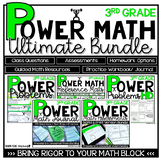
Save even more with bundles
Description
36 CONCEPTUAL BASED QUESTIONS TO TRANSFORM YOUR HOMEWORK ASSIGNMENTS. EACH SHEET HAS FOUR QUESTIONS THAT ARE MEANINGFUL AND RIGOROUS. NO MORE HAVING YOUR STUDENTS COMPLETE REPETITIVE PROCEDURAL QUESTIONS THAT ONLY SKIM THE SURFACE OF THINKING!
***DIGITAL VERSION IS NOW AVAILABLE FOR GOOGLE SLIDES!***
What's included in this product?
· 36 conceptual based math questions
· Quality prompts and word problems that promote rigorous thinking
· 4 questions per standard
· Each standard is formatted to one page
· Easy prep
· Answer keys
***CHECK OUT OUR BEST SELLING SET OF POWER PROBLEMS.*** CLICK HERE!
Perfect for your math lessons and in class practice.
WHAT ARE P.O.W.E.R PROBLEMS?
PURPOSEFUL - These problems are meant to keep students focused, while strengthening initiative and perseverance.
OPPORTUNITIES - These prompts can be used in a variety of ways. P.O.W.E.R problems can be used to introduce a lesson, spiral review, or as formative assessments.
WITH
ENGAGEMENT - Problems are real world applicable and designed to hook students with interest and presentation. Complexity of problems promotes problem solving skills.
RIGOR - Tasks are specifically designed to challenge students and assess conceptual understanding of curriculum versus procedural understanding. Students will need to apply more than just a “formula.”
WHY USE P.O.W.E.R PROBLEMS?
BUILD STAMINA WITHIN YOUR STUDENTS!
P.O.W.E.R problems are designed to challenge your students with their open ended presentation. Majority of problems that come from textbooks and workbooks assess procedural understanding of curriculum. Some textbooks even provide step by step instructions where the textbook is thinking for the students and taking away that “productive struggle” for children. When we rob students of that event, we rob them of their ability to reason, problem solve, and see beyond a standard algorithm. P.O.W.E.R problems are meant to show students that there are different ways to answer one question in math. With these tasks students take ownership and are part of the problem solving process versus filling in blanks in a textbook.
HOW TO USE POWER PROBLEMS:
YOUR KIDS. YOUR CHOICE. FLEXIBILITY.
TO INTRODUCE A LESSON - P.O.W.E.R problems can be used to introduce a new skill. In this case your students will experience a “productive struggle.” Their problem solving skills and prior knowledge will kick in. Often times most of my students will have the incorrect answer or no answer at all. I then have someone explain their method/reasoning and allow my students to critique their peer’s answer. This makes for great accountable talk discussions. If I see that most students do not have an answer I will assist the class in getting to a specific point and then allow them to finish independently.
SPIRAL REVIEW - Avoid your students forgetting standards, by using P.O.W.E.R problems to spiral review previously taught lessons.
FORMATIVE ASSESSMENTS - You can use these problems to assess mastery and levels of understanding.
4 questions per standard/topic!
Standards & Topics Covered
Operations & Algebraic Thinking
➥ 3.OA.1 - Interpreting products of whole numbers
➥ 3.OA.2 – Interpreting quotients of whole numbers
➥ 3.OA.3 – Use multiplication and division to solve word problems
➥ 3.OA.4 – Determining unknown numbers in a multiplication or division equation
➥ 3.OA.5 – Apply properties of operations to multiply and divide
➥ 3.OA.6 – Understand division as an unknown-factor problem.
➥ 3.OA.7 – Fluently multiply and divide within 100
➥ 3.OA.8 – Solve two-step word problems using the four operations.
➥ 3.OA.9 – Understanding patterns on a multiplication chart
