

Description
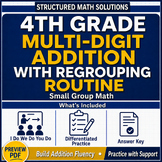
This is a structured 4th Grade Multi-Digit Addition With Regrouping Small Group Math Routine designed to help students add multi-digit whole numbers through 1,000,000 using place value understanding, regrouping models, expanded form reasoning, and the standard algorithm.
Align → Add → Regroup → Explain → Check
Help students build fluency with multi-digit addition using place value models, regrouping reasoning, and a structured small-group routine.
This is not a random addition worksheet packet.
This is not a shortcut-only standard algorithm resource.
Built specifically for small-group math instruction, this resource helps students understand why regrouping works—not just how to “carry the 1.” Students practice aligning addends by place value, adding one column at a time, regrouping across multiple places, checking reasonableness with estimation, and explaining regrouping using precise math language.
This resource is a:
• 4th grade multi-digit addition routine
• small-group addition with regrouping resource
• standard algorithm support routine
• place value model addition lesson sequence
• I Do → We Do → You Do math routine
• differentiated guided math resource
• 4.NBT.B.4 addition support tool
• concept-first small-group math routine
It is designed to help students:
• align addends by place value
• add multi-digit whole numbers through 1,000,000
• regroup ones to tens
• regroup tens to hundreds
• regroup hundreds to thousands
• regroup across larger place values
• use estimation to check reasonableness
• connect regrouping to place value exchange
• explain why regrouping works
This resource is NOT:
• a random computation worksheet set
• a full operations unit
• a scripted curriculum replacement
• a one-day review page
• a test prep packet
• a center-only activity
• a shortcut-only “carry the 1” resource
Instead, this is a structured small-group math routine that helps students understand multi-digit addition as place value reasoning, not just a memorized procedure.
What’s Included
This 24-page print-ready resource includes:
✔ quick reference and print guide
✔ teacher overview
✔ common misconceptions guide
✔ standards alignment
✔ printable anchor chart
✔ I Do teacher modeling pages
✔ We Do guided practice pages
✔ on-grade You Do practice
✔ modified/scaffolded practice
✔ challenge practice
✔ extension practice
✔ cut-apart exit tickets
✔ answer keys
✔ observation checklist
✔ re-engagement guide
✔ bundle connection reference
✔ terms of use
The routine is designed for 4–5 reusable small-group sessions of approximately 20–30 minutes each, making it practical for guided math, teacher table, tutoring, skill-based groups, and multi-digit operations instruction.
Built Around Place Value Regrouping
One of the strongest features of this resource is that regrouping is taught as a place value exchange.
Students learn that when a place-value sum reaches 10 or more, 10 of that unit are traded for 1 of the next larger unit.
That means:
• 10 ones become 1 ten
• 10 tens become 1 hundred
• 10 hundreds become 1 thousand
• 10 thousands become 1 ten thousand
This helps students understand that regrouping does not change the total value. It reorganizes the value into the next place.
Built Around I Do → We Do → You Do
This routine follows a predictable instructional structure that helps students move from teacher modeling to guided practice to independent application.
I Do — Teacher Modeling
The teacher models multi-digit addition step by step using place value language, vertical alignment, regrouping, and estimation.
Students see how to:
• line up digits by place value
• begin with the ones place
• add one place at a time
• decide when regrouping is needed
• write the regrouped digit in the next place
• include the regrouped digit when adding the next column
• use estimation to check reasonableness
The modeling pages include examples with no regrouping, regrouping across ones/tens/hundreds, regrouping across thousands and ten-thousands, zeros as placeholders, and sums that produce zeros in the answer.
We Do — Guided Practice
Students work with the teacher to practice addition with increasing independence.
Guided practice includes:
• 4-digit addition
• 5-digit addition
• 6-digit addition
• estimate-first routines
• place value alignment
• regrouping across multiple places
• error analysis
• word problem application
• reasonableness checks
Students are prompted to explain where regrouping happened and why the answer makes sense.
You Do — Independent Practice
Students complete structured practice aligned to the routine.
The on-grade pages include:
• multi-digit addition problems
• estimate-first problems
• 5-digit and 6-digit addition
• addition word problems
• error analysis
• reasoning prompts about regrouping
Students are expected to show their work, record regrouping, and check answers using estimation.
Differentiated Practice Included
This resource includes built-in differentiation so teachers can assign the right level of support based on student readiness.
Modified / Scaffolded Practice
The modified pages provide extra support through:
• pre-aligned problems
• place value column labels
• regrouping boxes
• structured vertical setups
• sentence frames
• scaffolded word problem support
• estimate check prompts
These pages are useful for students who misalign digits, forget regrouped digits, skip zeros, or need more visual structure when adding multi-digit numbers.
On-Grade Practice
The on-grade pages provide independent practice with increasingly complex addition problems.
Students practice examples such as:
• 4,582 + 3,739
• 17,364 + 25,487
• 83,209 + 45,674
• 256,418 + 134,579
• 472,630 + 285,194
• 128,465 + 96,738
This gives students repeated practice with the exact Grade 4 addition fluency expected in 4.NBT.B.4.
Challenge & Extension Practice
The challenge and extension pages push students into deeper reasoning through:
• estimate-and-solve tasks
• multi-place regrouping
• error analysis
• predicting where regrouping will happen before solving
• multi-step word problems
• constructing arguments about whether two 6-digit numbers always produce a 6-digit sum
These tasks are designed for students who are ready to move beyond basic computation into reasoning, explanation, and transfer.
Exit Tickets & Teacher Data Tools
This resource includes four cut-apart exit tickets for Sessions 1–4.
Exit tickets assess:
• alignment and addition without regrouping
• regrouping ones and tens
• 6-digit addition
• full-skill addition with reasonableness
Students solve problems such as:
• 2,341 + 3,154
• 3,682 + 4,759
• 185,426 + 93,847
• 374,582 + 285,619
The observation checklist helps teachers track whether students can align digits by place value, add without regrouping, regroup ones to tens, regroup tens to hundreds, regroup across thousands and ten-thousands, use estimation, and explain regrouping with place value language.
Re-Engagement Support Included
The included re-engagement guide helps teachers respond when students are not yet ready to move forward.
Common addition breakdowns include:
• misaligning digits across place value columns
• writing both digits of a 2-digit sum in one column
• forgetting to add the regrouped digit
• regrouping to the wrong place
• accepting an unreasonable answer without estimating
• treating regrouping as a trick instead of a place value exchange
For each error pattern, the guide provides the likely root cause, a targeted instructional approach, and where to return in the resource for re-engagement.
This makes the resource more than computation practice—it becomes a small-group decision-making tool.
Standards Alignment
This resource is aligned to:
• 4.NBT.B.4 — Fluently add and subtract multi-digit whole numbers using the standard algorithm.
It also supports:
• 4.NBT.A.1 — Recognize that in a multi-digit whole number, a digit in one place represents ten times what it represents in the place to its right.
• 4.NBT.A.2 — Read and write multi-digit whole numbers using base-ten numerals, number names, and expanded form.
This resource focuses specifically on the addition component of 4.NBT.B.4. Subtraction with regrouping and multi-step addition/subtraction word problems are developed in later resources in the bundle.
It also supports Mathematical Practices:
• MP.2 — Reason abstractly and quantitatively
• MP.3 — Construct viable arguments and critique reasoning
• MP.6 — Attend to precision
• MP.7 — Look for and make use of structure
• MP.8 — Look for repeated reasoning
Part of the 4th Grade Addition & Subtraction Small Group Bundle
This resource is part of the 4th Grade Multi- Digit Addition & Subtraction Small Group Math Bundle, a connected sequence designed to build multi-digit operations understanding step by step.
Resources in this series include:
• 4th Grade Multi-Digit Addition With Regrouping | Small Group Math
• 4th Grade Multi-Digit Subtraction With Regrouping | Small Group Math
• 4th Grade Multi-Digit Addition & Subtraction Word Problems Routine | Small Group Math
This first routine builds the addition foundation students need before moving into subtraction with regrouping and multi-step addition/subtraction word problems.
Flexible Classroom Use
This resource works well for:
• 4th grade multi-digit addition instruction
• addition with regrouping lessons
• guided math groups
• small-group math lessons
• math workshop teacher table
• operations unit instruction
• tutoring sessions
• reteach lessons
• skill-based grouping
• standard algorithm practice
Teachers can use it:
• during a 4th grade multi-digit operations unit
• before subtraction with regrouping
• before addition and subtraction word problems
• when students misalign digits
• when students forget regrouped digits
• when students carry incorrectly
• when students need to explain regrouping conceptually
Why Teachers Choose Structured Math Solutions
Structured Math Solutions resources are designed to provide:
• predictable instructional routines
• concept-first math instruction
• visual models that reduce confusion
• differentiated small-group practice
• teacher-friendly planning support
• built-in observation and next-step tools
• connected resources that work as a larger instructional system
Teachers do not need more addition worksheets that only tell students to “carry the 1.”
They need a clear routine that helps students understand place value alignment, regrouping as exchange, and how to check whether a sum makes sense.
This 4th Grade Addition With Regrouping Routine gives teachers a structured way to model, practice, assess, and re-engage students so multi-digit addition becomes accurate, meaningful, and transferable to subtraction and word problems.
4th Grade Multi-Digit Addition With Regrouping Routine | Small Group Math
Highlights


Save even more with bundles


Description
This is a structured 4th Grade Multi-Digit Addition With Regrouping Small Group Math Routine designed to help students add multi-digit whole numbers through 1,000,000 using place value understanding, regrouping models, expanded form reasoning, and the standard algorithm.
Align → Add → Regroup → Explain → Check
Help students build fluency with multi-digit addition using place value models, regrouping reasoning, and a structured small-group routine.
This is not a random addition worksheet packet.
This is not a shortcut-only standard algorithm resource.
Built specifically for small-group math instruction, this resource helps students understand why regrouping works—not just how to “carry the 1.” Students practice aligning addends by place value, adding one column at a time, regrouping across multiple places, checking reasonableness with estimation, and explaining regrouping using precise math language.
This resource is a:
• 4th grade multi-digit addition routine
• small-group addition with regrouping resource
• standard algorithm support routine
• place value model addition lesson sequence
• I Do → We Do → You Do math routine
• differentiated guided math resource
• 4.NBT.B.4 addition support tool
• concept-first small-group math routine
It is designed to help students:
• align addends by place value
• add multi-digit whole numbers through 1,000,000
• regroup ones to tens
• regroup tens to hundreds
• regroup hundreds to thousands
• regroup across larger place values
• use estimation to check reasonableness
• connect regrouping to place value exchange
• explain why regrouping works
This resource is NOT:
• a random computation worksheet set
• a full operations unit
• a scripted curriculum replacement
• a one-day review page
• a test prep packet
• a center-only activity
• a shortcut-only “carry the 1” resource
Instead, this is a structured small-group math routine that helps students understand multi-digit addition as place value reasoning, not just a memorized procedure.
What’s Included
This 24-page print-ready resource includes:
✔ quick reference and print guide
✔ teacher overview
✔ common misconceptions guide
✔ standards alignment
✔ printable anchor chart
✔ I Do teacher modeling pages
✔ We Do guided practice pages
✔ on-grade You Do practice
✔ modified/scaffolded practice
✔ challenge practice
✔ extension practice
✔ cut-apart exit tickets
✔ answer keys
✔ observation checklist
✔ re-engagement guide
✔ bundle connection reference
✔ terms of use
The routine is designed for 4–5 reusable small-group sessions of approximately 20–30 minutes each, making it practical for guided math, teacher table, tutoring, skill-based groups, and multi-digit operations instruction.
Built Around Place Value Regrouping
One of the strongest features of this resource is that regrouping is taught as a place value exchange.
Students learn that when a place-value sum reaches 10 or more, 10 of that unit are traded for 1 of the next larger unit.
That means:
• 10 ones become 1 ten
• 10 tens become 1 hundred
• 10 hundreds become 1 thousand
• 10 thousands become 1 ten thousand
This helps students understand that regrouping does not change the total value. It reorganizes the value into the next place.
Built Around I Do → We Do → You Do
This routine follows a predictable instructional structure that helps students move from teacher modeling to guided practice to independent application.
I Do — Teacher Modeling
The teacher models multi-digit addition step by step using place value language, vertical alignment, regrouping, and estimation.
Students see how to:
• line up digits by place value
• begin with the ones place
• add one place at a time
• decide when regrouping is needed
• write the regrouped digit in the next place
• include the regrouped digit when adding the next column
• use estimation to check reasonableness
The modeling pages include examples with no regrouping, regrouping across ones/tens/hundreds, regrouping across thousands and ten-thousands, zeros as placeholders, and sums that produce zeros in the answer.
We Do — Guided Practice
Students work with the teacher to practice addition with increasing independence.
Guided practice includes:
• 4-digit addition
• 5-digit addition
• 6-digit addition
• estimate-first routines
• place value alignment
• regrouping across multiple places
• error analysis
• word problem application
• reasonableness checks
Students are prompted to explain where regrouping happened and why the answer makes sense.
You Do — Independent Practice
Students complete structured practice aligned to the routine.
The on-grade pages include:
• multi-digit addition problems
• estimate-first problems
• 5-digit and 6-digit addition
• addition word problems
• error analysis
• reasoning prompts about regrouping
Students are expected to show their work, record regrouping, and check answers using estimation.
Differentiated Practice Included
This resource includes built-in differentiation so teachers can assign the right level of support based on student readiness.
Modified / Scaffolded Practice
The modified pages provide extra support through:
• pre-aligned problems
• place value column labels
• regrouping boxes
• structured vertical setups
• sentence frames
• scaffolded word problem support
• estimate check prompts
These pages are useful for students who misalign digits, forget regrouped digits, skip zeros, or need more visual structure when adding multi-digit numbers.
On-Grade Practice
The on-grade pages provide independent practice with increasingly complex addition problems.
Students practice examples such as:
• 4,582 + 3,739
• 17,364 + 25,487
• 83,209 + 45,674
• 256,418 + 134,579
• 472,630 + 285,194
• 128,465 + 96,738
This gives students repeated practice with the exact Grade 4 addition fluency expected in 4.NBT.B.4.
Challenge & Extension Practice
The challenge and extension pages push students into deeper reasoning through:
• estimate-and-solve tasks
• multi-place regrouping
• error analysis
• predicting where regrouping will happen before solving
• multi-step word problems
• constructing arguments about whether two 6-digit numbers always produce a 6-digit sum
These tasks are designed for students who are ready to move beyond basic computation into reasoning, explanation, and transfer.
Exit Tickets & Teacher Data Tools
This resource includes four cut-apart exit tickets for Sessions 1–4.
Exit tickets assess:
• alignment and addition without regrouping
• regrouping ones and tens
• 6-digit addition
• full-skill addition with reasonableness
Students solve problems such as:
• 2,341 + 3,154
• 3,682 + 4,759
• 185,426 + 93,847
• 374,582 + 285,619
The observation checklist helps teachers track whether students can align digits by place value, add without regrouping, regroup ones to tens, regroup tens to hundreds, regroup across thousands and ten-thousands, use estimation, and explain regrouping with place value language.
Re-Engagement Support Included
The included re-engagement guide helps teachers respond when students are not yet ready to move forward.
Common addition breakdowns include:
• misaligning digits across place value columns
• writing both digits of a 2-digit sum in one column
• forgetting to add the regrouped digit
• regrouping to the wrong place
• accepting an unreasonable answer without estimating
• treating regrouping as a trick instead of a place value exchange
For each error pattern, the guide provides the likely root cause, a targeted instructional approach, and where to return in the resource for re-engagement.
This makes the resource more than computation practice—it becomes a small-group decision-making tool.
Standards Alignment
This resource is aligned to:
• 4.NBT.B.4 — Fluently add and subtract multi-digit whole numbers using the standard algorithm.
It also supports:
• 4.NBT.A.1 — Recognize that in a multi-digit whole number, a digit in one place represents ten times what it represents in the place to its right.
• 4.NBT.A.2 — Read and write multi-digit whole numbers using base-ten numerals, number names, and expanded form.
This resource focuses specifically on the addition component of 4.NBT.B.4. Subtraction with regrouping and multi-step addition/subtraction word problems are developed in later resources in the bundle.
It also supports Mathematical Practices:
• MP.2 — Reason abstractly and quantitatively
• MP.3 — Construct viable arguments and critique reasoning
• MP.6 — Attend to precision
• MP.7 — Look for and make use of structure
• MP.8 — Look for repeated reasoning
Part of the 4th Grade Addition & Subtraction Small Group Bundle
This resource is part of the 4th Grade Multi- Digit Addition & Subtraction Small Group Math Bundle, a connected sequence designed to build multi-digit operations understanding step by step.
Resources in this series include:
• 4th Grade Multi-Digit Addition With Regrouping | Small Group Math
• 4th Grade Multi-Digit Subtraction With Regrouping | Small Group Math
• 4th Grade Multi-Digit Addition & Subtraction Word Problems Routine | Small Group Math
This first routine builds the addition foundation students need before moving into subtraction with regrouping and multi-step addition/subtraction word problems.
Flexible Classroom Use
This resource works well for:
• 4th grade multi-digit addition instruction
• addition with regrouping lessons
• guided math groups
• small-group math lessons
• math workshop teacher table
• operations unit instruction
• tutoring sessions
• reteach lessons
• skill-based grouping
• standard algorithm practice
Teachers can use it:
• during a 4th grade multi-digit operations unit
• before subtraction with regrouping
• before addition and subtraction word problems
• when students misalign digits
• when students forget regrouped digits
• when students carry incorrectly
• when students need to explain regrouping conceptually
Why Teachers Choose Structured Math Solutions
Structured Math Solutions resources are designed to provide:
• predictable instructional routines
• concept-first math instruction
• visual models that reduce confusion
• differentiated small-group practice
• teacher-friendly planning support
• built-in observation and next-step tools
• connected resources that work as a larger instructional system
Teachers do not need more addition worksheets that only tell students to “carry the 1.”
They need a clear routine that helps students understand place value alignment, regrouping as exchange, and how to check whether a sum makes sense.
This 4th Grade Addition With Regrouping Routine gives teachers a structured way to model, practice, assess, and re-engage students so multi-digit addition becomes accurate, meaningful, and transferable to subtraction and word problems.
