


Description
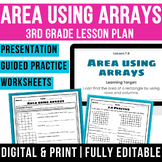
Help your 3rd grade students find area using arrays, rows, and columns with this comprehensive math lesson plan resource. Students learn how to organize square units into equal rows, use repeated addition, and find the total number of square units to determine area. Designed for introduction, guided practice, and review, this scaffolded lesson works seamlessly for whole-group instruction, interactive practice, sub plans, supplemental practice, review lessons, and print or digital classrooms.
Understanding area using arrays can be challenging because students often rely on counting each square one by one. This lesson provides explicit modeling and structured practice so students learn how organizing square units into rows and columns makes finding area more efficient, while building a foundation for multiplication in future lessons.
Teachers will love that everything is fully editable, making it easy to adapt pacing, examples, or activities to meet your classroom’s needs, whether you teach paperless, print-based, or a mix of both.
What’s Included:
This complete area lesson includes both teaching and student materials:
- Printable lesson plan with pacing, prompts, and instructional notes
- Editable Google Slides presentation for instruction (includes speaker notes aligned to the lesson plan)
- Interactive guided practice slides for students to follow along
- Printable guided practice version for print-based classrooms
- Independent practice worksheet (perfect for homework or extra in-class practice)
- Exit ticket and reflection prompts
- Answer keys for all student practice
How to Use It:
Teach this lesson during your geometry or measurement unit or after introducing area as equal units to extend understanding into arrays and structured counting. Present the lesson using the Google Slides, model strategies using the guided examples, and allow students to practice using the interactive slides or printable pages.
Because the resource is fully editable, you can:
- Choose digital, print, or hybrid formats
- Adjust examples or pacing
- Use it for whole group, small group, or reteaching
- Assign practice as classwork or homework
Standards Alignment:
CCSS.MATH.CONTENT.3.MD.C.6
Measure areas by counting unit squares (square cm, square m, square in, square ft, and improvised units).
CCSS.MATH.CONTENT.3.MD.C.7.D
Recognize area as additive. Find areas of rectilinear figures by decomposing them into non-overlapping rectangles and adding the areas of the non-overlapping parts, applying this technique to solve real world problems.
Save planning time and give your students the structured support they need to find area using arrays. Download this editable, ready-to-use lesson and teach with confidence!
Want the next lesson on Comparing Area?
Grab it here → Comparing Area Using Square Units | 3rd Grade Math Lesson Plan
Teach the entire unit on Geometry: Area & Perimeter with a money saving bundle!
Grab it here → 3rd Grade Geometry: Area & Perimeter Full Math Unit | 2D Shapes, Area, Perimeter
Area Using Arrays | Counting Rows & Columns | 3rd Grade Math Lesson Plan

Highlights


Save even more with bundles

Description
Help your 3rd grade students find area using arrays, rows, and columns with this comprehensive math lesson plan resource. Students learn how to organize square units into equal rows, use repeated addition, and find the total number of square units to determine area. Designed for introduction, guided practice, and review, this scaffolded lesson works seamlessly for whole-group instruction, interactive practice, sub plans, supplemental practice, review lessons, and print or digital classrooms.
Understanding area using arrays can be challenging because students often rely on counting each square one by one. This lesson provides explicit modeling and structured practice so students learn how organizing square units into rows and columns makes finding area more efficient, while building a foundation for multiplication in future lessons.
Teachers will love that everything is fully editable, making it easy to adapt pacing, examples, or activities to meet your classroom’s needs, whether you teach paperless, print-based, or a mix of both.
What’s Included:
This complete area lesson includes both teaching and student materials:
- Printable lesson plan with pacing, prompts, and instructional notes
- Editable Google Slides presentation for instruction (includes speaker notes aligned to the lesson plan)
- Interactive guided practice slides for students to follow along
- Printable guided practice version for print-based classrooms
- Independent practice worksheet (perfect for homework or extra in-class practice)
- Exit ticket and reflection prompts
- Answer keys for all student practice
How to Use It:
Teach this lesson during your geometry or measurement unit or after introducing area as equal units to extend understanding into arrays and structured counting. Present the lesson using the Google Slides, model strategies using the guided examples, and allow students to practice using the interactive slides or printable pages.
Because the resource is fully editable, you can:
- Choose digital, print, or hybrid formats
- Adjust examples or pacing
- Use it for whole group, small group, or reteaching
- Assign practice as classwork or homework
Standards Alignment:
CCSS.MATH.CONTENT.3.MD.C.6
Measure areas by counting unit squares (square cm, square m, square in, square ft, and improvised units).
CCSS.MATH.CONTENT.3.MD.C.7.D
Recognize area as additive. Find areas of rectilinear figures by decomposing them into non-overlapping rectangles and adding the areas of the non-overlapping parts, applying this technique to solve real world problems.
Save planning time and give your students the structured support they need to find area using arrays. Download this editable, ready-to-use lesson and teach with confidence!
Want the next lesson on Comparing Area?
Grab it here → Comparing Area Using Square Units | 3rd Grade Math Lesson Plan
Teach the entire unit on Geometry: Area & Perimeter with a money saving bundle!
Grab it here → 3rd Grade Geometry: Area & Perimeter Full Math Unit | 2D Shapes, Area, Perimeter
