


Description
Best suited for students in Years 4–7
- 10 Weeks Included (Google Slides & PowerPoint)
It’s back, the second set to add to your collection, Weeks 11 - 20. Make the Number is a highly engaging daily maths challenge designed to build students’ number sense, critical thinking, and problem-solving skills through purposeful use of the four operations. It is best suited for students in Years 4–8, where flexible thinking and strategic use of operations are key areas of development.
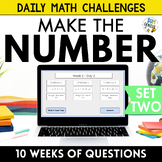
Each day, students are presented with a Magic Number and a set of up to six available numbers. Their task is to use mathematical reasoning to create the Magic Number by combining the available numbers using addition, subtraction, multiplication, and division and it comes with solutions!
To support differentiation and student choice, each daily challenge includes three levels of difficulty. Students may choose to solve one, two, or all three levels, allowing all learners to engage at an appropriate level while still providing meaningful stretch and challenge.
The Challenge Rules
Students must work within the following simple and consistent rules:
- Use only the numbers provided
- You may add, subtract, multiply, or divide numbers
- Each number can be used only once
- Numbers cannot be combined (e.g. 2 and 4 cannot become 24)
- Numbers cannot be turned into exponents
- You do not have to use all the numbers
- There may be multiple correct solutions to reach the Magic Number
Why It Works
Make the Number encourages students to:
- Think flexibly about numbers and operations
- Apply a range of problem-solving strategies
- Persevere, reflect, and learn from mistakes
- Justify and explain their mathematical thinking
- Recognise that mathematical problems can have multiple solutions
With minimal setup and maximum engagement, these challenges quickly become a favourite classroom routine — simple to start, hard to stop, and highly addictive.
Perfect as a daily warm-up, fast finisher, enrichment task, or whole-class discussion, Make the Number develops confident, capable problem solvers — one number at a time.
Daily Math Problem Solving Challenges Puzzle Mystery Number S2 4th 5th 6th Grade

Highlights


Description
Best suited for students in Years 4–7
- 10 Weeks Included (Google Slides & PowerPoint)
It’s back, the second set to add to your collection, Weeks 11 - 20. Make the Number is a highly engaging daily maths challenge designed to build students’ number sense, critical thinking, and problem-solving skills through purposeful use of the four operations. It is best suited for students in Years 4–8, where flexible thinking and strategic use of operations are key areas of development.
Each day, students are presented with a Magic Number and a set of up to six available numbers. Their task is to use mathematical reasoning to create the Magic Number by combining the available numbers using addition, subtraction, multiplication, and division and it comes with solutions!
To support differentiation and student choice, each daily challenge includes three levels of difficulty. Students may choose to solve one, two, or all three levels, allowing all learners to engage at an appropriate level while still providing meaningful stretch and challenge.
The Challenge Rules
Students must work within the following simple and consistent rules:
- Use only the numbers provided
- You may add, subtract, multiply, or divide numbers
- Each number can be used only once
- Numbers cannot be combined (e.g. 2 and 4 cannot become 24)
- Numbers cannot be turned into exponents
- You do not have to use all the numbers
- There may be multiple correct solutions to reach the Magic Number
Why It Works
Make the Number encourages students to:
- Think flexibly about numbers and operations
- Apply a range of problem-solving strategies
- Persevere, reflect, and learn from mistakes
- Justify and explain their mathematical thinking
- Recognise that mathematical problems can have multiple solutions
With minimal setup and maximum engagement, these challenges quickly become a favourite classroom routine — simple to start, hard to stop, and highly addictive.
Perfect as a daily warm-up, fast finisher, enrichment task, or whole-class discussion, Make the Number develops confident, capable problem solvers — one number at a time.
