


Description
Develop problem solving skills with this LOW FLOOR; HIGH CEILING reasoning & logic game! Minutes to learn; a lifetime to master! I have used from first grade to sixth grade! (Also a great way to teach combinations vs. Permutations if you like!)
A Very Simple Premise: Students determine the order of the characters. Who came in first, second third or fourth? Or who is on the 1st, 2nd, 3rd, 4th and 5th floors? Asking only simple order questions, "Is Batman above Superman?" or "Is the blue car in front of the red car?" students will keep track of what they learn, and solve the puzzle.
Low floor... means this game can be made accessible for struggling learners or very young learners. High ceiling means it can challenge your advanced students.. or teachers. Lowest level: Play with 3 characters. Move to 4 as soon as possible. Highest level: Play with 6 characters. Play a game or two whole class... and then move to a center! (If you can let it go:)
INCLUDES:
1 lesson plan (Directions & Tips)
4 optional recording sheets
3 Introduction Pages for students - one for each theme
Printable character cards to manipulate while you play Mastermind!
FORTNITE THEME
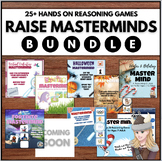
*This product is also part of a growing bundle which will be updated with holiday themes over the year! Purchase now and receive all updates for free. Price will increase with each update. Link to the BUNDLE.
Provide students with opportunities for patient problem solving. Engage with fun characters and then MODEL YOUR THINKING using the character cards. Modeling with mathematics is an important practice standard... and it doesn't simply mean using a bar model or an array.
“Modeling” is mathematizing a situation (which includes creating structure and making assumptions) in relation to the context. Modeling is important because it links classroom mathematics to solving problems in everyday life.
Thank you for exploring math with me!
Math Viking
*Please check out my store for products designed to develop deeper understanding! Follow me for notifications about awesome new products, offered at 50% OFF for the first 48 hours!
For more Fortnite fun:
FORTNITE Introduction to Algebraic Equations: Multiplication & Division grades 3-6
FORTNITE / APEX LEGENDS: BATTLE PASSES & SWAG TAGS!
FORTNITE Fraction Battle Royale: Includes Bonus Battle Passes & Swag Tags!
To emphasize PROBLEM SOLVING with actual thinking: Go Numberless!:
Grade 2 Standards Numberless Word Problems to Sort & Solve
Grade 1/Early 2 Numberless Word Problem Sort & Solve
Grade 3 Numberless Sort & Solve
Number Composition
Shake, Spill & Show: At the Bakery
THE BIG MOVE From Number Composition to Unitizing
Addition and Subtraction Sorts: Composing Numbers 12 Sorting Activities
For Emerging Place Value Understanding:
PLACE VALUE BAKERY Number Sense and Unitizing Packing: Cookies Tens and Ones
Part Whole Model PLACE VALUE BAKERY Task Cards First & Second Grade
Place Value Fun & Depth of Understanding for one of the BIGGEST standards we teach!
MYSTERY NUMBER Place Value Freebie!
MYSTERY NUMBER Scoot Task Cards for Place Value, Reasoning & Vocabulary
For DOUBLES FACT Fluency Assessments, Games, Interventions & Enrichment check out:
For MATH OLYMPICS check out:
COMPLETE MATH OLYMPICS EVENT PACK: Games, Certificates, Posters & Google Doc
Math Olympics Kindergarten Race to 10 or 20 and Build a Tower
Math Olympics Version of Flexible Place Value Task Cards
For THIRD GRADE ROUNDING, check out:
ROUNDING MOUNTAIN Number Line Rounding Spin It, Show It, Round It Game
For THIRD & FOURTH GRADE Problem Solving:
Fortnite Logic & Deductive Reasoning Mastermind Game Video Grid Game ALL AGES

Highlights


Save even more with bundles
Description
Develop problem solving skills with this LOW FLOOR; HIGH CEILING reasoning & logic game! Minutes to learn; a lifetime to master! I have used from first grade to sixth grade! (Also a great way to teach combinations vs. Permutations if you like!)
A Very Simple Premise: Students determine the order of the characters. Who came in first, second third or fourth? Or who is on the 1st, 2nd, 3rd, 4th and 5th floors? Asking only simple order questions, "Is Batman above Superman?" or "Is the blue car in front of the red car?" students will keep track of what they learn, and solve the puzzle.
Low floor... means this game can be made accessible for struggling learners or very young learners. High ceiling means it can challenge your advanced students.. or teachers. Lowest level: Play with 3 characters. Move to 4 as soon as possible. Highest level: Play with 6 characters. Play a game or two whole class... and then move to a center! (If you can let it go:)
INCLUDES:
1 lesson plan (Directions & Tips)
4 optional recording sheets
3 Introduction Pages for students - one for each theme
Printable character cards to manipulate while you play Mastermind!
FORTNITE THEME
*This product is also part of a growing bundle which will be updated with holiday themes over the year! Purchase now and receive all updates for free. Price will increase with each update. Link to the BUNDLE.
Provide students with opportunities for patient problem solving. Engage with fun characters and then MODEL YOUR THINKING using the character cards. Modeling with mathematics is an important practice standard... and it doesn't simply mean using a bar model or an array.
“Modeling” is mathematizing a situation (which includes creating structure and making assumptions) in relation to the context. Modeling is important because it links classroom mathematics to solving problems in everyday life.
Thank you for exploring math with me!
Math Viking
*Please check out my store for products designed to develop deeper understanding! Follow me for notifications about awesome new products, offered at 50% OFF for the first 48 hours!
For more Fortnite fun:
FORTNITE Introduction to Algebraic Equations: Multiplication & Division grades 3-6
FORTNITE / APEX LEGENDS: BATTLE PASSES & SWAG TAGS!
FORTNITE Fraction Battle Royale: Includes Bonus Battle Passes & Swag Tags!
To emphasize PROBLEM SOLVING with actual thinking: Go Numberless!:
Grade 2 Standards Numberless Word Problems to Sort & Solve
Grade 1/Early 2 Numberless Word Problem Sort & Solve
Grade 3 Numberless Sort & Solve
Number Composition
Shake, Spill & Show: At the Bakery
THE BIG MOVE From Number Composition to Unitizing
Addition and Subtraction Sorts: Composing Numbers 12 Sorting Activities
For Emerging Place Value Understanding:
PLACE VALUE BAKERY Number Sense and Unitizing Packing: Cookies Tens and Ones
Part Whole Model PLACE VALUE BAKERY Task Cards First & Second Grade
Place Value Fun & Depth of Understanding for one of the BIGGEST standards we teach!
MYSTERY NUMBER Place Value Freebie!
MYSTERY NUMBER Scoot Task Cards for Place Value, Reasoning & Vocabulary
For DOUBLES FACT Fluency Assessments, Games, Interventions & Enrichment check out:
For MATH OLYMPICS check out:
COMPLETE MATH OLYMPICS EVENT PACK: Games, Certificates, Posters & Google Doc
Math Olympics Kindergarten Race to 10 or 20 and Build a Tower
Math Olympics Version of Flexible Place Value Task Cards
For THIRD GRADE ROUNDING, check out:
ROUNDING MOUNTAIN Number Line Rounding Spin It, Show It, Round It Game
For THIRD & FOURTH GRADE Problem Solving:
Reviews
