


Description
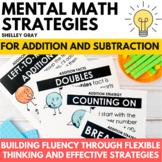
This unit is part of the Mental Math Strategy Collection.
Left-to-right addition is a powerful mental math strategy for adding numbers with two or more digits. Place value understanding is key, as students will be grouping the tens and then the ones. For example, to solve 24+53, we will first add 20+50 to make 70, then 4+3 to make 7, and finally 70+7 to make 77.
Left-to-right addition is important to teach BEFORE students learn the traditional algorithm. This is because left-to-right addition focuses on conceptual understanding rather than on the memorization of a series of steps.
This Mental Math Strategy Unit is divided into two sections – addition with no regrouping, and addition with regrouping. Spend plenty of time with this strategy without regrouping first. You will likely find that when students become very comfortable with left to right addition without regrouping, regrouping will happen very naturally and will not cause the confusion that you might expect. Understanding is KEY.
This unit includes:
- Left to Right Addition Strategy Reference Poster
- Thinking About Math strategy reflection
- Classroom Math Talk: Use these prompts for Number Talks or to get a conversation started about strategies and flexible thinking.
- Activity Sheets: A variety of activities to practice the left to right addition strategy in a fun and conceptual way. There are two sections included: without regrouping and with regrouping.
- Small Group or Station Activities: Use these task card activities for guided math groups, small groups, or even individual learning.
- Mini Flashcards with Suggested Activities
My Math Fact Philosophy
My resources are created with this philosophy in mind:
•Math should be taught using the Concrete-Representational-Abstract model.
•UNDERSTANDING math facts is more important than memorizing math facts. Conceptual understanding is the key to math fact fluency.
•Students must be able to visualize the math in order to really understand it.
•True math fact fluency is more than just speed and accuracy. It also includes flexibility, which is essential to true fluency.
•One of the best ways to build flexibility is by making connections and forming relationships between facts.
Thank you for your interest in my resources,
Shelley Gray
www.ShelleyGrayTeaching.com

Highlights


Save even more with bundles

Description
This unit is part of the Mental Math Strategy Collection.
Left-to-right addition is a powerful mental math strategy for adding numbers with two or more digits. Place value understanding is key, as students will be grouping the tens and then the ones. For example, to solve 24+53, we will first add 20+50 to make 70, then 4+3 to make 7, and finally 70+7 to make 77.
Left-to-right addition is important to teach BEFORE students learn the traditional algorithm. This is because left-to-right addition focuses on conceptual understanding rather than on the memorization of a series of steps.
This Mental Math Strategy Unit is divided into two sections – addition with no regrouping, and addition with regrouping. Spend plenty of time with this strategy without regrouping first. You will likely find that when students become very comfortable with left to right addition without regrouping, regrouping will happen very naturally and will not cause the confusion that you might expect. Understanding is KEY.
This unit includes:
- Left to Right Addition Strategy Reference Poster
- Thinking About Math strategy reflection
- Classroom Math Talk: Use these prompts for Number Talks or to get a conversation started about strategies and flexible thinking.
- Activity Sheets: A variety of activities to practice the left to right addition strategy in a fun and conceptual way. There are two sections included: without regrouping and with regrouping.
- Small Group or Station Activities: Use these task card activities for guided math groups, small groups, or even individual learning.
- Mini Flashcards with Suggested Activities
My Math Fact Philosophy
My resources are created with this philosophy in mind:
•Math should be taught using the Concrete-Representational-Abstract model.
•UNDERSTANDING math facts is more important than memorizing math facts. Conceptual understanding is the key to math fact fluency.
•Students must be able to visualize the math in order to really understand it.
•True math fact fluency is more than just speed and accuracy. It also includes flexibility, which is essential to true fluency.
•One of the best ways to build flexibility is by making connections and forming relationships between facts.
Thank you for your interest in my resources,
Shelley Gray
www.ShelleyGrayTeaching.com
