TPT
Total:
$0.00
Math Three Reads Note Catcher | Reusable Word Problem Routine | Problem Solving
Share

Description

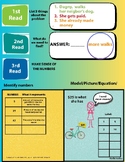
Help students make sense of math word problems all year long with this reusable Three Reads Math Note Catcher. Designed to support student thinking during problem solving, this tool walks learners through a clear, repeatable process for understanding the problem, identifying what they need to solve, making sense of the numbers, and showing their thinking with a model, picture, or equation.

This resource includes both a modeled example page and a blank student note catcher page, making it easy to introduce the routine and then use it again and again during whole group lessons, small groups, intervention, math workshop, or test prep. The layout prompts students to list key details from the problem, name what they are trying to find, organize important numbers and what they represent, and record their math thinking in a structured way

Because it can be laminated and reused throughout the school year, this resource is a practical, high-value tool for building independence and consistency in math problem solving.

Why teachers love it:

  • Encourages students to slow down and make sense of the problem
  • Gives students a clear routine they can use independently
  • Supports math discourse and reasoning
  • Helps students organize numbers and key information
  • Easy to laminate and reuse all year
  • Great for repeated use across many problem types
Report this resource to TPT
Reported resources will be reviewed by our team. Report this resource to let us know if this resource violates TPT's content guidelines.

Math Three Reads Note Catcher | Reusable Word Problem Routine | Problem Solving

Lisa LeGault
1 Follower
$4.00

Highlights

Digital downloads
Grades icon
Grades
2nd - 8th
Standards icon
Standards
Pages
2
Teaching Duration
Lifelong tool

Description

Help students make sense of math word problems all year long with this reusable Three Reads Math Note Catcher. Designed to support student thinking during problem solving, this tool walks learners through a clear, repeatable process for understanding the problem, identifying what they need to solve, making sense of the numbers, and showing their thinking with a model, picture, or equation.

This resource includes both a modeled example page and a blank student note catcher page, making it easy to introduce the routine and then use it again and again during whole group lessons, small groups, intervention, math workshop, or test prep. The layout prompts students to list key details from the problem, name what they are trying to find, organize important numbers and what they represent, and record their math thinking in a structured way

Because it can be laminated and reused throughout the school year, this resource is a practical, high-value tool for building independence and consistency in math problem solving.

Why teachers love it:

  • Encourages students to slow down and make sense of the problem
  • Gives students a clear routine they can use independently
  • Supports math discourse and reasoning
  • Helps students organize numbers and key information
  • Easy to laminate and reuse all year
  • Great for repeated use across many problem types
Report this resource to TPT
Reported resources will be reviewed by our team. Report this resource to let us know if this resource violates TPT's content guidelines.

Reviews

This product has not yet been rated.
Rated 0 out of 5

Questions & Answers

Loading

Standards

to see state-specific standards (only available in the US).
Make sense of problems and persevere in solving them. Mathematically proficient students start by explaining to themselves the meaning of a problem and looking for entry points to its solution. They analyze givens, constraints, relationships, and goals. They make conjectures about the form and meaning of the solution and plan a solution pathway rather than simply jumping into a solution attempt. They consider analogous problems, and try special cases and simpler forms of the original problem in order to gain insight into its solution. They monitor and evaluate their progress and change course if necessary. Older students might, depending on the context of the problem, transform algebraic expressions or change the viewing window on their graphing calculator to get the information they need. Mathematically proficient students can explain correspondences between equations, verbal descriptions, tables, and graphs or draw diagrams of important features and relationships, graph data, and search for regularity or trends. Younger students might rely on using concrete objects or pictures to help conceptualize and solve a problem. Mathematically proficient students check their answers to problems using a different method, and they continually ask themselves, "Does this make sense?" They can understand the approaches of others to solving complex problems and identify correspondences between different approaches.
Reason abstractly and quantitatively. Mathematically proficient students make sense of quantities and their relationships in problem situations. They bring two complementary abilities to bear on problems involving quantitative relationships: the ability to decontextualize-to abstract a given situation and represent it symbolically and manipulate the representing symbols as if they have a life of their own, without necessarily attending to their referents-and the ability to contextualize, to pause as needed during the manipulation process in order to probe into the referents for the symbols involved. Quantitative reasoning entails habits of creating a coherent representation of the problem at hand; considering the units involved; attending to the meaning of quantities, not just how to compute them; and knowing and flexibly using different properties of operations and objects.
Construct viable arguments and critique the reasoning of others. Mathematically proficient students understand and use stated assumptions, definitions, and previously established results in constructing arguments. They make conjectures and build a logical progression of statements to explore the truth of their conjectures. They are able to analyze situations by breaking them into cases, and can recognize and use counterexamples. They justify their conclusions, communicate them to others, and respond to the arguments of others. They reason inductively about data, making plausible arguments that take into account the context from which the data arose. Mathematically proficient students are also able to compare the effectiveness of two plausible arguments, distinguish correct logic or reasoning from that which is flawed, and-if there is a flaw in an argument-explain what it is. Elementary students can construct arguments using concrete referents such as objects, drawings, diagrams, and actions. Such arguments can make sense and be correct, even though they are not generalized or made formal until later grades. Later, students learn to determine domains to which an argument applies. Students at all grades can listen or read the arguments of others, decide whether they make sense, and ask useful questions to clarify or improve the arguments.
Loading