TPT
Total:
$0.00
Multi Step Word Problems Winter Math Activities Two Step Problem Solving
Share

Description

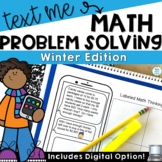
Winter multistep word problems for 4th and 5th graders made simple! These engaging winter math word problems are written in the form of a text and require critical thinking, problem-solving, and written responses from your students. This set covers a variety of skills to help you use these all winter long!

Your students will enjoy problem-solving when they get to text back the answer in these REAL-WORLD math problems.

See the best-selling original Text Me Mahth set HERE.

Written in a text format is not only engaging for students but also requires students to write their mathematical solutions in written form to reply to the text they were sent.

These problems come in two formats. One with open space for students to organize their own work, and the second with four boxes to help students complete each step in a different box, labeling as they solve.

Kindly Note: Blank templates are included for students to create their own word problems. These are NOT editable files, but blank templates for students to handwrite in their own word problems for their peers to solve.

Word problems are perfect for fourth and fifth graders and could work as a challenge for third graders.

Third Grade Text Me Problems are here: Third Grade Text Me Word Problems

Also available in a money-saving bundle: Text Me BUNDLE

This set includes BOTH a printable and digital version.


CONTENTS:

  • Google Classroom Directions and Link Included
  • 10 Winter Themed Math Word Problem Sheets in Text Form (in two different formats)
  • Answer Key included

Teacher approved!

⭐️⭐️⭐️⭐️⭐️

"My students are so engaged when using these!"

⭐️⭐️⭐️⭐️⭐️

"Perfect engagement to get my kids wanting to solve word problems!"

⭐️⭐️⭐️⭐️⭐️

"My students love these because they are "cool"!"

You will also love...

Follow me HERE for notifications of new products and sales. Remember new products are always 50% off the first 24 hours!

Questions? Email me directly HERE.

Report this resource to TPT
Reported resources will be reviewed by our team. Report this resource to let us know if this resource violates TPT's content guidelines.

Multi Step Word Problems Winter Math Activities Two Step Problem Solving

Think Grow Giggle
42k Followers
$4.00

Highlights

Digital downloads
Grades icon
Grades
4th - 5th
Standards icon
Standards
Pages
10+
Answer Key
Included

Save even more with bundles

Looking for multiple-step word problems to help your fourth and fifth graders master solving multi-step word problems? These easy-to-use and high-interest and engaging text-style problem-solving activities will keep your students motivated and critically thinking during test prep season or any time!
Price $15.50Original Price $24.50Save $9.00
7

Description

Winter multistep word problems for 4th and 5th graders made simple! These engaging winter math word problems are written in the form of a text and require critical thinking, problem-solving, and written responses from your students. This set covers a variety of skills to help you use these all winter long!

Your students will enjoy problem-solving when they get to text back the answer in these REAL-WORLD math problems.

See the best-selling original Text Me Mahth set HERE.

Written in a text format is not only engaging for students but also requires students to write their mathematical solutions in written form to reply to the text they were sent.

These problems come in two formats. One with open space for students to organize their own work, and the second with four boxes to help students complete each step in a different box, labeling as they solve.

Kindly Note: Blank templates are included for students to create their own word problems. These are NOT editable files, but blank templates for students to handwrite in their own word problems for their peers to solve.

Word problems are perfect for fourth and fifth graders and could work as a challenge for third graders.

Third Grade Text Me Problems are here: Third Grade Text Me Word Problems

Also available in a money-saving bundle: Text Me BUNDLE

This set includes BOTH a printable and digital version.


CONTENTS:

  • Google Classroom Directions and Link Included
  • 10 Winter Themed Math Word Problem Sheets in Text Form (in two different formats)
  • Answer Key included

Teacher approved!

⭐️⭐️⭐️⭐️⭐️

"My students are so engaged when using these!"

⭐️⭐️⭐️⭐️⭐️

"Perfect engagement to get my kids wanting to solve word problems!"

⭐️⭐️⭐️⭐️⭐️

"My students love these because they are "cool"!"

You will also love...

Follow me HERE for notifications of new products and sales. Remember new products are always 50% off the first 24 hours!

Questions? Email me directly HERE.

Report this resource to TPT
Reported resources will be reviewed by our team. Report this resource to let us know if this resource violates TPT's content guidelines.

Reviews

4.8
Rated 4.83 out of 5, based on 49 reviews
49
ratings
5
42
4
7
3
0
2
0
1
0
Grades used with
Reviews
5
4
4
3rd
4th
5th
All verified TPT purchases
Creative Math Word Problems
Rated 4 out of 5
November 28, 2025
Met expectations
Great value
Standards-aligned
Good resource to use to practice solving math word problems. Good for 3rd graders.
1,122 reviews • California
Grades taught: 3rd
Rated 5 out of 5
August 5, 2024
My learners loved this activity! It was very engaging!
Casey W.
543 reviews
Grades taught: 4th
Rated 5 out of 5
July 9, 2024
This was a great resource for my students to practice and demonstrate their learning.
Renee Bentley
(TPT Seller)
646 reviews
Grades taught: 3rd
Rated 4 out of 5
May 2, 2022
Fun way to practice problem solving strategies.
Mallory M.
923 reviews
Grades taught: 5th
Student populations: Learning difficulties
Rated 5 out of 5
February 2, 2022
Thank you!
Linda A.
389 reviews
Grades taught: 4th
Rated 5 out of 5
January 17, 2022
I've been using these with my high achievers. It has been a great resource! Thank you!
Kaitlynn Meyer
(TPT Seller)
328 reviews
Grades taught: 3rd
Rated 5 out of 5
January 6, 2022
This was a great resource that gave the students extra practice with word problems.
ersell C.
220 reviews
Grades taught: 5th
Rated 4 out of 5
January 24, 2021
Thank you for creating a product that saves me time planning, yet meets the academic needs of my students.
Diana M.
400 reviews
Grades taught: 5th

Questions & Answers

Loading

Standards

to see state-specific standards (only available in the US).
Make sense of problems and persevere in solving them. Mathematically proficient students start by explaining to themselves the meaning of a problem and looking for entry points to its solution. They analyze givens, constraints, relationships, and goals. They make conjectures about the form and meaning of the solution and plan a solution pathway rather than simply jumping into a solution attempt. They consider analogous problems, and try special cases and simpler forms of the original problem in order to gain insight into its solution. They monitor and evaluate their progress and change course if necessary. Older students might, depending on the context of the problem, transform algebraic expressions or change the viewing window on their graphing calculator to get the information they need. Mathematically proficient students can explain correspondences between equations, verbal descriptions, tables, and graphs or draw diagrams of important features and relationships, graph data, and search for regularity or trends. Younger students might rely on using concrete objects or pictures to help conceptualize and solve a problem. Mathematically proficient students check their answers to problems using a different method, and they continually ask themselves, "Does this make sense?" They can understand the approaches of others to solving complex problems and identify correspondences between different approaches.
Model with mathematics. Mathematically proficient students can apply the mathematics they know to solve problems arising in everyday life, society, and the workplace. In early grades, this might be as simple as writing an addition equation to describe a situation. In middle grades, a student might apply proportional reasoning to plan a school event or analyze a problem in the community. By high school, a student might use geometry to solve a design problem or use a function to describe how one quantity of interest depends on another. Mathematically proficient students who can apply what they know are comfortable making assumptions and approximations to simplify a complicated situation, realizing that these may need revision later. They are able to identify important quantities in a practical situation and map their relationships using such tools as diagrams, two-way tables, graphs, flowcharts and formulas. They can analyze those relationships mathematically to draw conclusions. They routinely interpret their mathematical results in the context of the situation and reflect on whether the results make sense, possibly improving the model if it has not served its purpose.
Attend to precision. Mathematically proficient students try to communicate precisely to others. They try to use clear definitions in discussion with others and in their own reasoning. They state the meaning of the symbols they choose, including using the equal sign consistently and appropriately. They are careful about specifying units of measure, and labeling axes to clarify the correspondence with quantities in a problem. They calculate accurately and efficiently, express numerical answers with a degree of precision appropriate for the problem context. In the elementary grades, students give carefully formulated explanations to each other. By the time they reach high school they have learned to examine claims and make explicit use of definitions.
Loading