


Description
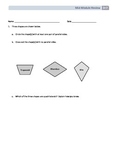
This is a review sheet that students can use in class or for homework to prepare them for the NYS Math, Gr. 3, Module 7, Mid-Module Test. I created this review sheet to mirror the test. Each problem reviews a concept that is on the test. The problem (story) and the numbers have been changed from the actual test.
Report this resource to TPT
Reported resources will be reviewed by our team. Report this resource to let us know if this resource violates TPT's content guidelines.

$4.50
Highlights
Digital downloads

Grades
3rd

Subjects

Standards
CCSS3.MD.D.8
CCSS3.OA.D.8
CCSS3.G.A.1
Tags
Pages
10
Answer Key
Included
Teaching Duration
1 hour
Description
This is a review sheet that students can use in class or for homework to prepare them for the NYS Math, Gr. 3, Module 7, Mid-Module Test. I created this review sheet to mirror the test. Each problem reviews a concept that is on the test. The problem (story) and the numbers have been changed from the actual test.
Report this resource to TPT
Reported resources will be reviewed by our team. Report this resource to let us know if this resource violates TPT's content guidelines.
Reviews
All verified TPT purchases
Perfect for review.
Great resource!
Great for review
Great Resource!
Questions & Answers
Loading
Standards
to see state-specific standards (only available in the US).
CCSS3.MD.D.8
Solve real world and mathematical problems involving perimeters of polygons, including finding the perimeter given the side lengths, finding an unknown side length, and exhibiting rectangles with the same perimeter and different areas or with the same area and different perimeters.
CCSS3.OA.D.8
Solve two-step word problems using the four operations. Represent these problems using equations with a letter standing for the unknown quantity. Assess the reasonableness of answers using mental computation and estimation strategies including rounding.
CCSS3.G.A.1
Understand that shapes in different categories (e.g., rhombuses, rectangles, and others) may share attributes (e.g., having four sides), and that the shared attributes can define a larger category (e.g., quadrilaterals). Recognize rhombuses, rectangles, and squares as examples of quadrilaterals, and draw examples of quadrilaterals that do not belong to any of these subcategories.
Loading
