


Description
Give your students the foundation they need to actually understand ratios not just memorize steps.
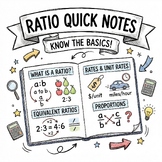
This 7-page visual reference collection covers every major concept in a 6th grade ratios and rates unit, organized as a progressive "course" from Ratios 100 through Ratios 106. Each sheet is designed to be visually engaging, clearly organized, and easy for middle schoolers to read independently making them ideal for introducing new concepts, supporting students during practice, or reviewing before a quiz or test.
What sets these reference sheets apart is the depth of each page. This isn't a glossary. Every concept is broken down with labeled examples, visual models, rules, and real-world context so students can actually make sense of the math not just look up a definition.
What's Included — The Full Series:
Ratios & Rates 100: Key Vocabulary — Ratio, Rate, Unit Rate, and Equivalent Ratios defined with clear examples and all three ways to write a ratio.
Ratios 101: Understanding Ratios — Ratio basics and notation, part-to-part vs. part-to-whole comparisons, order matters, simplifying ratios, and equivalent ratios.
Ratios 102: Equivalent Ratios — The scaling rule, simplest form, the multiplier test, checking for equivalence, and identifying non-equivalent ratios with a full example table.
Ratios 103: Ratio Tables — Creating ratio tables using multiplication and division, scaling up and scaling down, and key rules for building accurate tables.
Ratios 104: Proportions — Identifying proportional relationships, the cross product test, verification by simplifying, setting up proportions, cross multiplying to solve for missing values, and scaling with unit ratios.
Ratios 105: Comparing Ratios — Three methods for comparing ratios: common denominator, unit rates, and converting to decimals — with side-by-side worked examples for each method.
Ratios 106: Graphing Ratios — Building ratio tables into coordinate points, assigning axes, the straight line test for proportionality, steepness as rate, and spotting calculation errors visually.
Skills Covered:
- Ratio notation and vocabulary
- Part-to-part vs. part-to-whole ratios
- Equivalent ratios and simplest form
- Ratio tables (scaling up and down)
- Proportional relationships and cross multiplication
- Comparing ratios using three methods
- Graphing ratios in the coordinate plane
Standards Aligned:
- CCSS 6.RP.A.1 — Understand the concept of a ratio
- CCSS 6.RP.A.2 — Understand the concept of a unit rate
- CCSS 6.RP.A.3 — Use ratio and rate reasoning to solve real-world problems
- CCSS 6.RP.A.3a — Make tables of equivalent ratios
- CCSS 6.RP.A.3b — Solve unit rate problems
Perfect for: introducing new concepts, guided notes, independent reference during classwork, homework support, test prep, math interactive notebooks, or sub plans.
Ratios & Rates Reference Sheets | Visual Study Guides | 6th Grade Math | Ratios

Highlights


Save even more with bundles
Description
Give your students the foundation they need to actually understand ratios not just memorize steps.
This 7-page visual reference collection covers every major concept in a 6th grade ratios and rates unit, organized as a progressive "course" from Ratios 100 through Ratios 106. Each sheet is designed to be visually engaging, clearly organized, and easy for middle schoolers to read independently making them ideal for introducing new concepts, supporting students during practice, or reviewing before a quiz or test.
What sets these reference sheets apart is the depth of each page. This isn't a glossary. Every concept is broken down with labeled examples, visual models, rules, and real-world context so students can actually make sense of the math not just look up a definition.
What's Included — The Full Series:
Ratios & Rates 100: Key Vocabulary — Ratio, Rate, Unit Rate, and Equivalent Ratios defined with clear examples and all three ways to write a ratio.
Ratios 101: Understanding Ratios — Ratio basics and notation, part-to-part vs. part-to-whole comparisons, order matters, simplifying ratios, and equivalent ratios.
Ratios 102: Equivalent Ratios — The scaling rule, simplest form, the multiplier test, checking for equivalence, and identifying non-equivalent ratios with a full example table.
Ratios 103: Ratio Tables — Creating ratio tables using multiplication and division, scaling up and scaling down, and key rules for building accurate tables.
Ratios 104: Proportions — Identifying proportional relationships, the cross product test, verification by simplifying, setting up proportions, cross multiplying to solve for missing values, and scaling with unit ratios.
Ratios 105: Comparing Ratios — Three methods for comparing ratios: common denominator, unit rates, and converting to decimals — with side-by-side worked examples for each method.
Ratios 106: Graphing Ratios — Building ratio tables into coordinate points, assigning axes, the straight line test for proportionality, steepness as rate, and spotting calculation errors visually.
Skills Covered:
- Ratio notation and vocabulary
- Part-to-part vs. part-to-whole ratios
- Equivalent ratios and simplest form
- Ratio tables (scaling up and down)
- Proportional relationships and cross multiplication
- Comparing ratios using three methods
- Graphing ratios in the coordinate plane
Standards Aligned:
- CCSS 6.RP.A.1 — Understand the concept of a ratio
- CCSS 6.RP.A.2 — Understand the concept of a unit rate
- CCSS 6.RP.A.3 — Use ratio and rate reasoning to solve real-world problems
- CCSS 6.RP.A.3a — Make tables of equivalent ratios
- CCSS 6.RP.A.3b — Solve unit rate problems
Perfect for: introducing new concepts, guided notes, independent reference during classwork, homework support, test prep, math interactive notebooks, or sub plans.
