


Description
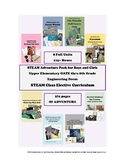
Another STEM unit that is very popular with my students. We teachers are a sneaky sort, though . . . because this unit is packed with challenging critical thinking activities, math, physics, and engineering—even a GATE social-emotional lesson. If you’ve purchased any of my STEM design lessons and units before, you know what to expect. If you have not, please read the reviews!
Use this for your advanced groups, or send students off on an independent investigation.
Level: Extra challenging for 3rd grade GATE and appropriate all the way up to 7th grade.
Time: 10 hours+
Cost: about 50 cents per student
Overview of Lessons
Amusement Park Season Passes: We start with math and economics as we examine season passes based on a printed advertisement. Follow this with challenging, multi-step math computations. Our math, of course, is Common Core referenced.
Scarcity: Our economics lesson continues as we study economic scarcity. What scarce skills do we have? In a social-emotional extension and graphic design challenge, our students think about their own scarce skills and design a “ticket” for others who might find those skills useful.
Swing Rides and Inertia: Go out to the playground for careful observations, and document them graphically to show your understanding of inertia in this real-world application. Next Generation Science referenced.
Swing Ride Construction: See the materials list in the preview. This construction only requires one wood cut—a simple one. That doesn’t mean it’s not challenging. We’ll construct a rubber band driven miniature swing ride using our best geometry and measurement skills for accurate design and engineering. The instructions are written so students may complete this as an independent project.
Pendulum Physics Experiment: Our students use their swing ride to conduct a physics experiment with pendulums. What affects period the most? Length of string, mass, or starting position?
Safety Design Engineering Challenge: Our swings will have to be safe. Use the templates provided to make seats for marble passengers, or present the seat design as an engineering challenge.
What is RPM? Physics and multi-step math problems.
RPM Applications: We adapt our swings into automated rubber band driven machines and study potential and kinetic energy along the way as we collect data and make calculations in a physics experiment.
Design a Sign: Students design a sign for their swinging rides as they prepare to share their creations with other students. It’s a real world summary of learning!
Bonus Challenge: Can students use a primary source photo to construct a model of a swing seen at the World’s Fair of 1904?
Use this for your advanced groups, or send students off on an independent investigation.
Level: Extra challenging for 3rd grade GATE and appropriate all the way up to 7th grade.
Time: 10 hours+
Cost: about 50 cents per student
Overview of Lessons
Amusement Park Season Passes: We start with math and economics as we examine season passes based on a printed advertisement. Follow this with challenging, multi-step math computations. Our math, of course, is Common Core referenced.
Scarcity: Our economics lesson continues as we study economic scarcity. What scarce skills do we have? In a social-emotional extension and graphic design challenge, our students think about their own scarce skills and design a “ticket” for others who might find those skills useful.
Swing Rides and Inertia: Go out to the playground for careful observations, and document them graphically to show your understanding of inertia in this real-world application. Next Generation Science referenced.
Swing Ride Construction: See the materials list in the preview. This construction only requires one wood cut—a simple one. That doesn’t mean it’s not challenging. We’ll construct a rubber band driven miniature swing ride using our best geometry and measurement skills for accurate design and engineering. The instructions are written so students may complete this as an independent project.
Pendulum Physics Experiment: Our students use their swing ride to conduct a physics experiment with pendulums. What affects period the most? Length of string, mass, or starting position?
Safety Design Engineering Challenge: Our swings will have to be safe. Use the templates provided to make seats for marble passengers, or present the seat design as an engineering challenge.
What is RPM? Physics and multi-step math problems.
RPM Applications: We adapt our swings into automated rubber band driven machines and study potential and kinetic energy along the way as we collect data and make calculations in a physics experiment.
Design a Sign: Students design a sign for their swinging rides as they prepare to share their creations with other students. It’s a real world summary of learning!
Bonus Challenge: Can students use a primary source photo to construct a model of a swing seen at the World’s Fair of 1904?
Report this resource to TPT
Reported resources will be reviewed by our team. Report this resource to let us know if this resource violates TPT's content guidelines.
STEM Kid Constructions -- Rubber Band Swing Ride

Mark Hess & Portable Gifted and Talented
3.6k Followers
$6.99
Highlights
Digital downloads

Grades
3rd - 7th

Subjects

Standards
CCSS4.NF.B.4c
CCSS5.NF.B.6
CCSS6.G.A.1
Pages
43
Answer Key
Included
Teaching Duration
Other
Save even more with bundles
115+ hours of class time, 374 pages. This collection is big and includes big savings--42% off individual purchases of some. Pretty much everything in the Portable Gifted and Talented store is rated 4.0, but take a couple minutes to peruse the comments for these individual units. I think you’ll li
Price $34.99Original Price $51.42Save $16.43
8
Description
Another STEM unit that is very popular with my students. We teachers are a sneaky sort, though . . . because this unit is packed with challenging critical thinking activities, math, physics, and engineering—even a GATE social-emotional lesson. If you’ve purchased any of my STEM design lessons and units before, you know what to expect. If you have not, please read the reviews!
Use this for your advanced groups, or send students off on an independent investigation.
Level: Extra challenging for 3rd grade GATE and appropriate all the way up to 7th grade.
Time: 10 hours+
Cost: about 50 cents per student
Overview of Lessons
Amusement Park Season Passes: We start with math and economics as we examine season passes based on a printed advertisement. Follow this with challenging, multi-step math computations. Our math, of course, is Common Core referenced.
Scarcity: Our economics lesson continues as we study economic scarcity. What scarce skills do we have? In a social-emotional extension and graphic design challenge, our students think about their own scarce skills and design a “ticket” for others who might find those skills useful.
Swing Rides and Inertia: Go out to the playground for careful observations, and document them graphically to show your understanding of inertia in this real-world application. Next Generation Science referenced.
Swing Ride Construction: See the materials list in the preview. This construction only requires one wood cut—a simple one. That doesn’t mean it’s not challenging. We’ll construct a rubber band driven miniature swing ride using our best geometry and measurement skills for accurate design and engineering. The instructions are written so students may complete this as an independent project.
Pendulum Physics Experiment: Our students use their swing ride to conduct a physics experiment with pendulums. What affects period the most? Length of string, mass, or starting position?
Safety Design Engineering Challenge: Our swings will have to be safe. Use the templates provided to make seats for marble passengers, or present the seat design as an engineering challenge.
What is RPM? Physics and multi-step math problems.
RPM Applications: We adapt our swings into automated rubber band driven machines and study potential and kinetic energy along the way as we collect data and make calculations in a physics experiment.
Design a Sign: Students design a sign for their swinging rides as they prepare to share their creations with other students. It’s a real world summary of learning!
Bonus Challenge: Can students use a primary source photo to construct a model of a swing seen at the World’s Fair of 1904?
Use this for your advanced groups, or send students off on an independent investigation.
Level: Extra challenging for 3rd grade GATE and appropriate all the way up to 7th grade.
Time: 10 hours+
Cost: about 50 cents per student
Overview of Lessons
Amusement Park Season Passes: We start with math and economics as we examine season passes based on a printed advertisement. Follow this with challenging, multi-step math computations. Our math, of course, is Common Core referenced.
Scarcity: Our economics lesson continues as we study economic scarcity. What scarce skills do we have? In a social-emotional extension and graphic design challenge, our students think about their own scarce skills and design a “ticket” for others who might find those skills useful.
Swing Rides and Inertia: Go out to the playground for careful observations, and document them graphically to show your understanding of inertia in this real-world application. Next Generation Science referenced.
Swing Ride Construction: See the materials list in the preview. This construction only requires one wood cut—a simple one. That doesn’t mean it’s not challenging. We’ll construct a rubber band driven miniature swing ride using our best geometry and measurement skills for accurate design and engineering. The instructions are written so students may complete this as an independent project.
Pendulum Physics Experiment: Our students use their swing ride to conduct a physics experiment with pendulums. What affects period the most? Length of string, mass, or starting position?
Safety Design Engineering Challenge: Our swings will have to be safe. Use the templates provided to make seats for marble passengers, or present the seat design as an engineering challenge.
What is RPM? Physics and multi-step math problems.
RPM Applications: We adapt our swings into automated rubber band driven machines and study potential and kinetic energy along the way as we collect data and make calculations in a physics experiment.
Design a Sign: Students design a sign for their swinging rides as they prepare to share their creations with other students. It’s a real world summary of learning!
Bonus Challenge: Can students use a primary source photo to construct a model of a swing seen at the World’s Fair of 1904?
Report this resource to TPT
Reported resources will be reviewed by our team. Report this resource to let us know if this resource violates TPT's content guidelines.
Reviews
All verified TPT purchases
This was a perfect addition to our amusement park stem unit!
My students loved these hands on activities. I used this with my enrichment classes for 3rd and 4th grade math. A keeper for sure!
great activity for STEM
This was a great activity. My students really enjoyed it.
Lots of fun activities!
Fun activity for kids
Great Resource
Engaging
Questions & Answers
Loading
Standards
to see state-specific standards (only available in the US).
CCSS4.NF.B.4c
Solve word problems involving multiplication of a fraction by a whole number, e.g., by using visual fraction models and equations to represent the problem. For example, if each person at a party will eat 3/8 of a pound of roast beef, and there will be 5 people at the party, how many pounds of roast beef will be needed? Between what two whole numbers does your answer lie?
CCSS5.NF.B.6
Solve real world problems involving multiplication of fractions and mixed numbers, e.g., by using visual fraction models or equations to represent the problem.
CCSS6.G.A.1
Find the area of right triangles, other triangles, special quadrilaterals, and polygons by composing into rectangles or decomposing into triangles and other shapes; apply these techniques in the context of solving real-world and mathematical problems.
Loading
