


Description
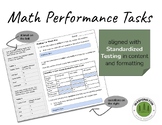
Practice 3rd and 4th grade performance task skills critical to success on Standardized Tests. This task is designed to mirror released standardized test sample items. Stimuli is on the right and questions are on the left. The task is shortened from a typical 5 questions to just 3 so that the resource can be used within an hour session.
Report this resource to TPT
Reported resources will be reviewed by our team. Report this resource to let us know if this resource violates TPT's content guidelines.

$3.00
Highlights
Digital downloads

Grades
3rd - 4th

Subjects

Standards
CCSS3.OA.D.8
CCSS4.OA.A.3
CCSSMP1
Pages
4
Answer Key
Not Included
Teaching Duration
1 hour
Description
Practice 3rd and 4th grade performance task skills critical to success on Standardized Tests. This task is designed to mirror released standardized test sample items. Stimuli is on the right and questions are on the left. The task is shortened from a typical 5 questions to just 3 so that the resource can be used within an hour session.
Report this resource to TPT
Reported resources will be reviewed by our team. Report this resource to let us know if this resource violates TPT's content guidelines.
Reviews
All verified TPT purchases
These are great to use as an end of unit assessment and for CAASPP performance task practice.
Questions & Answers
Loading
Standards
to see state-specific standards (only available in the US).
CCSS3.OA.D.8
Solve two-step word problems using the four operations. Represent these problems using equations with a letter standing for the unknown quantity. Assess the reasonableness of answers using mental computation and estimation strategies including rounding.
CCSS4.OA.A.3
Solve multistep word problems posed with whole numbers and having whole-number answers using the four operations, including problems in which remainders must be interpreted. Represent these problems using equations with a letter standing for the unknown quantity. Assess the reasonableness of answers using mental computation and estimation strategies including rounding.
CCSSMP1
Make sense of problems and persevere in solving them. Mathematically proficient students start by explaining to themselves the meaning of a problem and looking for entry points to its solution. They analyze givens, constraints, relationships, and goals. They make conjectures about the form and meaning of the solution and plan a solution pathway rather than simply jumping into a solution attempt. They consider analogous problems, and try special cases and simpler forms of the original problem in order to gain insight into its solution. They monitor and evaluate their progress and change course if necessary. Older students might, depending on the context of the problem, transform algebraic expressions or change the viewing window on their graphing calculator to get the information they need. Mathematically proficient students can explain correspondences between equations, verbal descriptions, tables, and graphs or draw diagrams of important features and relationships, graph data, and search for regularity or trends. Younger students might rely on using concrete objects or pictures to help conceptualize and solve a problem. Mathematically proficient students check their answers to problems using a different method, and they continually ask themselves, "Does this make sense?" They can understand the approaches of others to solving complex problems and identify correspondences between different approaches.
Loading
