TPT
Total:
$0.00
Statistics Digital Notes
Share

Description

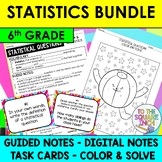
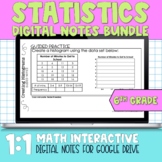
6th Grade Statistics and Statistics Math Digital Notes for Google Drive

Topics Included:

  1. Statistical Questions
  2. Shapes of Distributions
  3. Finding Mean
  4. Finding Mode
  5. Finding Median
  6. Finding Range
  7. Quartiles
  8. Interquartile Range (IQR)
  9. Mean Absolute Deviation (MAD)
  10. Line Plots
  11. Histograms
  12. Box and Whisker Plots
  13. Stem and Leaf Plots

This product contains 13 sets of Google Slides notes- students can complete notes and practice digitally. Included for each topic:

-Guided Notes and guided practice

-Practice Problems

-Vocabulary Models

-2 warm-ups

-2 exit slips

-1 page with Google Tools Shortcuts for student use

-Answer Keys

Check out my other Distance Learning Digital Products Here

Report this resource to TPT
Reported resources will be reviewed by our team. Report this resource to let us know if this resource violates TPT's content guidelines.

Statistics Digital Notes

$29.98
$45.50
SAVE
$15.52

Highlights

Digital downloads
Grades icon
Grades
6th
Subjects icon
Subjects
Standards icon
Standards
Pages
132
Answer Key
Included

Save even more with bundles

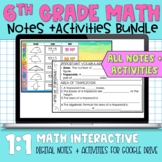
6th Grade Math Digital Notes and Activities BundleThis is a growing bundle. As new 6th grade notes and activities are completed, they will be added for free. 6th Grade Math Digital Notes for Google DriveThis product contains 51 sets of Google Slides notes- students can complete notes and practice di
Price $175.00Original Price $390.00Save $215.00
111
6th Grade Math Ultimate Bundle Unlock a world of math excellence with this comprehensive 6th Grade Math Ultimate Curriculum Bundle. This all-in-one resource is the key to ensuring your students not only grasp mathematical concepts but thrive in their 6th-grade math journey.Unbelievable Savings: This
Price $600.00Original Price $1333.00Save $733.00
345
Statistics and Probability BundleCovers CCS: 6.SP.A.1 - 6.SP.B.5This combination of resources will have your students proficient in all statistics and probability common core standards while keeping them engaged and actively learning. These resources are bundled together for a 25% discount, plus yo
Price $70.00Original Price $154.00Save $84.00
48

Description

6th Grade Statistics and Statistics Math Digital Notes for Google Drive

Topics Included:

  1. Statistical Questions
  2. Shapes of Distributions
  3. Finding Mean
  4. Finding Mode
  5. Finding Median
  6. Finding Range
  7. Quartiles
  8. Interquartile Range (IQR)
  9. Mean Absolute Deviation (MAD)
  10. Line Plots
  11. Histograms
  12. Box and Whisker Plots
  13. Stem and Leaf Plots

This product contains 13 sets of Google Slides notes- students can complete notes and practice digitally. Included for each topic:

-Guided Notes and guided practice

-Practice Problems

-Vocabulary Models

-2 warm-ups

-2 exit slips

-1 page with Google Tools Shortcuts for student use

-Answer Keys

Check out my other Distance Learning Digital Products Here

Report this resource to TPT
Reported resources will be reviewed by our team. Report this resource to let us know if this resource violates TPT's content guidelines.

Reviews

This product has not yet been rated.
Rated 0 out of 5

Questions & Answers

Loading

Standards

to see state-specific standards (only available in the US).
Recognize a statistical question as one that anticipates variability in the data related to the question and accounts for it in the answers. For example, “How old am I?” is not a statistical question, but “How old are the students in my school?” is a statistical question because one anticipates variability in students’ ages.
Understand that a set of data collected to answer a statistical question has a distribution which can be described by its center, spread, and overall shape.
Recognize that a measure of center for a numerical data set summarizes all of its values with a single number, while a measure of variation describes how its values vary with a single number.
Loading