


Description
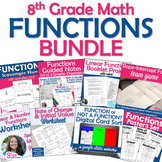
This 8th grade functions resource bundle includes notes, activities, and vocabulary posters to help you with your functions unit. This bundle includes all 9 of these resources! Save over 25% with this bundle!
- Functions Posters Set- Ready-to-go word wall for your functions unit! This set of 5 printable posters provides visuals, definitions, and reminders for students of essential 8th grade functions vocabulary. This set includes the following terms: function, rate of change, initial value, linear, & nonlinear. The posters are black and white and can be printed on card stock from your own printer, or can be printed as 8th grade math anchor charts as large as 18" x 24".
- Slope-Intercept Form Game- Printable! And so fun! Only a ruler is required. This interdependent game is played to review graphing and writing equations in slope-intercept form. Teacher instructions are included. Students can come up with their own equations, so the game can be played as many times as you want. What I love about this game is that every member of the team must participate! Students will get or write an equation in slope-intercept form to give to another student. The next student will then graph it. They will then give their graph to another student to write the equation based on the graph. This continues and teams win if the first equation matches the last graph. Great conversations occur when mistakes are made :)
- Functions Scavenger Hunt Activity- No prep! Just print and hang. Students answer a question at the bottom of a page and HUNT for the answer at the top of another. Students love these! There are 14 problems, which include finding the rate of change and initial value of functions from a description, graph, table, or equation or determining if a function is linear or nonlinear or increasing or decreasing. A student recording sheet is included and an answer key allows you to check their work quickly and easily.
- Functions Notes Graphic Organizer- These 3 graphic organizers help guide your students to learn all they need to know about functions in an organized, sequential way! This resource includes each of these guided notes pages:
- Functions vs. Not a Function: Students will learn what is a function and what is not a function represented in multiple representations (table, ordered pairs, mapping diagram, and graph).
- Rate of Change & Initial Value: Students will receive the definition of rate of change and initial value and learn how to identify them represented in different ways (table, equation, verbal description, and graph).
- Linear & Nonlinear Functions: Students will compare functions that are linear and nonlinear in various forms (graph, equation, and table). These notes have really helped my students understand the properties of functions and kept my instruction organized. These resources can also be used as review assignments or a formative assessment. A suggested key is included for each guided notes page.
- Linear Functions Booklet Project- This resource contains student directions and a scoring rubric for a Linear Functions booklet. Students CREATE a booklet using the instructions in which they answer questions, write a verbal description, create a table, and graph a function. They will have to determine rate of change and initial value as well as interpret their meaning in a scenario that they come up with. This is a great way to review linear functions or it can be used as part of their notes or a study guide. Differentiate! Choose which function rule each student gets and differentiate by difficulty level.
- Rate of Change and Initial Value Worksheet- This assignment has students determine the rate of change and initial value of linear functions from multiple representations. Students are given tables, graphs, equations, and verbal descriptions in which they must find the rate of change and the initial value. There are 16 questions (4 of each representation.) Use this resource as homework, extra practice, a quiz, or cut it apart to use as stations or math centers. A key is included.
- Linear & Nonlinear Functions Worksheet- This assignment has students determine whether a function is linear or nonlinear from multiple representations. Students are given tables, graphs, and equations in which they must decide if the function is linear or not. There are 14 questions (4 tables, 4 equations, & 6 graphs.) Use this resource as homework, extra practice, a quiz, or cut it apart to use as stations or math centers. A key is included.
- Function or Not a Function Digital Card Sort Activity- Want to make sure your students know what a function is? This quick digital card sort is a low-prep way to find out! The activity uses Google Slides to practice or assess if students can identify a function. The digital cards show graphs, tables, mapping diagrams, and sets of ordered pairs. Students will drag 16 cards onto the correct section ("function" or "not a function"). They can then share with you by emailing their copy or turning it in through Google Classroom. A key is included, which you can remove before sharing with students or keep for self-checking. Use this to assess that students understand that a function is a rule that assigns to each input exactly one output using multiple representations.
- Functions Analogy Assignment- In your introduction to functions, have students create an analogy that will help them remember what a function is. Students will compare an everyday object with a function and determine the input and the output. For example, a student might say, "A toaster is like a function because you input bread and you output toast." They will then create an image to illustrate their comparison. An optional rubric is included. Use this as a mini-project, formative assessment, or extra credit.
You may also like...
Functions Patterns Activity Bundle
Function or Not a Function Halloween Game
Report this resource to TPT
Reported resources will be reviewed by our team. Report this resource to let us know if this resource violates TPT's content guidelines.
8th Grade Math Functions Resources - Notes, Activities, and Posters

8th Grade Math Teacher
3.5k Followers
$17.00
$23.75
SAVE
$6.75
Highlights

Grades
7th - 9th


Standards
CCSS8.F.A.1
CCSS8.F.A.2
CCSS8.F.A.3
Tags
Pages
N/A
Answer Key
Included
Description
This 8th grade functions resource bundle includes notes, activities, and vocabulary posters to help you with your functions unit. This bundle includes all 9 of these resources! Save over 25% with this bundle!
- Functions Posters Set- Ready-to-go word wall for your functions unit! This set of 5 printable posters provides visuals, definitions, and reminders for students of essential 8th grade functions vocabulary. This set includes the following terms: function, rate of change, initial value, linear, & nonlinear. The posters are black and white and can be printed on card stock from your own printer, or can be printed as 8th grade math anchor charts as large as 18" x 24".
- Slope-Intercept Form Game- Printable! And so fun! Only a ruler is required. This interdependent game is played to review graphing and writing equations in slope-intercept form. Teacher instructions are included. Students can come up with their own equations, so the game can be played as many times as you want. What I love about this game is that every member of the team must participate! Students will get or write an equation in slope-intercept form to give to another student. The next student will then graph it. They will then give their graph to another student to write the equation based on the graph. This continues and teams win if the first equation matches the last graph. Great conversations occur when mistakes are made :)
- Functions Scavenger Hunt Activity- No prep! Just print and hang. Students answer a question at the bottom of a page and HUNT for the answer at the top of another. Students love these! There are 14 problems, which include finding the rate of change and initial value of functions from a description, graph, table, or equation or determining if a function is linear or nonlinear or increasing or decreasing. A student recording sheet is included and an answer key allows you to check their work quickly and easily.
- Functions Notes Graphic Organizer- These 3 graphic organizers help guide your students to learn all they need to know about functions in an organized, sequential way! This resource includes each of these guided notes pages:
- Functions vs. Not a Function: Students will learn what is a function and what is not a function represented in multiple representations (table, ordered pairs, mapping diagram, and graph).
- Rate of Change & Initial Value: Students will receive the definition of rate of change and initial value and learn how to identify them represented in different ways (table, equation, verbal description, and graph).
- Linear & Nonlinear Functions: Students will compare functions that are linear and nonlinear in various forms (graph, equation, and table). These notes have really helped my students understand the properties of functions and kept my instruction organized. These resources can also be used as review assignments or a formative assessment. A suggested key is included for each guided notes page.
- Linear Functions Booklet Project- This resource contains student directions and a scoring rubric for a Linear Functions booklet. Students CREATE a booklet using the instructions in which they answer questions, write a verbal description, create a table, and graph a function. They will have to determine rate of change and initial value as well as interpret their meaning in a scenario that they come up with. This is a great way to review linear functions or it can be used as part of their notes or a study guide. Differentiate! Choose which function rule each student gets and differentiate by difficulty level.
- Rate of Change and Initial Value Worksheet- This assignment has students determine the rate of change and initial value of linear functions from multiple representations. Students are given tables, graphs, equations, and verbal descriptions in which they must find the rate of change and the initial value. There are 16 questions (4 of each representation.) Use this resource as homework, extra practice, a quiz, or cut it apart to use as stations or math centers. A key is included.
- Linear & Nonlinear Functions Worksheet- This assignment has students determine whether a function is linear or nonlinear from multiple representations. Students are given tables, graphs, and equations in which they must decide if the function is linear or not. There are 14 questions (4 tables, 4 equations, & 6 graphs.) Use this resource as homework, extra practice, a quiz, or cut it apart to use as stations or math centers. A key is included.
- Function or Not a Function Digital Card Sort Activity- Want to make sure your students know what a function is? This quick digital card sort is a low-prep way to find out! The activity uses Google Slides to practice or assess if students can identify a function. The digital cards show graphs, tables, mapping diagrams, and sets of ordered pairs. Students will drag 16 cards onto the correct section ("function" or "not a function"). They can then share with you by emailing their copy or turning it in through Google Classroom. A key is included, which you can remove before sharing with students or keep for self-checking. Use this to assess that students understand that a function is a rule that assigns to each input exactly one output using multiple representations.
- Functions Analogy Assignment- In your introduction to functions, have students create an analogy that will help them remember what a function is. Students will compare an everyday object with a function and determine the input and the output. For example, a student might say, "A toaster is like a function because you input bread and you output toast." They will then create an image to illustrate their comparison. An optional rubric is included. Use this as a mini-project, formative assessment, or extra credit.
You may also like...
Functions Patterns Activity Bundle
Function or Not a Function Halloween Game
Report this resource to TPT
Reported resources will be reviewed by our team. Report this resource to let us know if this resource violates TPT's content guidelines.
Reviews
All verified TPT purchases
Functions is such huge topic in 8th grade math. This resource really helped with my planning for the unit and I love the digital options.
This really helped my students to understand functions.
My students liked this activity! we used this as an I do, you do, we do practice worksheet!
Great bundle to use when learning about functions!
For whatever reason, I find that students struggle with the functions topics so much as there are so many new ideas to wrap their brains around. I am looking forward to adding this bundle of resources to my toolbox of activities so that I can provide engaging materials that present the topic well. This is a well-done bundle and covers the topic in depth. Thank you for a wonderful resource.
Thank you so much! I love all your resources :)
I love getting things that are easy to assign and understand. The students knew exactly what to do.
I have used a few activities in this bundle and have been extremely happy with them. I really loved the function activity that talks about one input. They loved coming up with different examples.
Questions & Answers
Loading
Standards
to see state-specific standards (only available in the US).
CCSS8.F.A.1
Understand that a function is a rule that assigns to each input exactly one output. The graph of a function is the set of ordered pairs consisting of an input and the corresponding output.
CCSS8.F.A.2
Compare properties of two functions each represented in a different way (algebraically, graphically, numerically in tables, or by verbal descriptions). For example, given a linear function represented by a table of values and a linear function represented by an algebraic expression, determine which function has the greater rate of change.
CCSS8.F.A.3
Interpret the equation 𝘺 = 𝘮𝘹 + 𝘣 as defining a linear function, whose graph is a straight line; give examples of functions that are not linear. For example, the function 𝘈 = 𝑠² giving the area of a square as a function of its side length is not linear because its graph contains the points (1,1), (2,4) and (3,9), which are not on a straight line.
Loading
