


Description
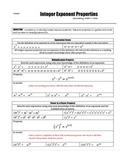
These notes (Teacher and Student Versions) are designed to help students recognize the patterns that can be found in integer exponents. With guided examples, students will discover and define the multiplication property, division property, power to a power property, and negative power property. This lesson also includes four different justifications for the zero power property, which is infamous for the student frustration that it causes in middle school and high school. These notes help meet the requirements for A.SEE.1 in Math 1, and help prepare students for N.RN.2 in Math 2.
Work Smarter.
Work Smarter.
Report this resource to TPT
Reported resources will be reviewed by our team. Report this resource to let us know if this resource violates TPT's content guidelines.

FREE
Highlights


Description
These notes (Teacher and Student Versions) are designed to help students recognize the patterns that can be found in integer exponents. With guided examples, students will discover and define the multiplication property, division property, power to a power property, and negative power property. This lesson also includes four different justifications for the zero power property, which is infamous for the student frustration that it causes in middle school and high school. These notes help meet the requirements for A.SEE.1 in Math 1, and help prepare students for N.RN.2 in Math 2.
Work Smarter.
Work Smarter.
Report this resource to TPT
Reported resources will be reviewed by our team. Report this resource to let us know if this resource violates TPT's content guidelines.
Reviews
All verified TPT purchases
Thank you for this resource. It was very helpful for me and my students.
LOVE this
Great resource used for review!
Great Resource!
Thanks for sharing. This worked great as a supplement for the flip notes my ESL Algebra class completed.
Questions & Answers
Loading
Standards
to see state-specific standards (only available in the US).
CCSSHSA-SSE.A.1
Interpret expressions that represent a quantity in terms of its context.
CCSSMP3
Construct viable arguments and critique the reasoning of others. Mathematically proficient students understand and use stated assumptions, definitions, and previously established results in constructing arguments. They make conjectures and build a logical progression of statements to explore the truth of their conjectures. They are able to analyze situations by breaking them into cases, and can recognize and use counterexamples. They justify their conclusions, communicate them to others, and respond to the arguments of others. They reason inductively about data, making plausible arguments that take into account the context from which the data arose. Mathematically proficient students are also able to compare the effectiveness of two plausible arguments, distinguish correct logic or reasoning from that which is flawed, and-if there is a flaw in an argument-explain what it is. Elementary students can construct arguments using concrete referents such as objects, drawings, diagrams, and actions. Such arguments can make sense and be correct, even though they are not generalized or made formal until later grades. Later, students learn to determine domains to which an argument applies. Students at all grades can listen or read the arguments of others, decide whether they make sense, and ask useful questions to clarify or improve the arguments.
CCSSMP7
Look for and make use of structure. Mathematically proficient students look closely to discern a pattern or structure. Young students, for example, might notice that three and seven more is the same amount as seven and three more, or they may sort a collection of shapes according to how many sides the shapes have. Later, students will see 7 × 8 equals the well remembered 7 × 5 + 7 × 3, in preparation for learning about the distributive property. In the expression 𝑥² + 9𝑥 + 14, older students can see the 14 as 2 × 7 and the 9 as 2 + 7. They recognize the significance of an existing line in a geometric figure and can use the strategy of drawing an auxiliary line for solving problems. They also can step back for an overview and shift perspective. They can see complicated things, such as some algebraic expressions, as single objects or as being composed of several objects. For example, they can see 5 – 3(𝑥 – 𝑦)² as 5 minus a positive number times a square and use that to realize that its value cannot be more than 5 for any real numbers 𝑥 and 𝑦.
Loading
